Services ▾
All servicesMeta Ads ManagementGoogle Ads ManagementTikTok Ads ManagementeCommerce MarketingSEO ServicesGenerative Engine OptimisationAnswer Engine OptimisationLocal SEOWordPress DevelopmenteCommerce WebsitesCustom WebsitesLanding PagesCase study · Ecommerce
How a home & kitchen brand reached 11x ROAS in two months
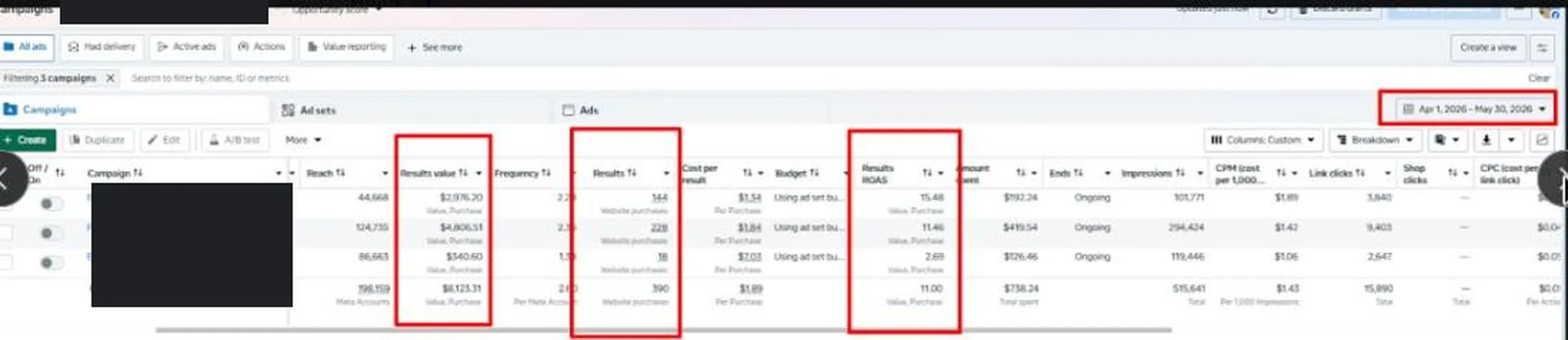
Three campaigns, one product line, and a deliberately narrow structure. The account turned $738 of ad spend into $8,123 of tracked purchase value in 60 days.
1 April – 30 May 2026 · Meta Ads · South Asia market, account currency USD
 By Abdul Kader Zilani, Meta Ads & growth consultant·Campaigns managed by me personally·Last reviewed
A single product, a thin margin and no room to guess
The brand sells transparent PVC table covers direct to consumers. One product category, a low average order value, and cash on delivery in the mix, which means every wasted click is a real cost and a refused parcel is worse than a lost sale.
That combination rules out the usual advice. There is no budget to run twenty creatives at once, and no margin to let a campaign sit in the learning phase for three weeks while it works itself out.
Spend was spread too thin to teach Meta anything
The pattern we see in most accounts this size is the same one that was holding this one back: budget split across several small ad sets, each chasing a different interest. None of them collects enough conversions in a week for Meta to learn from, so every one of them stays expensive.
Meta’s own documented floor is roughly 50 optimisation events per ad set per week. Six ad sets on a small daily budget will not clear that in any of them. One ad set might.
Four decisions, in this order
Fix the conversion signal first
Pixel and Conversions API firing together and deduplicated, optimising for the purchase event rather than a cheap proxy like PageView or AddToCart. A weak signal teaches the ranking models to find weak buyers, and no amount of creative fixes that.
Collapse the structure
Three campaigns, not ten. A bottom-of-funnel sales campaign pointed at the product landing page, a lookalike prospecting campaign on ABO, and a second BOFU campaign for a different angle. Budget concentrated enough that the main campaign actually exits learning.
Send traffic to the product page, not the catalogue
Cold traffic went to a single-offer landing page matching the exact product in the ad. Category pages are where small-budget ecommerce ROAS goes to die, because the visitor has to make a second decision before they can buy.
Judge on the backend, then scale
Meta-reported purchases reconciled against the order system weekly before any budget increase, and increases kept small and infrequent so the ad sets were not pushed back into learning.
60 days, three campaigns, 11x
- Ad spend$738.24
- Purchase value$8,123.31
- Purchases390
- ROAS11.00x
- Cost per purchase$1.89
- Impressions515,641
- CPM$1.43
- Link clicks15,890
The honest version
Two things. First, the creative set was narrower than we would now run after Meta’s Andromeda changes, which reward genuinely different concepts rather than variations of one. Second, 60 days is a short window on a seasonal product category, and we would want a full quarter before calling this a repeatable number rather than a good run.
If you want the reasoning behind the creative point, we wrote it up in what the Meta Andromeda update actually changed.
About the author
I am Abdul Kader Zilani, a Meta Ads and growth consultant working with ecommerce and service businesses. I run my own direct-to-consumer brand as well, which means I spend my own money in the same auctions I manage for clients. Every figure on this page came out of an ad account I had my hands in, and I will tell you when a number flatters me.
Want to know what your account could do?
Most accounts we review are losing money on tracking long before creative is the problem. A free consultation gets you a straight answer on which of the two it is.