Services ▾
All servicesMeta Ads ManagementGoogle Ads ManagementTikTok Ads ManagementeCommerce MarketingSEO ServicesGenerative Engine OptimisationAnswer Engine OptimisationLocal SEOWordPress DevelopmenteCommerce WebsitesCustom WebsitesLanding PagesCase study · SEO
32 million search impressions a month across four live accounts
Four Search Console properties we hold access to, in the same 28-day window. They range from 2.1 million clicks a month to 52. Put side by side they show the one thing most SEO reports hide: why impressions without clicks is the most expensive problem in search.
 By Abdul Kader Zilani, Meta Ads & growth consultant·SEO delivered with my team·Last reviewed
14 October – 10 November 2026 · Google Search Console, web search · South Asia market
Four accounts, one 28-day window
These are not before-and-after screenshots and we are not going to present them as growth claims. They are the current state of four properties we work on, pulled on the same day, over the same dates, with no filters applied. We are showing them because the contrast between them teaches more than any single success story would.
- Account A2.1M clicks
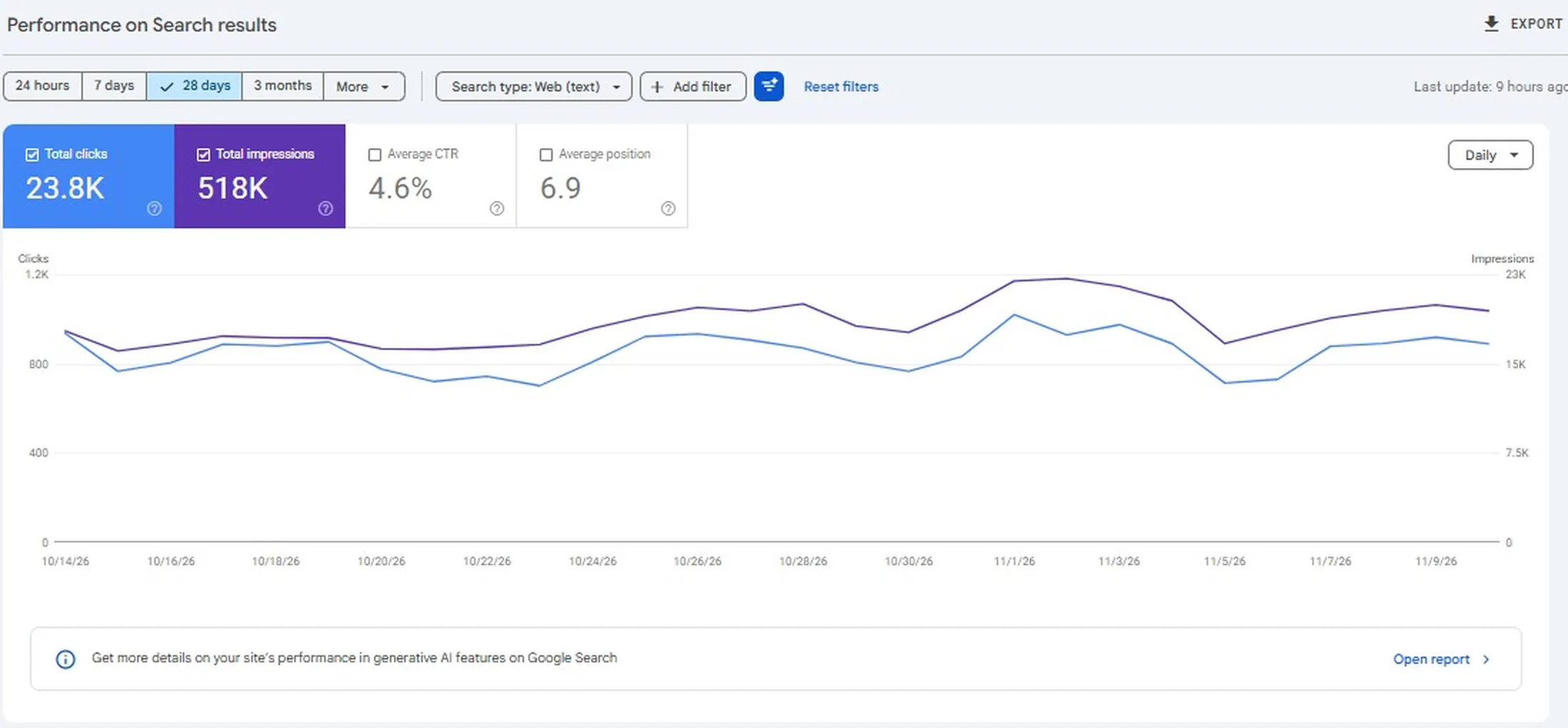
- Account B23.8K clicks
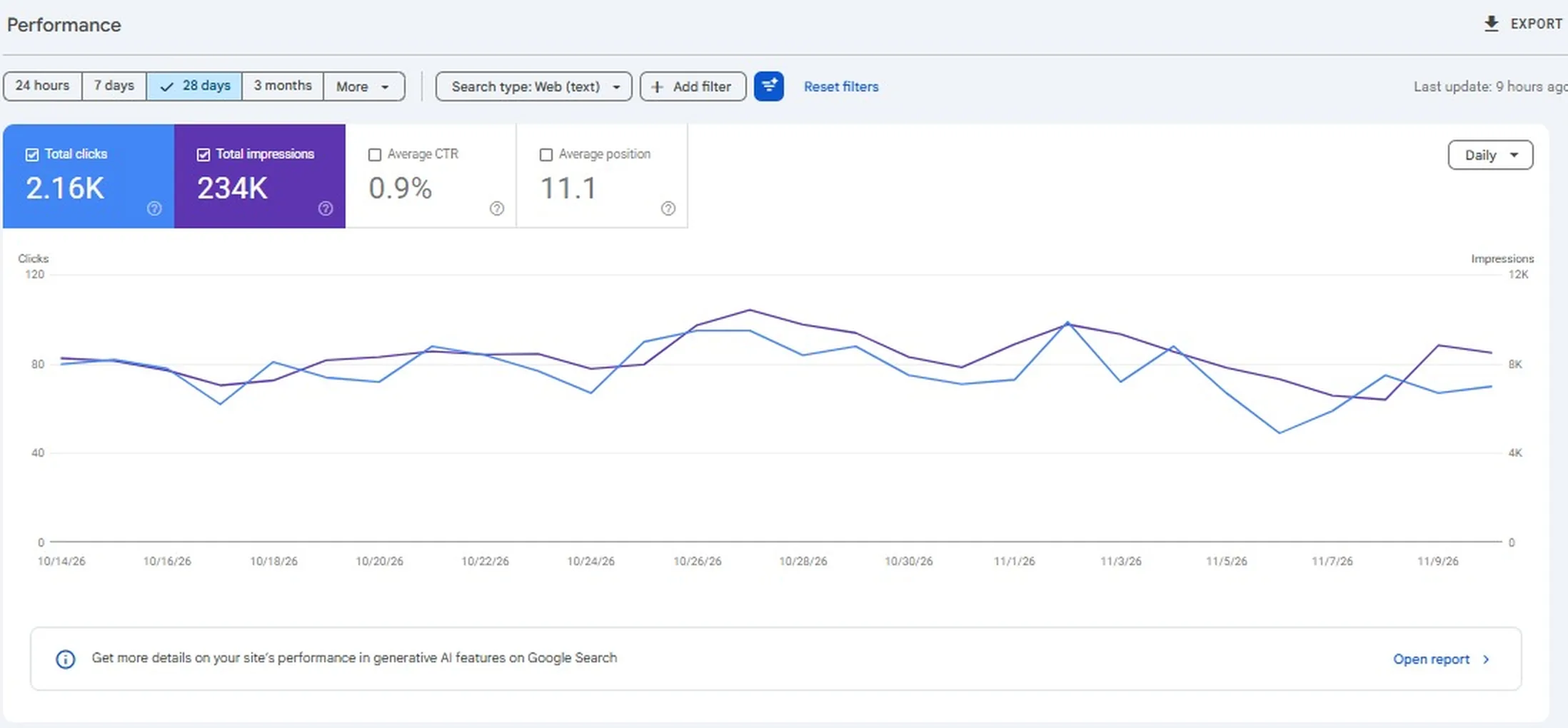
- Account C2.16K clicks
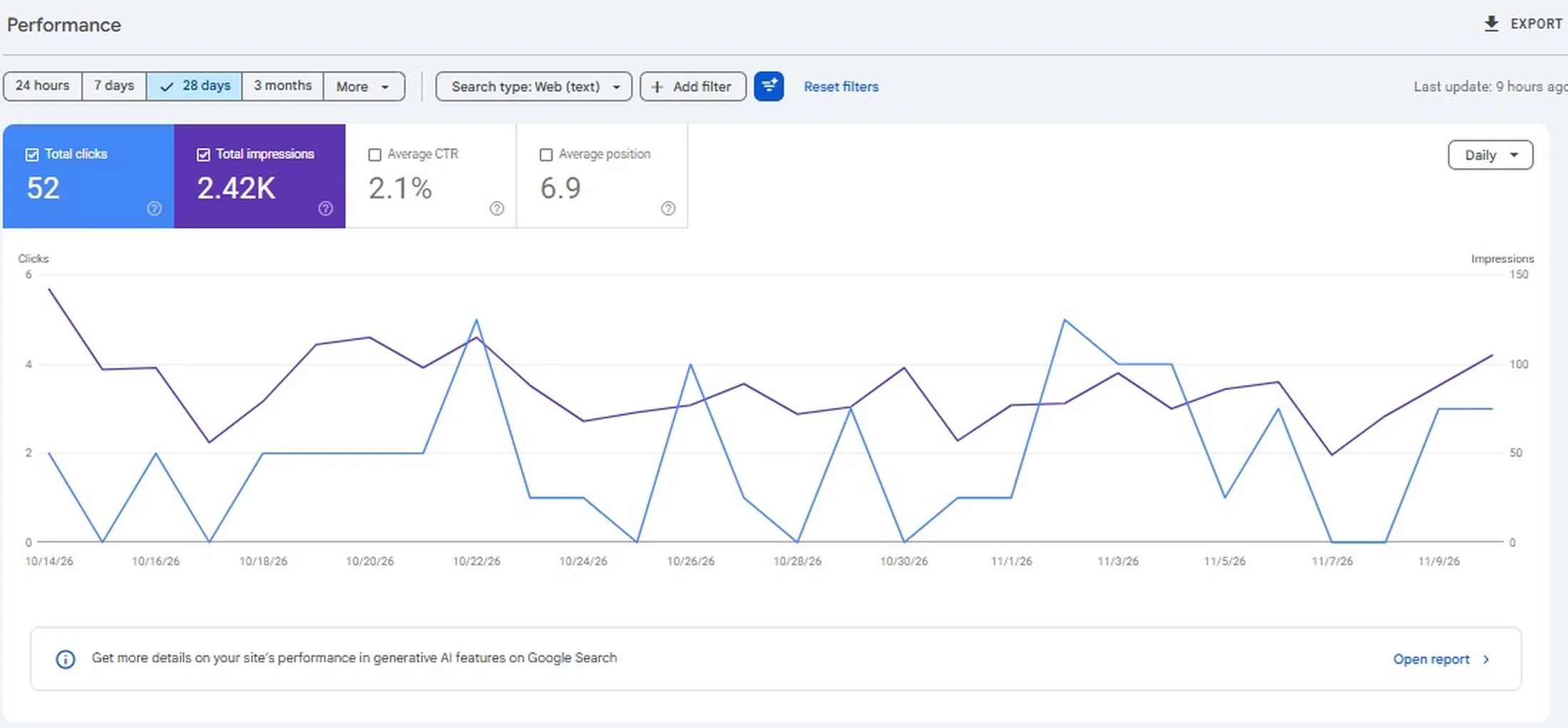
- Account D52 clicks
An ecommerce marketplace at national scale
2.1 million clicks and 31.3 million impressions in 28 days, at an average position of 5 and a 6.7% click-through rate. At this size the job stops being about getting pages to rank and becomes about not breaking what already ranks.
A site with tens of thousands of indexable URLs fails in ways a small site never does: crawl budget wasted on faceted navigation, duplicate product pages competing with each other, out-of-stock items left indexable, and a template change that silently drops internal links from a million pages at once. Most of the work here is monitoring, log analysis and refusing to let people ship things that look harmless.

An education site winning on question-led content
23,800 clicks from 518,000 impressions, average position 6.9, click-through rate 4.6%. This is what a healthy content-led site looks like when the topic is something people research rather than buy immediately.
The useful detail is the relationship between position and CTR. At an average position of 6.9 a 4.6% CTR is slightly ahead of what you would expect, which usually means the titles and descriptions are doing real work rather than just repeating the H1. That is the cheapest win available in search and the one most sites never bother with.
The expensive one: 234,000 impressions, 2,160 clicks
This is a specialist medical practice, and it is the most instructive account of the four. 234,000 impressions in 28 days sounds like a site that is winning. It converted into 2,160 clicks, a 0.9% click-through rate, at an average position of 11.1.
Average position 11.1 is the top of page two. Almost nobody goes to page two. The site is being shown to a quarter of a million people a month and is sitting just below the fold of the results page for nearly all of them.
The reflex is to blame the titles for the 0.9% CTR. The titles are not the problem. CTR is the symptom; position is the disease. Moving this account from an average of 11 to an average of 8 would do more for it than any amount of title rewriting, because it moves the listings from a page almost nobody sees onto one almost everybody does.
A new site, and why we are including it
52 clicks and 2,420 impressions in 28 days. Next to 2.1 million it looks like nothing, and it is in the portfolio for a reason.
The number that matters on a new site is not clicks, it is average position, and this one is at 6.9. Being on page one for the queries you can reach, on a site with almost no authority yet, is the right shape for month one. The clicks follow once there are more pages competing for more queries. A new site showing position 25 and 2,000 impressions would be the one to worry about, even though the impressions look the same.
How we read any account, in this order
Position before anything else
Average position tells you whether you have a rankings problem or a click-through problem. Everything downstream is a waste of effort until that is settled. Account C and Account B have nearly identical click-through potential; the only real difference between them is four positions.
Impressions tell you whether the demand exists
High impressions and low clicks is a good problem, because the audience is already there. Low impressions means the content does not exist yet or is not eligible, which is a slower and more expensive fix.
CTR, judged against the position, not against a benchmark
A 0.9% CTR at position 11 is normal. A 0.9% CTR at position 3 is a broken title or a snippet being rewritten by Google. The same number means opposite things, which is why benchmark tables are mostly useless.
Then queries and pages, not before
Only once the shape of the account is clear is it worth opening the query and page reports, because by then you know what you are looking for.
What these screenshots do and do not prove
They prove we hold working access to and report on properties at this scale, and that the accounts are in the state shown on the dates shown. They are platform-reported figures with no filters applied.
They do not prove growth, because there is no before-and-after here. Some of these accounts were already large when we started on them. Anyone showing you a single 28-day screenshot and calling it a result is hoping you will not ask what the number was last year, and that is a fair question to ask us too.
These are also South Asian markets. Search demand, competition and seasonality are different in the UK, so treat the volumes as evidence of scale rather than as a forecast for your own site.
The two-minute version for your own site
Open Search Console, set the range to 28 days, and tick all four boxes: clicks, impressions, CTR and average position. Then ask one question. Is our average position above or below 10?
Below 10, and you have a visibility problem that titles will not solve. Above 10 with a weak CTR, and you have a presentation problem worth a week of work. High impressions either way means the demand is already there and you are closer than you think.
If you want that read done properly on your account, that is what the SEO work starts with, and it is also most of what happens on a free call.
About the author
I am Abdul Kader Zilani, a Meta Ads and growth consultant working with ecommerce and service businesses. I run the paid media myself and deliver search and web work with a small team I have worked with for years. The Search Console views on this page are from properties we hold access to. I will tell you when a number flatters us.
Want to know which of these four your site is?
Send us your domain. On a free call we will pull up the same four numbers for you and tell you, honestly, whether your problem is rankings, click-through or demand.