Generative Engine Optimisation in the UK: A Practical 10-Step Playbook Beyond Traditional SEO
 By Priotum Dhar
·
· 8 min read
Generative engine optimisation (GEO, or generative engine optimization in US spelling) has become one of the noisiest topics in marketing. Some of the advice is useful. A lot of it is people selling new labels for old work, or tricks that Google now says openly it ignores.
This playbook keeps to what the platforms have published and what independent research has measured. It gives UK businesses ten practical steps, in order, to make it more likely that AI search tools find your site, understand what you do and cite you in their answers.
Generative engine optimisation means making your business easy for AI search tools to find, understand, trust and cite. Google says there are no extra technical requirements for AI Overviews or AI Mode beyond being indexed and eligible for a snippet, and that llms.txt files and special schema are not needed. The steps that matter are crawl access, clear answer-first pages, original evidence, consistent business details and genuine mentions of your brand on other sites.
What generative engine optimisation is (and is not)
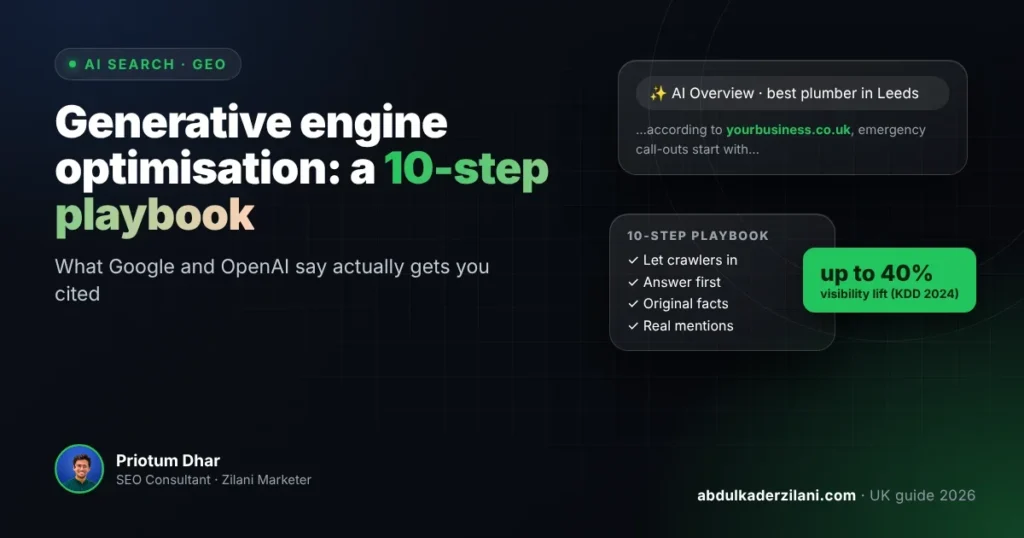
The term comes from a 2023 research paper, “GEO: Generative Engine Optimization”, by researchers from Princeton University and IIT Delhi, later published at KDD 2024. The authors tested ways of rewriting content and found that some methods could boost a source’s visibility in generative answers by up to 40%. The methods that worked best were adding citations to reliable sources, quotations from relevant sources and statistics. Traditional keyword stuffing showed little or no benefit.
In practice, GEO in 2026 is mostly good SEO with a sharper focus on being quotable. Google’s own guidance says generative AI features in Search are built on its core ranking and quality systems, so the foundations are the same. Our explainer on Google AI Overviews covers how those answers appear in UK results.
| What GEO is | What GEO is not |
|---|---|
| Making pages easy to crawl, read and quote | Writing for robots instead of customers |
| Publishing original facts, figures and first-hand experience | Rewriting the same content “for AI” |
| Earning genuine mentions of your brand on other sites | Buying fake mentions or spammy listings |
| Keeping your business details consistent everywhere | Adding llms.txt files and hoping |
| Measuring citations and referral traffic honestly | Paying for tools that promise “AI rankings” |
Why the generative engine optimisation playbook matters for UK businesses
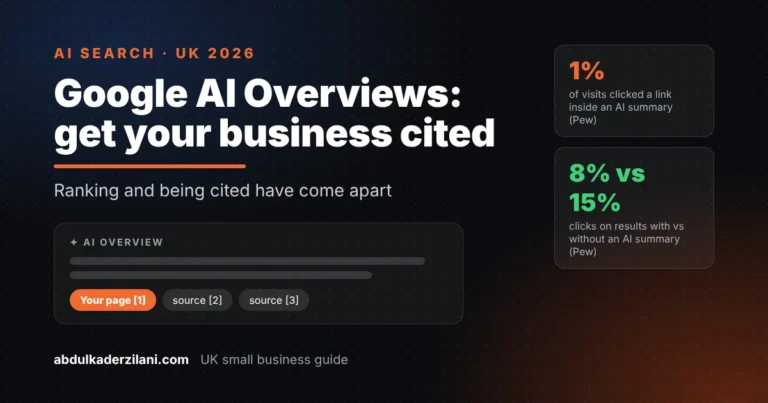
AI answers sit above or instead of the traditional list of links, which changes who gets the click. Pew Research Center’s July 2025 study of US users found that clicks on a traditional search result fell from 15% to 8% of visits when an AI summary appeared. That is a US study, but Google’s AI features work the same way here.
The upside is that the sources cited inside those answers still get seen and clicked. Google says AI Mode and AI Overviews may show a wider and more diverse set of links than a classic results page, so a smaller business with a clear, useful page can appear next to much larger brands.
The 10-step generative engine optimisation playbook
Work through these in order. The early steps are quick and cheap; the later ones take months.
Step 1: Make sure AI and search crawlers can reach you
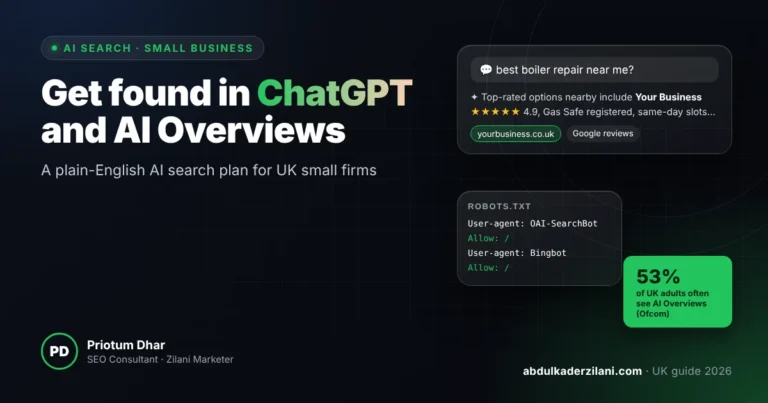
Check robots.txt and any CDN or security firewall settings. For Google, it is ordinary Googlebot access that matters. For ChatGPT, OpenAI’s documentation says sites that block OAI-SearchBot will not be shown in ChatGPT search answers. Blocking GPTBot is a separate choice: it controls whether content can be used to train OpenAI’s models, and OpenAI says each setting is independent.
Step 2: Get indexed and eligible for snippets
Google states that to appear in AI Overviews or AI Mode a page must be indexed and eligible to be shown in Google Search with a snippet. Verify your site in Google Search Console, check key pages with the URL Inspection tool, and avoid nosnippet on pages you want cited.
Step 3: Give every key page a direct answer first
Start service and guide pages with a two or three sentence answer to the main question, then the detail. Use clear headings that match how people ask, such as “How much does X cost?” or “How long does X take?”. Google says there is no ideal page length and no need to “chunk” content for AI, so this is about clarity, not formatting tricks.
Step 4: Publish facts no one else has
Generic content is easy to replace with an AI summary. Original evidence is not. Add first-hand detail: your own prices or how you price, timelines from real jobs, photos, process steps, and figures with sources. Google’s AI guidance asks for non-commodity, people-first content, and the GEO paper found statistics and citations improved visibility.
Step 5: Cite your sources on the page
Link to the official or primary source for any figure you use. It helps readers check you, and it matches what the GEO researchers measured. A short “Sources” list at the end of long guides works well.
Step 6: Make your business details consistent everywhere
AI tools build a picture of your business from many places. Keep your name, address, phone, services and opening hours the same on your website, Google Business Profile, social profiles and directories. For local businesses this overlaps with local SEO, and Google tells local and ecommerce businesses to keep Business Profile and Merchant Center data up to date.
Step 7: Earn genuine mentions of your brand
Ahrefs studied 75,000 brands and found that branded web mentions had the strongest correlation with appearing in Google AI Overviews (0.664), well ahead of the number of backlinks (0.218). Correlation is not causation, but it points the same way as common sense: be talked about on trade sites, local news, supplier pages and industry lists. Google warns against chasing inauthentic mentions, so do not buy them.
Step 8: Collect real reviews
Reviews are one of the most visible trust signals on Google Business Profile and many third-party sites. Ask every happy customer, reply to every review and never offer undisclosed incentives. Fake and undisclosed incentivised reviews have been unlawful in the UK since 6 April 2025.
Step 9: Use structured data properly, not as a shortcut
Structured data such as Organization, LocalBusiness, Product and FAQPage still helps for rich results and keeps facts machine-readable. But Google is clear that there is no special schema.org markup for AI features and that structured data must match the visible text on the page.
Step 10: Measure what you can and ignore what you cannot
Google includes AI Overviews and AI Mode traffic in the Search Console Performance report. Track referral visits from chatgpt.com and other AI tools in GA4, run a monthly check of your key questions in AI tools and note who is cited, and watch branded search. Be sceptical of any tool claiming exact “AI rankings”; Google’s guide warns against third-party tools that promise ranking success.
Generative engine optimisation myths to skip
| Claim | What the sources say |
|---|---|
| “You need an llms.txt file” | Google says Search ignores llms.txt; it neither helps nor harms |
| “You need special AI schema” | Google says there is no special schema.org markup for AI features |
| “Break content into tiny chunks” | Google says there is no ideal length and chunking is not needed |
| “Create a page for every possible question” | Mass-producing pages to manipulate answers can breach Google’s scaled content abuse policy |
| “Blocking GPTBot hides you from ChatGPT search” | OpenAI says GPTBot (training) and OAI-SearchBot (search) are separate settings |
| “GEO replaces SEO” | Google says its AI features rely on core Search ranking systems |
A 90-day generative engine optimisation plan for a small business
| Weeks | Focus | Output |
|---|---|---|
| 1 to 2 | Steps 1 and 2 | Crawl access confirmed, Search Console clean, key pages indexed |
| 3 to 6 | Steps 3 to 5 | Top 5 to 10 pages rewritten with direct answers, original facts and sources |
| 5 to 8 | Steps 6 and 8 | Consistent business details; a simple review request process running |
| 6 to 12 | Step 7 | Three to five genuine mentions earned (trade press, partners, local media) |
| Ongoing | Steps 9 and 10 | Structured data checked; monthly citation and referral review |
For most small UK businesses this sits alongside normal SEO rather than replacing it. Our guide to small business SEO covers the wider foundations, and how to get recommended by ChatGPT goes deeper on ChatGPT specifically.
Frequently asked questions
What is generative engine optimisation?
It is the practice of making your business easy for AI search tools such as Google AI Overviews, AI Mode and ChatGPT to find, understand and cite. The term comes from a 2023 research paper, and the work overlaps heavily with good SEO.
Is generative engine optimization different from generative engine optimisation?
No. They are the US and UK spellings of the same thing. This guide covers both.
Do I need an llms.txt file?
Not for Google. Google says Search ignores llms.txt and that you do not need new AI text files or special markup to appear in its AI features.
How do I get my business into ChatGPT search?
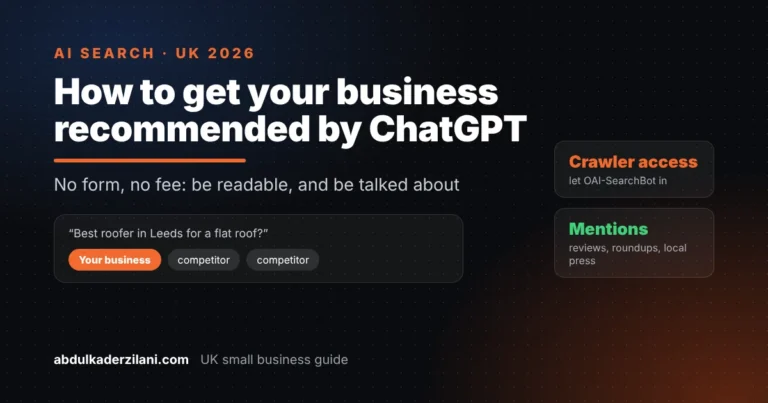
Allow OAI-SearchBot in robots.txt, make your service pages clear and specific, keep business details consistent and earn genuine mentions and reviews on other sites. OpenAI says sites that block OAI-SearchBot will not be shown in ChatGPT search answers.
How long does GEO take to work?
Crawl and indexing fixes can show up within weeks. Content rewrites and brand mentions usually take several months, and results vary by how competitive your topic is.
Can I track AI search traffic?
Partly. Search Console includes AI Overviews and AI Mode in the Performance report, and GA4 shows referral visits from AI tools like ChatGPT. No tool can show every citation, so combine data with regular manual checks.
The bottom line
A good generative engine optimisation playbook is not a bag of tricks. Let the crawlers in, answer questions clearly, publish facts only you have, cite your sources and get your brand mentioned in genuine places. That is what Google and OpenAI describe, and it is what the research measured.
If you want a hand putting this into practice, see our generative engine optimisation service and answer engine optimisation support, or book a strategy call.
Sources
- Google Search Central: AI features and your website
- Google Search Central: Optimising your website for generative AI features on Google Search
- OpenAI: Overview of OpenAI crawlers
- Aggarwal et al., GEO: Generative Engine Optimization (KDD 2024)
- Ahrefs: An analysis of AI Overview brand visibility factors (75K brands)
- The Register: Pew study on Google AI Overviews and clicks (July 2025)