Answer Engine Optimisation: 12 Steps for UK Businesses to Win AI Answers in 2026
 By Priotum Dhar
·
· 9 min read
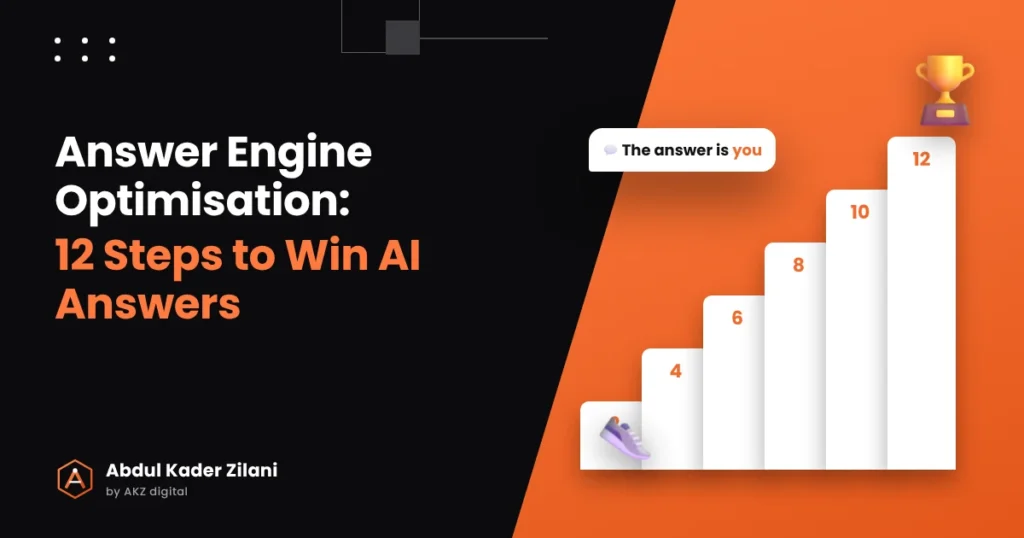
More and more questions now end with an AI answer instead of a list of links. Google shows AI Overviews and AI Mode, Microsoft has Copilot and AI summaries in Bing, and many people simply ask ChatGPT. If your business is not one of the sources those answers lean on, you can lose the click even when your page ranks.
Answer engine optimisation (AEO, also spelt answer engine optimization) is the work of making your pages easy for these systems to find, understand and quote. There is a lot of hype around it. This checklist sticks to what Google, Microsoft and OpenAI have actually published, and turns it into 12 steps a UK small business can work through.
Answer engine optimisation is mostly good SEO done carefully: let the bots in, get indexed, answer real questions clearly near the top of the page, use tables and lists, keep facts consistent across the web, and earn reviews and mentions. Google says no special files or schema are required. Measure with Search Console and Bing Webmaster Tools, not guesswork.
Why an answer engine optimisation checklist matters now
AI answers change who gets the click. Pew Research found that when Google showed an AI summary, users clicked a traditional result in 8% of visits, against 15% when there was no summary, as reported by The Register. That was a US study, but the pattern is the reason UK businesses are paying attention.
The good news is that the rules are not secret. Google’s own guidance says optimising for its generative AI features is optimising for search, and it points site owners back to core SEO. Microsoft has published detailed advice on how content gets picked for AI answers. So a checklist built on those sources is more useful than any “AEO hack”.
| Answer engine | Where it gets content | What you control |
|---|---|---|
| Google AI Overviews and AI Mode | Google’s search index | Indexing, snippets, clear content, Business Profile, Merchant Center |
| Microsoft Copilot and Bing AI summaries | Bing’s index | Bing indexing, IndexNow, Bing Places, clear structure |
| ChatGPT search | OpenAI’s search crawler plus partners | Allowing OAI-SearchBot, mentions on trusted sites |
The 12-step answer engine optimisation checklist
Work through these in order. The first four are technical basics; skip them and nothing else matters.
Step 1: Let the right bots crawl your site
Check your robots.txt and any firewall or CDN settings. Google says pages must be crawlable, including through your CDN or host. For ChatGPT search, OpenAI says its OAI-SearchBot crawler needs access for your pages to appear in search results, per OpenAI’s bot documentation. Some security plugins block unknown bots by default, so test.
Step 2: Make sure your key pages are indexed
Google’s AI features page is plain about it: a page must be indexed and eligible to show with a snippet, and there are no additional technical requirements. Use the Page indexing report in Search Console and the URL Inspection tool on your main service pages.
Step 3: Get indexed in Bing too
Copilot and Bing’s AI summaries draw on Bing. Verify your site in Bing Webmaster Tools, submit your sitemap and use IndexNow so new or updated pages are picked up quickly. Microsoft recommends IndexNow for freshness in its AI Performance announcement.
Step 4: Do not block snippets by accident
The nosnippet, data-nosnippet and max-snippet controls limit how your content can be shown, including in AI features. These are sometimes added by themes or plugins. Check the source of your key pages.
Step 5: Answer the question in the first lines
Put a direct, two or three sentence answer near the top of the page, then expand. Microsoft advises short, self-contained sentences that still make sense if lifted out of context, in its guide to content for AI search answers. A plumber’s emergency page might open with the area covered, the response time and how pricing works.
Step 6: Write headings that match real questions
Your title, meta description and H1 should agree with each other, which Microsoft also recommends. Then use H2s that mirror the questions customers ask: “How much does a boiler service cost in Leeds?” beats “Our pricing philosophy”.
Step 7: Use tables and lists for comparisons and steps
AI answers often pull steps and comparisons. Microsoft suggests lists and comparison tables for how-to and feature content, and Bing says clear headings, tables and FAQ sections help surface key information. Use real HTML tables, not images of tables.
Step 8: Keep important answers in plain text
Do not hide key facts in images, PDFs or content that only loads after clicks. Microsoft warns that AI systems may not render hidden content. Prices, service areas, opening hours and policies should be visible text on the page.
Step 9: Add structured data that matches the page
Google says there is no special schema you need for AI features, but structured data still helps search engines understand a page, and it must match what is visible. Useful types for small businesses are LocalBusiness or Organization, Product, Article and Review where genuine. Note that Google limited FAQ rich results in 2023 to well-known government and health sites, so FAQ markup will not give most businesses a rich result in Google.
Step 10: Show first-hand experience
Google’s generative AI guide asks for unique, valuable content such as first-hand experience, and warns against mass-produced pages made to influence AI answers. Original photos, real process steps, named authors and specific local detail are things a generic summary cannot copy.
Step 11: Keep your business facts consistent everywhere
AI answers about local businesses lean on profiles and listings. Keep your name, address, phone, hours and services the same on your site, Google Business Profile, Bing Places and the main directories in your trade. Google says Business Profiles help local visibility in its AI responses. Our local SEO guide covers the setup.
Step 12: Earn genuine reviews and mentions
Answer engines look beyond your own site. Reviews on Google and trade sites, local press, supplier pages and industry bodies all add to the picture. Keep it honest: fake reviews and undisclosed incentivised reviews have been unlawful in the UK since 6 April 2025 under the DMCC Act 2024.
Answer engine optimisation checklist: quick-reference table
| Step | Task | Tool to check it | Time (example) |
|---|---|---|---|
| 1 | Bot access | robots.txt, CDN or firewall settings | 30 minutes |
| 2 | Google indexing | Search Console Page indexing, URL Inspection | 1 hour |
| 3 | Bing indexing | Bing Webmaster Tools, IndexNow | 1 hour |
| 4 | Snippet controls | Page source | 30 minutes |
| 5 | Direct answers | Your top 5 pages | 2 to 4 hours |
| 6 | Question-led headings | Title, H1, H2s | 2 hours |
| 7 | Tables and lists | Service and guide pages | 2 hours |
| 8 | Visible text, not images | Page review | 1 hour |
| 9 | Structured data | Rich Results Test, Schema validator | 2 hours |
| 10 | First-hand content | Photos, process, author pages | Ongoing |
| 11 | Consistent business facts | GBP, Bing Places, directories | 2 to 3 hours |
| 12 | Reviews and mentions | Review requests, PR | Ongoing |
The time estimates are examples for a small site of 10 to 30 pages, not fixed figures.
Answer engine optimisation myths to skip
- “You need an llms.txt file.” Google’s guidance says no new machine-readable files are needed to appear in its AI features.
- “You need special AEO schema.” Google says there is no special schema.org markup required.
- “Chop every page into tiny chunks.” Google’s guide says content does not need to be split up for AI. Write for people with clear sections.
- “AEO replaces SEO.” The same indexing, content quality and trust signals drive both. See our GEO playbook for how the labels overlap.
How to measure answer engine optimisation honestly
You cannot see every AI mention, but you can see more than before.
| Tool | What it shows | Limits |
|---|---|---|
| Google Search Console | Clicks and impressions from AI Overviews and AI Mode within Web search; Google has also added a generative AI performance report | Does not show your exact wording in the answer |
| Bing Webmaster Tools AI Performance (preview) | Citations in Copilot and Bing AI summaries, cited pages, sample grounding queries | Citations do not mean ranking or authority |
| GA4 referrals | Visits from chatgpt.com, copilot.microsoft.com and similar | Many AI visits arrive with no referrer |
| Manual checks | Ask the same 10 customer questions monthly in each tool | Answers vary by user and day |
Track a small set of real customer questions each month, note who gets cited, and look for trends rather than single results.
A 30-day answer engine optimisation plan
- Week 1: Steps 1 to 4. Fix crawling, indexing and snippet blocks. Verify Bing.
- Week 2: Steps 5 to 8 on your five most important pages.
- Week 3: Step 9 and step 11. Add matching structured data and tidy your listings.
- Week 4: Steps 10 and 12. Add first-hand detail and start a steady review request routine. Set up your monthly measurement check.
For a wider view that includes Gemini and ChatGPT, read AI search optimisation for UK small businesses and how to get recommended by ChatGPT. For how AI Overviews affect clicks, see our Google AI Overviews guide.
Want a quick self-check first? Work through our free UK AI search visibility checklist to see where your site stands today.
Frequently asked questions
What is answer engine optimisation?
It is the work of making your content easy for AI answer tools such as Google AI Overviews, Copilot and ChatGPT to find, understand and cite. In practice it is careful SEO with extra attention to direct answers, structure and trust.
Is answer engine optimisation different from SEO?
Mostly not. Google says optimising for its generative AI features is optimising for search. AEO puts more weight on direct answers, clear structure and consistent facts across the web, but the foundations are the same.
Do I need llms.txt or special schema for AEO?
Google says no new machine-readable files and no special schema are needed for its AI features. Normal structured data that matches your visible content is still useful.
How do I know if AI answers cite my site?
Use Google Search Console, the AI Performance report in Bing Webmaster Tools, GA4 referral data and a monthly manual check of your key customer questions.
How long does answer engine optimisation take to work?
Technical fixes can be picked up once pages are recrawled, which Google says can take from several days to several months. Reviews and mentions build over months.
Is AEO spelt with an s or a z?
Both are used. UK writers tend to use answer engine optimisation and US writers answer engine optimization. They mean the same thing.
The bottom line
Answer engine optimisation is not a trick. It is a checklist: let the bots in, get indexed on Google and Bing, answer questions clearly in visible text, structure pages with headings, tables and lists, keep your business facts consistent and earn honest reviews and mentions. Then measure with the tools Google and Microsoft provide.
If you want us to run this checklist on your site, see our answer engine optimisation service or book a strategy call. For the wider strategy, our generative engine optimisation service covers mentions and digital PR.
Sources
- Google Search Central: AI features and your website
- Google Search Central: Optimising for generative AI features in Google Search
- Google Search Central blog: Changes to HowTo and FAQ rich results (August 2023)
- Microsoft Advertising: Optimizing your content for inclusion in AI search answers (October 2025)
- Bing Webmaster Blog: Introducing AI Performance in Bing Webmaster Tools (February 2026)
- OpenAI: Overview of OpenAI crawlers
- The Register: Pew study on Google AI Overviews and clicks (July 2025)