Hiring an SEO Consultant in the UK: Costs, Deliverables and Questions to Ask First
 By Priotum Dhar
·
· 8 min read
Hiring an SEO consultant feels risky because you cannot easily check the work. Rankings move for reasons nobody controls, reports are full of jargon, and the person selling the service is usually the one grading it.
You can reduce that risk a lot before you sign anything. Google publishes its own advice on hiring an SEO, updated in June 2026, and it is more useful than most sales pages. This guide combines that advice with what we look for when we review other people’s SEO work: when a consultant is the right choice, what the deliverables should be, how to think about cost, and the questions to ask in the first call.
Hire an SEO consultant when you need expert judgement and a clear plan more than you need a big team producing content. Expect a written audit with prioritised fixes in the first month, read-only access to your Search Console at the start, and reporting tied to enquiries or sales. Walk away from anyone who guarantees a first-place ranking. Google’s own guidance says no one can.
SEO consultant vs SEO agency
Both can do good work. The difference is mostly about who does the thinking and how much volume you need. If you are still weighing up the agency route, our guide to what an SEO agency actually does goes into that side.
| Factor | SEO consultant | SEO agency |
|---|---|---|
| Who does the work | Usually the person you spoke to | Often a team, with an account manager in the middle |
| Best for | Audits, technical fixes, strategy, small to mid-sized sites | Large sites, heavy content production, link outreach at scale |
| Capacity | Limited by one person’s time | Can scale up, but quality varies by who is assigned |
| Speed of decisions | Fast, one point of contact | Slower if several people need to sign off |
| Risk | Illness or holidays pause the work | Staff turnover changes who handles your account |
| Typical engagement | Project audit, then a small retainer or ad hoc days | Monthly retainer with a minimum term |
For most small UK businesses with one location and a site of a few dozen pages, a consultant is often enough. Once you need dozens of new pages a month or a multi-location rollout, a team starts to make more sense.
What an SEO consultant should deliver
The first deliverable is almost always an audit. A good audit is not a 90-page export from a tool. Google’s updated hiring guide makes this point itself: it says third-party SEO tools do not have access to Google’s internal ranking data, and Google does not endorse any tool as “approved”. A useful audit uses tools for evidence and then applies judgement.
| Deliverable | What good looks like | Red flag |
|---|---|---|
| Technical audit | Crawl and indexing issues, speed, mobile, broken pages, ranked by impact | Hundreds of “errors” with no priority |
| Search Console review | What you already rank for, pages losing clicks, queries with impressions but few clicks | No mention of Search Console data at all |
| Keyword and page plan | Which searches each important page should target, and gaps to fill | A keyword list with no pages attached |
| Local review (if relevant) | Google Business Profile, categories, reviews, citations | Ignoring the map pack for a local business |
| AI search check | Whether your pages answer questions clearly and can be cited in AI answers | Promises to “rank you in ChatGPT” |
| Action plan | 10 to 20 tasks in order, with who does each one | “Ongoing optimisation” with no tasks named |
After the audit, the work usually splits between fixes the consultant does, fixes your developer does, and content you or a writer produce. Make sure the plan says who does what. Our breakdown of what SEO services include covers each strand in more depth.
What about AI search?
Google now tells business owners to ask whether an SEO’s advice on AEO or GEO (answer engine and generative engine optimisation) matches Google’s own guidance on generative AI in Search. That is a good filter. The basics that help in AI answers are mostly the same basics that help in normal search: clear pages, direct answers, accurate business information and genuine third-party mentions. Clicks are also changing. Pew Research found that in its US sample, people clicked a traditional result 8% of the time when an AI summary appeared, compared with 15% when it did not. Our guide to Google AI Overviews explains what that means for small sites.
How to think about the cost
We are not going to repeat other consultants’ price lists, because they are sales material and vary widely. Instead, ask every consultant to quote in days of work and deliverables. That lets you compare like with like.
Here is an example of how a sensible scope might break down for a small service business with a 30-page website. The numbers are illustrative, not a quote.
| Work item (example) | Rough time | Output |
|---|---|---|
| Access, crawl and Search Console review | 1 day | Data pulled and first issues logged |
| Technical and on-page audit | 1 to 2 days | Prioritised fix list |
| Keyword and page mapping | 1 day | Each money page matched to target searches |
| Local SEO review | Half a day | Google Business Profile and citation fixes |
| Write-up and walkthrough call | Half a day | Action plan you can hand to anyone |
| Total for the audit stage | 4 to 5 days |
Ongoing work is usually a few days a month: implementing fixes, improving pages, checking results and reporting. When a quote is much lower than the work described, something is being skipped. When it is much higher, ask what the extra time buys.
If you are on a tight budget, read our guide on small business SEO on £500 to £1,000 a month for the order we would spend it in.
How long it takes
Google does not publish a standard timeline for SEO, and nobody else can honestly give you a fixed one either. Instead, Google suggests you ask the SEO directly: what results they expect and in what timeframe. Their answer tells you a lot.
A sensible answer sounds like this: technical fixes and better titles can show in Search Console within weeks once Google recrawls the pages; new pages and stronger rankings for competitive terms usually take several months; local map pack changes depend on reviews, distance and how well your profile matches the search. Google says local results are based on relevance, distance and prominence, so a consultant cannot move your business closer to a customer.
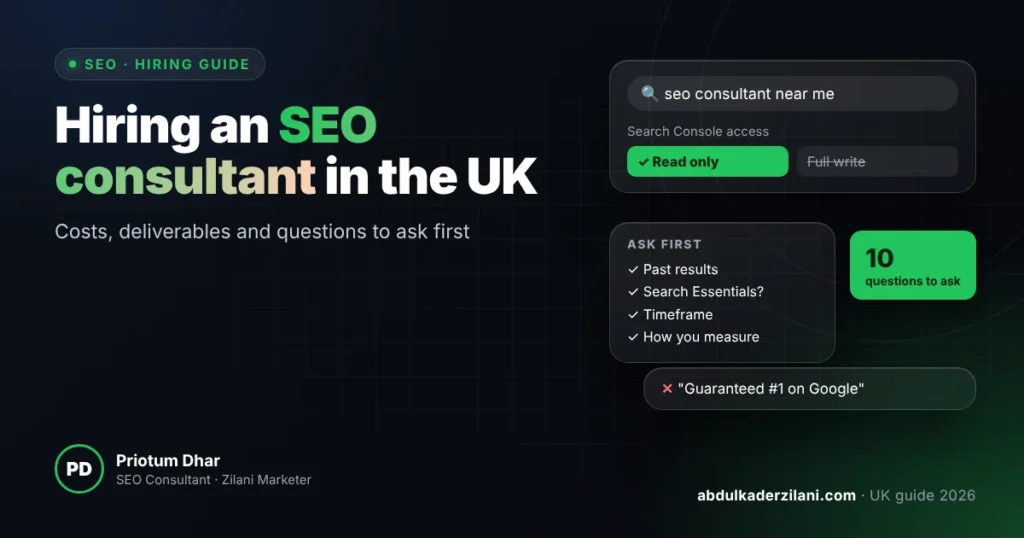
10 questions to ask before hiring
The first group of these comes straight from Google’s own hiring advice. The rest are ours.
- Can you show me examples of past work and what changed as a result?
- Do you follow Google Search Essentials?
- What results do you expect for my site, and in what timeframe?
- How will you measure success? Which number goes at the top of the report?
- Do you have experience in my industry and my part of the UK?
- How will you tell me about changes you make to the site?
- If you advise on AEO or GEO, how does that match Google’s guidance on generative AI?
- Which of the fixes will you do yourself, and which will need my developer?
- Can I keep everything, including reports, content and access, if we stop working together?
- What would you not recommend for my business?
Access: start with read only
Google gives a specific instruction here: at the audit stage, give an SEO read access to Search Console, not write access. Do the same with Google Analytics and Google Business Profile. Upgrade access only when you have agreed the work. Never share your own passwords; add the consultant as a user so you can remove them later.
Warning signs
Google lists several warning signs and we see the same ones in practice.
- A guarantee of a “#1 ranking on Google”. Google’s advice is to find someone else.
- Cold emails promising quick rankings.
- Talk of link schemes, private blog networks or submitting your site to thousands of search engines.
- Secret methods they will not explain.
- Reports that only show rankings for terms nobody searches for.
Remember that you remain responsible for what a consultant does to your site. Google says unethical SEO can lead to a site being demoted or removed from its index.
Frequently asked questions
What does an SEO consultant do?
An SEO consultant audits your website and search visibility, decides which fixes and pages matter most, and either does the work or directs your developer and writers. They should also report on the clicks, enquiries or sales that come from search.
How much does an SEO consultant cost in the UK?
Costs vary with experience and scope, so ask each consultant to quote in days of work with named deliverables. A focused audit for a small site is typically a few days of work; ongoing support is usually a few days a month. Compare quotes on what you will receive, not just the headline figure.
Is a consultant better than an agency for SEO?
For a small or mid-sized site that needs expert judgement and a clear plan, a consultant is often better value and quicker to work with. For large sites or high volumes of content and outreach, an agency’s team may be more practical.
Can an SEO consultant guarantee first page rankings?
No. Google states that no one can guarantee a first-place ranking, and advises you to look elsewhere if someone does. A consultant can commit to agreed work and honest reporting, not to a position.
What access should I give an SEO consultant?
Start with read-only access to Search Console and Analytics for the audit, as Google recommends. Add edit access to the website or Business Profile only once you have agreed the work, and always add them as a user rather than sharing your login.
Does SEO still matter with AI search?
Yes. AI answers still draw on websites, and the pages most likely to be used are clear, accurate and well structured. Clicks from search are changing, so measure enquiries and sales, not just rankings.
The bottom line
The best SEO consultant for a small UK business is the one who gives you a short, prioritised plan, explains it in plain English, starts with read-only access, and agrees how success will be measured before any work starts. Use Google’s own questions as your interview script and treat guarantees as a reason to walk away.
If you want us to look at your site, see how our SEO service and local SEO service work, or book a strategy call and we will tell you what we would fix first.
Sources
- Google Search Central: Do you need an SEO?
- PPC Land: Google’s SEO hiring guide now flags third-party tool risks and AI advice (8 June 2026)
- Google Search Central: SEO Starter Guide
- Google Business Profile Help: How Google determines local ranking
- The Register: Google AI Overviews suppress clicks, Pew Research (July 2025)
- Search Console Help: Add or remove users