How to Get Your Business on Google: 12 Steps for UK Small Businesses
 By Priotum Dhar
·
· Updated 15 Nov 2026 · 11 min read
Most UK small businesses do not have a visibility problem because they are bad at what they do. They have one because a competitor with a finished Google Business Profile, more recent reviews and a clearer website is easier for Google to show. The good news is that the steps that matter most are free and take a few hours, not a few months.
This guide shows you how to get your business on Google, in Google Maps and in AI answers, in the order that pays off fastest. It is built for owners who do their own marketing: about three hours to set up, then about an hour a week. There are 5.64 million small businesses in the UK, 99.2% of all private-sector businesses, and 75% of them have no employees (Department for Business and Trade, 2025). If that is you, the time budget matters as much as the tactics.
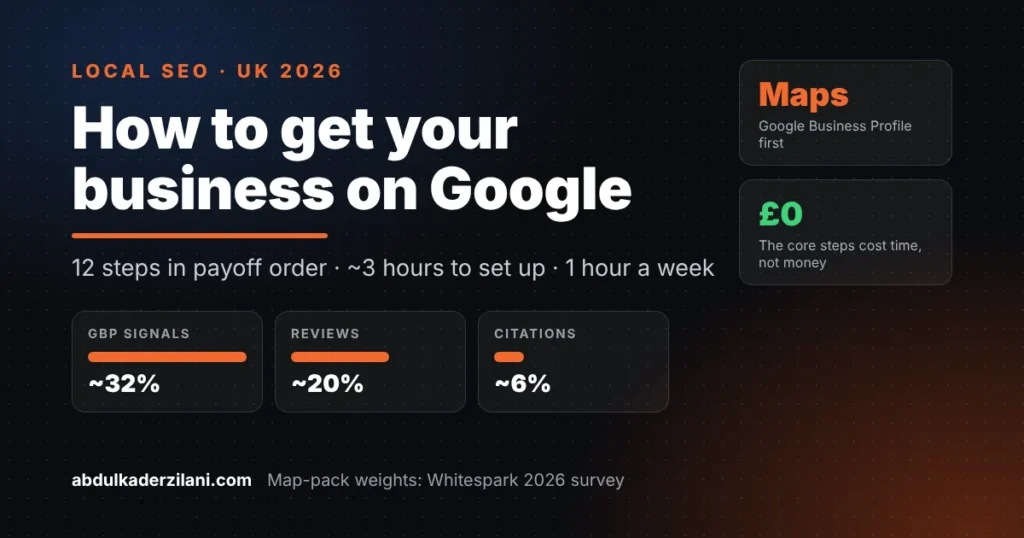
- Start with your Google Business Profile. Experts in the Whitespark 2026 survey weight Business Profile signals at about 32% of map-pack ranking, reviews at about 20% and directory citations at about 6%.
- You cannot pay Google for a better local ranking. Google ranks local results on relevance, distance and prominence.
- Fake or incentivised reviews are now illegal in the UK. Since 6 April 2025, the CMA can fine businesses up to 10% of global turnover.
- AI assistants are a new discovery channel. ChatGPT cannot see inside Google reviews, so reviews on other trusted sites now matter too.
- Measure calls and enquiries, not just traffic. In the AI era, calls can rise while website sessions fall.
What does online visibility mean in 2026?
Online visibility is how easily the right customers find and choose your business when they search, whether that is in normal Google results, Google Maps or AI answers such as Google AI Overviews and ChatGPT. It is no longer just about your website ranking.
It helps to split it in two:
- Found when they are ready to buy. Searches such as “electrician near me” or “book a dog groomer in Bristol”. Google Maps and your Business Profile win these.
- Found when they are researching. Searches such as “how much does a rewire cost”. Helpful pages on your website win these, and AI Overviews now answer many of them at the top of the page. Our guide to Google AI Overviews covers that side in detail.
Visibility comes first for a reason: if customers cannot find you, nothing else on this list matters. Being found is the foundation; everything after it is about being chosen.
Before you start: 30 minutes that save you months
Write down one main service, one main town or area, and one type of customer. Every step below is easier when you know who you want to be found by. A gas engineer in Leeds who wants boiler installations is far easier to make visible than “a heating company” that does everything everywhere.
Where Google puts the weight
Google says local results are based on relevance, distance and prominence, and that “there’s no way to request or pay for a better local ranking” (Google Business Profile Help). The Whitespark Local Search Ranking Factors 2026 survey of 47 local SEO experts estimates how the map pack is weighted:
| Signal | Approximate weight | What it means for you |
|---|---|---|
| Google Business Profile signals | ~32% | Category, services, completeness and activity on your profile |
| Reviews | ~20% | How many, how recent, how good, and whether you reply |
| Citations (directory listings) | ~6% | Consistent name, address and phone number across key sites |
That single table explains the order of the steps below. It also explains why paying for “40 directory listings” is poor value.
How to get your business on Google: 12 steps in payoff order
1. Claim and complete your Google Business Profile
Time: about 25 to 30 minutes, once. This is your free shopfront in Google Search and Maps. Choose the most accurate primary category, add every service, your attributes, opening hours, real photos and answers to common questions. In the UK, verification is usually by postcard (5 to 7 days), video or phone.
If you work from home or visit customers, such as plumbers, cleaners and mobile services, hide your home address and set service areas instead. Most guides assume a high-street shop and skip this.
2. Fix your name, address and phone number everywhere
Time: about an hour, once. Your business name, address and phone number should match exactly on your website, your Business Profile and every listing. Inconsistent details are one of the most common reasons a business does not show up properly on Google Maps.
3. Build one page for each service and town you cover
One generic “Services” page cannot rank for everything you do. Create a page for each main service, and for each town you genuinely serve, with real prices, real photos and examples of real jobs. Avoid near-identical “doorway” pages for every town on the map; Google treats those as spam.
A useful addition: a short “What does [service] cost in [town] in 2026?” section with a real price range, what is included and what changes the price. These are exactly the questions AI Overviews now answer.
4. Get reviews the legal way, and reply to every one
Time: about 10 minutes a week. Reviews are now a legal issue as well as a marketing one. Under the Digital Markets, Competition and Consumers Act 2024, fake reviews and concealed incentivised reviews have been banned since 6 April 2025. The Competition and Markets Authority can fine businesses directly, up to 10% of global turnover, and opened investigations into five businesses on 27 March 2026. Google goes further: it bans any incentive and any “review gating”, and it blocked or removed 240 million policy-breaking reviews in 2024.
So: no discount for a review, no prize draw, and no asking “did you enjoy it?” first and only sending happy customers to Google. Here is a simple, compliant ask you can use:
“If you’re happy, would you leave us a Google review? Here’s the link. It takes a minute, and honest feedback helps either way.”
Say it as you finish the job, then send the link by text or WhatsApp within the hour. Ask every customer, with nothing attached, and never tell them what to write.
Reviews also work as a threshold. In BrightLocal’s Local Consumer Review Survey 2026 (a US panel of 1,002 people, so treat it as a guide for the UK): 97% read reviews, 68% require at least 4 stars, 74% want reviews from the last three months, and 47% will not use a business with fewer than 20 reviews. 89% expect a reply, and 83% of people who were asked to leave a review did. About half are put off by copy-and-paste replies, so reply within 48 hours and mention the job and the town.
5. Claim the five free listings that matter, then stop
Time: about an hour, once. Google Business Profile, then Bing Places (you can import from Google in about 10 minutes), Apple Business, Facebook and LinkedIn, plus two or three listings specific to your trade. Citations carry about 6% of map-pack weight, so consistency beats quantity.
6. Answer the ten questions customers actually ask
Use Google’s “People also ask” boxes and a free tool such as AnswerThePublic to find the questions behind your service. Answer each one clearly, with the answer in the first two sentences. The same content helps you appear in AI Overviews.
7. Turn one job into a week of content
Time: about 45 minutes a week. Take a photo of a finished job, post it to your Business Profile, record a 60-second phone video answering the question that job raised, and share it on your one social channel. One real job feeds Google, Maps, YouTube and AI answers at once.
8. Pick one social channel and post consistently
Not five channels done badly. 54% of UK owners already spend one to three hours a week creating social content, and 65% have never had any training (Markel Direct and Censuswide, 2026, 501 UK owners). 73% say customers expect them to be active on social media, and 63% struggle to stand out. Choose the one channel your customers actually use and reuse your job content there.
9. Make your website turn the click into an enquiry
Being found and being chosen are different problems. Plenty of businesses have a website that never brings in work. Show prices, real photos, how fast you reply and one clear next step on every page. If your site is the weak link, our landing page design and WordPress web design services are built for this.
10. Get mentioned locally
Suppliers, local press, community groups, trade bodies and local sponsorships all create mentions that both Google and AI assistants read. One genuine local mention is worth more than dozens of low-quality links.
11. Check what AI says about your business
Time: about 20 minutes a month. Ask ChatGPT, Gemini and Google AI Mode the ten questions your buyers ask and note who gets named. BrightLocal’s 2026 survey (US panel) found the share of consumers using AI tools for local recommendations jumped from 6% to 45% in a year. There is a catch: according to BrightLocal’s CEO, ChatGPT cannot see inside Google’s review system and leans on directories such as Yelp. A business with only Google reviews can be invisible to it, so gather some reviews on other trusted sites too.
12. Measure what matters, monthly
Time: about 15 minutes a month. On the first Monday of the month, record four things in one spreadsheet row: Business Profile calls, direction requests and website clicks; enquiries and form fills; a tally of “how did you hear about us?”; and the results of your AI check. If calls are up and website sessions are down, you are probably winning.
What to do in 2026, and what to stop
| Do this | Stop doing this |
|---|---|
| Complete your Business Profile and keep it active with posts, photos, questions and review replies | Setting it up once and forgetting it; stuffing keywords into your business name (suspension risk) |
| One page for each service and town, with real prices | One generic Services page, or a near-copy page for every town |
| Ask every customer for a review, neutrally, and reply to all of them | Buying reviews, offering incentives or filtering out unhappy customers, which is now unlawful in the UK |
| Five free listings done properly, plus two or three for your trade | Paying for 40 directory listings |
| One real job story a week, reused across channels | Posting daily on five platforms, or publishing mass AI-written blog posts |
| Tracking calls, directions and enquiries | Reporting “traffic is up” while enquiries fall |
How much does it cost, and how long does it take?
Most small businesses work with tight marketing budgets, so cutting waste matters as much as adding tactics. Here is how the main routes compare:
| Route | Typical cost | What to expect |
|---|---|---|
| Do it yourself | Free tools (Google Business Profile, Search Console, Bing Places), plus your time | Business Profile and review improvements can show within weeks |
| Freelancer or consultant | Usually a fixed monthly fee for an agreed scope | Ask for a written list of monthly tasks and a report on enquiries, not just rankings |
| Agency | Usually a higher monthly fee that includes account management | Check who actually does the work, and add 20% VAT if the provider is VAT-registered |
Timelines: Business Profile and review changes can be measurable in 4 to 12 weeks, low-competition keywords in 3 to 4 months, and competitive or national terms in 6 to 12 months. Be wary of anyone guaranteeing rankings or not reporting on enquiries.
Your first-week checklist
- Decide your one service, one town and one customer.
- Claim or complete your Google Business Profile.
- Make your name, address and phone number identical everywhere.
- Claim Bing Places, Apple Business, Facebook and LinkedIn.
- Send the review request to your last ten customers.
- Reply to every existing review.
- Write down your four monthly numbers so you have a starting point.
28 practical checks to get your business found on Google, Google Maps and in AI answers, with a time estimate for each and a monthly tracker. Get the free checklist →
Frequently asked questions
How do I get my business on Google for free?
Create and verify a Google Business Profile, fill in every section, add real photos and ask customers for reviews. It costs nothing. Then make sure your website has a page for each service you offer and your name, address and phone number match everywhere.
How do I get my business on Google Maps?
Your Business Profile is what puts you on Google Maps. Claim it, choose the right primary category, verify it by postcard, video or phone, and set your address or service areas. Showing up higher in the map pack then depends on relevance, distance and prominence, especially reviews.
Why is my business not showing on Google Maps when competitors are?
Usually because the profile is incomplete: the wrong primary category, inconsistent contact details, few photos or few recent reviews. It is rarely a penalty. Work through steps 1, 2 and 4 of this guide first.
How can I get more Google reviews without breaking UK rules?
Ask every customer, neutrally, as you finish the job, and send the link straight away. Do not offer discounts or prizes, do not pre-screen customers, and do not tell them what to write. Fake and concealed incentivised reviews have been banned in the UK since 6 April 2025.
How long does it take to improve online visibility?
Business Profile and review improvements can show within 4 to 12 weeks. Ranking your website for low-competition searches usually takes 3 to 4 months, and competitive searches 6 to 12 months.
Should I be on TikTok, Instagram or LinkedIn, or just Google?
Google first, because people searching there are already looking for what you sell. Then choose one social channel your customers use and post consistently, rather than spreading yourself across five.
How much should a UK small business spend on local SEO?
Doing it yourself costs mostly time, because the core tools are free. If you pay for help, agree a fixed monthly scope, ask for reports on enquiries rather than just rankings, and treat any guarantee of rankings as a warning sign.
Want help getting found?
We help UK small businesses get found on Google, in Maps and in AI answers, and we report on calls and enquiries, not vanity numbers. See our local SEO services and SEO services, read our SEO case study from four live accounts, or book a free 30-minute call and we will tell you the three changes most likely to move your numbers.
Sources
- Department for Business and Trade: Business population estimates 2025
- Google Business Profile Help: tips to improve your local ranking
- BrightLocal: Local Consumer Review Survey 2026
- Google Business Profile Help: Tips to improve your local ranking on Google
- Whitespark Local Search Ranking Factors 2026; Markel Direct and Censuswide (2026); Competition and Markets Authority guidance on the Digital Markets, Competition and Consumers Act 2024.