Services ▾
All servicesMeta Ads ManagementGoogle Ads ManagementTikTok Ads ManagementeCommerce MarketingSEO ServicesGenerative Engine OptimisationAnswer Engine OptimisationLocal SEOWordPress DevelopmenteCommerce WebsitesCustom WebsitesLanding PagesMarketing for ecommerce and DTC brands in the UK
More profitable sales from Meta Ads, Google Shopping and SEO, measured on what actually reaches your bank account. Built for UK online stores selling direct to consumers.
 Written by Abdul Kader Zilani, digital marketing consultant·Serving UK businesses from Chattogram, Bangladesh·Last updated
Why do DTC brands stall after the first good months?
Most DTC brands grow on one channel, usually Meta Ads, until costs rise, a winning ad burns out and the numbers in Ads Manager stop matching the numbers in Shopify. At that point spending more makes things worse, not better.
We fix it in a fixed order: tracking you can trust, creative that keeps finding new buyers, a second channel such as Google Shopping or SEO so you are not dependent on one platform, and decisions made on contribution margin rather than platform ROAS alone.
A good fit if you
- Sell your own products online through Shopify or WooCommerce
- Spend or plan to spend at least £1,500 a month on ads
- Rely on one channel for most of your sales
- Cannot tell which channel is really profitable
- Want one partner across ads, SEO and tracking
What does DTC marketing include?
DTC marketing for an ecommerce brand usually combines paid social, Google Shopping, ecommerce SEO, conversion rate work and accurate tracking, all judged on profit per order rather than clicks or platform ROAS.
Meta Ads for ecommerce
Prospecting and retargeting campaigns on Facebook and Instagram, with a steady creative testing routine. See our Meta Ads management service.
Google Shopping & PMax
Clean product feeds, Shopping and Performance Max campaigns that capture people already searching for what you sell.
Ecommerce SEO
Category and product pages that rank, structured data, internal links and content that answers buying questions.
Tracking you can trust
Meta Pixel with Conversions API, GA4 ecommerce events and Google Ads conversions, checked against real orders.
Conversion improvements
Product page, delivery information and checkout fixes so more of your paid traffic turns into orders.
Profit reporting
Contribution margin, new-customer cost and repeat rate, not just ROAS. Try our break-even ROAS calculator.
Ecommerce accounts we have run, with the screenshots
Real Meta Ads Manager and Search Console screenshots from ecommerce accounts, with client names hidden.
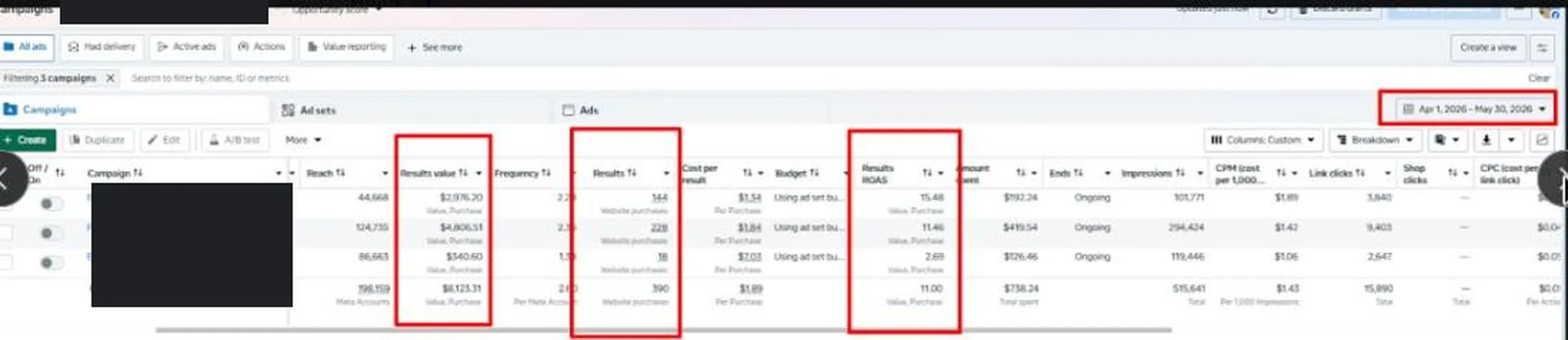
Meta Ads · Ecommerce
11x ROAS for a home & kitchen brand
Three campaigns turned $738 of ad spend into $8,123 of tracked purchase value. The structure did more of the work than the creative did.
Read the full case study →
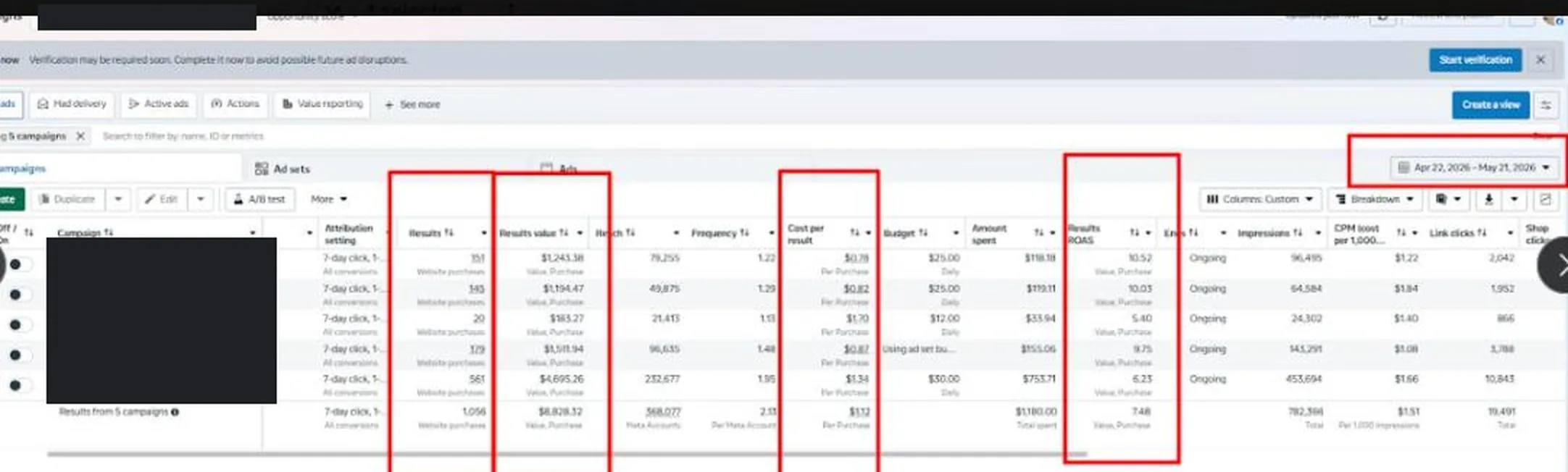
Meta Ads · Scaling
1,056 purchases in 30 days at 7.5x ROAS
The cheapest campaign and the most profitable campaign were not the same campaign. How to tell them apart before you cut the wrong one.
Read the full case study →
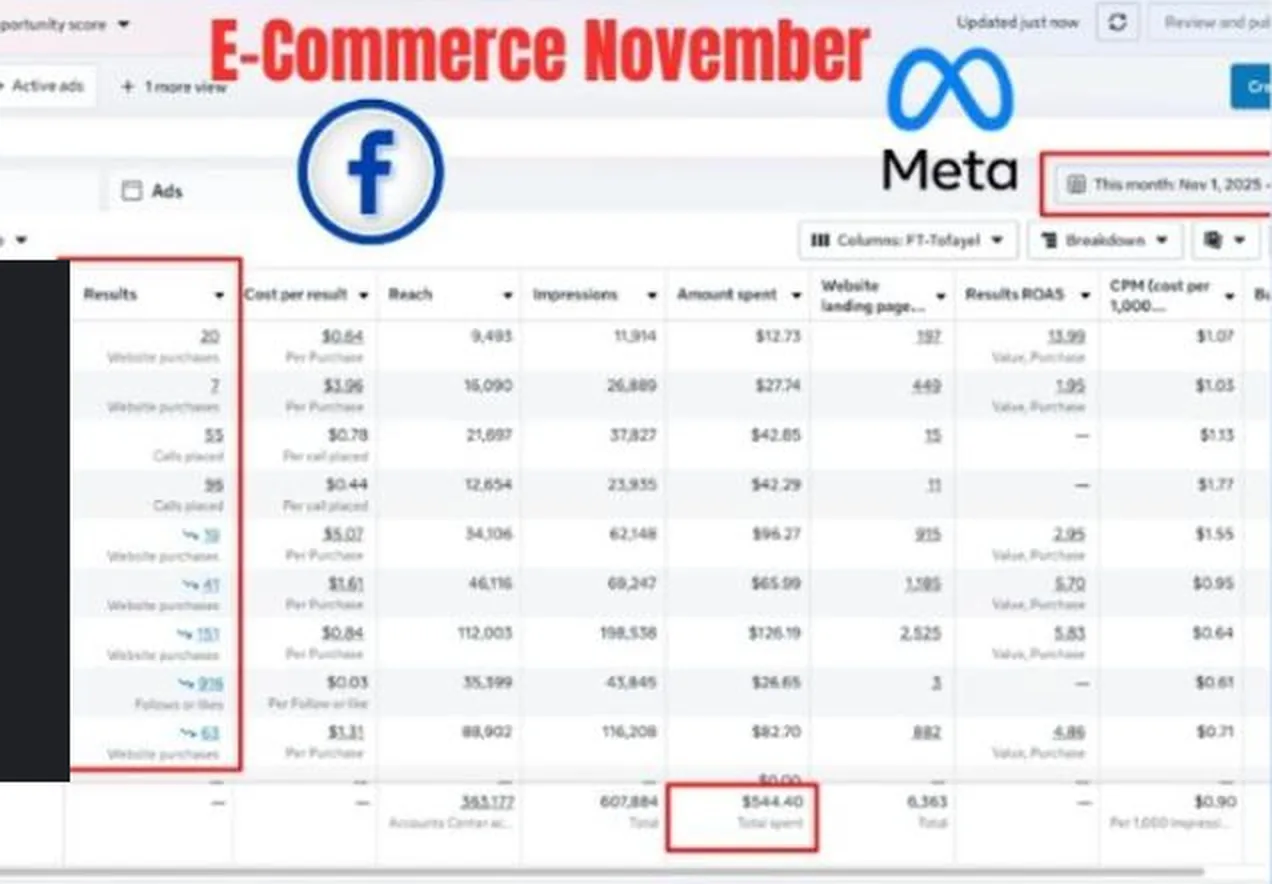
Meta Ads · Mixed objectives
6,363 results from $544 of ad spend
Purchases, phone calls and page growth in one account. Why reading it as one number will make you cut the wrong campaign.
Read the full case study →

SEO · Four accounts
32M search impressions a month across four live accounts
Four Search Console properties in one 28-day window, from 2.1M clicks down to 52. Why impressions without clicks is the most expensive problem in search.
Read the full case study →
Honest note: these accounts are outside the UK, and UK ad costs are usually higher. The methods transfer; the budgets and benchmarks we plan for UK brands are set separately.
Which UK rules affect ecommerce marketing?
The rules that matter most for UK online stores are the Digital Markets, Competition and Consumers Act 2024, the Consumer Contracts Regulations, the ASA CAP Code and UK GDPR with PECR. They decide how you show prices, handle reviews, run promotions and collect emails.
| Rule | What it means for your marketing | What we do about it |
|---|---|---|
| DMCCA 2024: drip pricing | Since 6 April 2025, the headline price must include mandatory fees. Fees added late in checkout can be treated as unfair. | We check that ads, product pages and landing pages show the full price people will pay. |
| DMCCA 2024: fake reviews | Fake reviews and concealed incentivised reviews are banned practices. The CMA can fine up to 10% of global turnover. | Review requests go to every customer, with no incentive and no filtering. |
| Consumer Contracts Regulations 2013 | Online shoppers usually have 14 days to cancel after delivery. | Returns information is clear on product pages and in ads that mention guarantees. |
| ASA CAP Code | Claims such as “best”, “cheapest” or “sale” prices must be accurate and provable. | We keep evidence for every claim and avoid fake countdown timers. |
| UK GDPR and PECR | Marketing emails need consent, or the soft opt-in for existing customers. Non-essential cookies need consent. | Tracking is set up to respect your cookie banner, and email capture records consent properly. |
This is a practical summary, not legal advice. For anything specific to your business, check with your regulator or a solicitor.
How do we start with a DTC brand?
In the first 30 days we fix tracking, find where profit is leaking, and launch one focused test, so every later decision is based on numbers you can trust.
Audit
Ads, tracking, product pages and margins reviewed against real orders.
Fix tracking
Pixel, Conversions API and GA4 checked so platforms learn from real purchases.
Quick wins
The two or three changes most likely to lift profit in weeks, not months.
Test
A structured creative and offer test on the channel with the most headroom.
Scale
Budget moves to what is profitable, and a second channel is added.
Ecommerce & DTC marketing questions
What is a DTC marketing agency?
A DTC (direct-to-consumer) marketing agency helps brands that sell their own products straight to customers, usually through their own online store. The focus is on paid social, Google Shopping, email and SEO that bring profitable first orders and repeat customers.
How much should a UK DTC brand spend on ads?
There is no single figure. As a rule of thumb, Meta Ads needs enough budget to get roughly 50 purchases a week per ad set to optimise well. We work out a starting budget from your average order value, margin and break-even ROAS.
Is ROAS the right number to judge success?
Only partly. Platform ROAS can over-count sales and ignores product costs and delivery. We judge success on contribution margin, the cost of a new customer and repeat purchase rate.
Should I start with Meta Ads or Google Shopping?
If people already search for your product, start with Google Shopping. If you are creating demand for something new or visual, start with Meta Ads. Most growing brands need both within a few months.
Do you work with Shopify and WooCommerce?
Yes, both. We set up tracking, product feeds and SEO on either platform.
About the author
I am Abdul Kader Zilani, a digital marketing consultant working with UK ecommerce brands and service businesses. I run the paid media myself and deliver search and web work with a small team I have worked with for years. I also run my own direct-to-consumer brands, which means I spend my own money in the same auctions and on the same search results I work on for clients. Every figure in our case studies comes with the platform screenshot behind it.
Ready to grow your store profitably?
Book a free 30-minute call. We will look at your ads, tracking and margins and tell you where the next profit is most likely to come from.
Free 30-minute call. No obligation, no hard sell.