Break-Even ROAS: How to Calculate It (With Examples)
 By Abdul Kader Zilani
·
· Updated 10 Nov 2026 · 4 min read
If you run Meta Ads or Google Ads for an online store, there’s one number you need before you look at any campaign report: your break-even ROAS. Without it, a “3x ROAS” could mean healthy profit — or a business quietly losing money on every order.
This guide explains what break-even ROAS is, how to calculate it step by step, and how to turn it into a realistic target for your campaigns.
What is break-even ROAS?
ROAS (return on ad spend) is revenue divided by ad spend. A ROAS of 3 means £3 of revenue for every £1 spent on ads.
Break-even ROAS is the ROAS at which your ads pay for themselves exactly — no profit, no loss — once product costs, shipping and fees are taken into account. Anything above it is profitable; anything below it costs you money.
The formula
Break-even ROAS depends on your contribution margin: the share of each sale left after the variable costs of that order, before advertising.
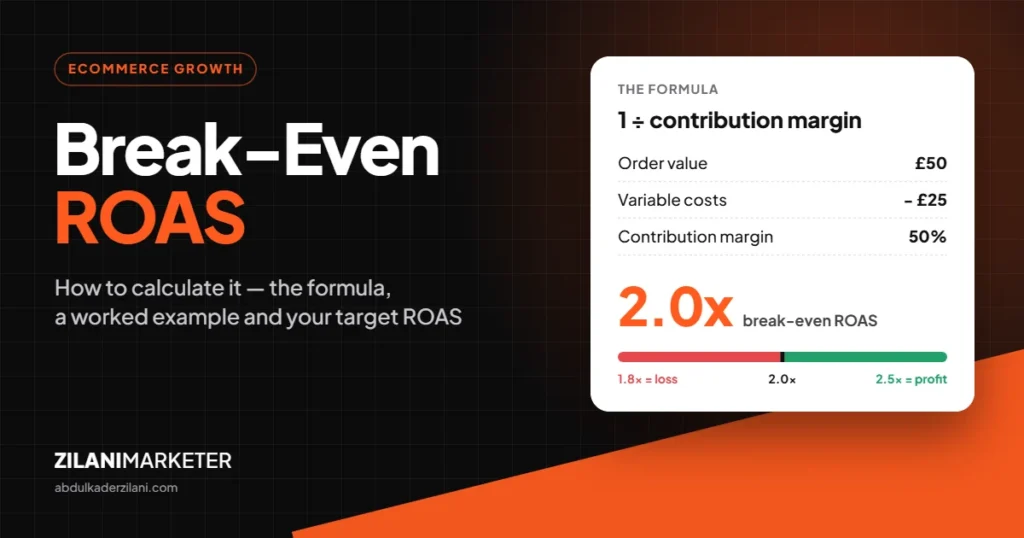
Break-even ROAS = 1 ÷ contribution margin (as a decimal)
So a 50% margin gives a break-even ROAS of 1 ÷ 0.50 = 2.0. A 25% margin gives 1 ÷ 0.25 = 4.0. The thinner your margin, the higher the ROAS you need just to stand still.
Step-by-step example
Say you sell a product for £50 (excluding VAT). For each order you pay:
| Cost per order | Amount |
|---|---|
| Product cost (COGS) | £18 |
| Shipping & packaging | £5 |
| Payment & platform fees | £2 |
| Total variable cost | £25 |
- Contribution per order: £50 − £25 = £25
- Contribution margin: £25 ÷ £50 = 50%
- Break-even ROAS: 1 ÷ 0.50 = 2.0
- Break-even CPA: £25 — the most you can pay in ad spend per order before losing money
In this example, a campaign at 1.8x ROAS loses money on every sale, while one at 2.5x is profitable — even though both might look “fine” in an ad dashboard.
From break-even to target ROAS
Break-even is the floor, not the goal. To build in profit, decide what profit margin you want to keep after ad spend and subtract it from your contribution margin:
Target ROAS = 1 ÷ (contribution margin − target profit margin)
With a 50% contribution margin and a 15% profit target: 1 ÷ (0.50 − 0.15) = 2.86. That’s the ROAS your campaigns need to hit for each order to keep 15% profit.
Four things that change the picture
1. Returns and refunds
If 10% of orders are returned, your real revenue per order is lower than the platform reports. Fashion brands in particular should factor return rates into their margin before calculating break-even.
2. Discounts
A 20% discount code doesn’t just cut revenue — it cuts your margin and raises your break-even ROAS. Recalculate whenever you run promotions.
3. Repeat purchases
If customers typically buy again, you may be able to accept a lower first-order ROAS. But only do this when you have reliable data on repeat rate and lifetime value — not as a hopeful assumption.
4. Tracking accuracy
Platform-reported ROAS is only as accurate as your conversion tracking. Missing purchase events make ROAS look worse; duplicate events make it look better than it is. Before trusting any ROAS figure, check that your Meta Pixel and Conversions API are set up and deduplicated correctly, and compare platform revenue against your store’s actual sales.
Use blended numbers as a sense check
Ad platforms each claim credit for sales, and their totals often add up to more than your real revenue. A useful sense check is MER (marketing efficiency ratio): total store revenue ÷ total marketing spend across all channels. If platform ROAS looks great but MER keeps falling, something in the attribution needs a closer look.
Calculate yours in seconds
You can work out your break-even ROAS, break-even CPA and maximum ad spend with the free break-even calculator. Enter your average order value, product cost percentage and fixed costs, and it does the maths for you.
Key takeaways
- Break-even ROAS = 1 ÷ contribution margin.
- Your target ROAS should include the profit you want to keep, not just break even.
- Returns, discounts and tracking errors all shift the real number.
- Check platform ROAS against blended MER and your actual store revenue.
Not sure what ROAS your Meta or Google campaigns should be aiming for? Get a free consultation and I’ll help you work out a realistic target from your own numbers.