AI Search Optimisation for UK Small Businesses: Getting Found in ChatGPT, Gemini and Google AI Overviews
 By Priotum Dhar
·
· 9 min read
Customers are starting to ask ChatGPT, Gemini and Google’s AI Overviews questions they used to type into a normal search box: “best emergency plumber in Leeds”, “is a private GP worth it”, “which accountant handles limited companies near me”. If your business is not in those answers, you may never know you were left out.
The good news for small businesses is that AI search optimisation is mostly not a new dark art. The official guidance from Google and OpenAI points to the same basics that already win local and organic search, plus a few technical checks that many small sites get wrong. This guide sets out what actually matters, what to ignore, and how to measure it without fooling yourself.
AI search optimisation for a small business means four things: let the right bots crawl your site, publish clear pages that answer what customers ask, build reviews and mentions on trusted third-party sites, and keep your Google Business Profile complete. Google says there are no special requirements or AI text files needed for AI Overviews or AI Mode. Ignore anyone selling secret “AI ranking” tricks.
What AI search optimisation means for a small business
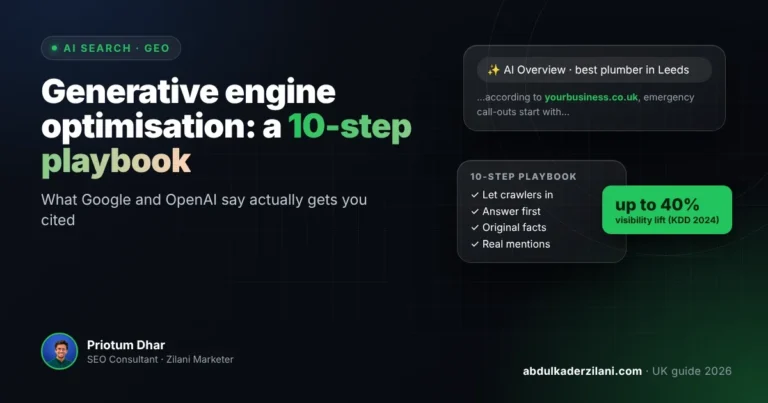
AI search optimisation (also called generative engine optimisation, GEO, or answer engine optimisation, AEO) is the work of making your business easy for AI tools to find, understand and recommend. Our GEO playbook goes step by step for larger sites; this guide is the small-business version.
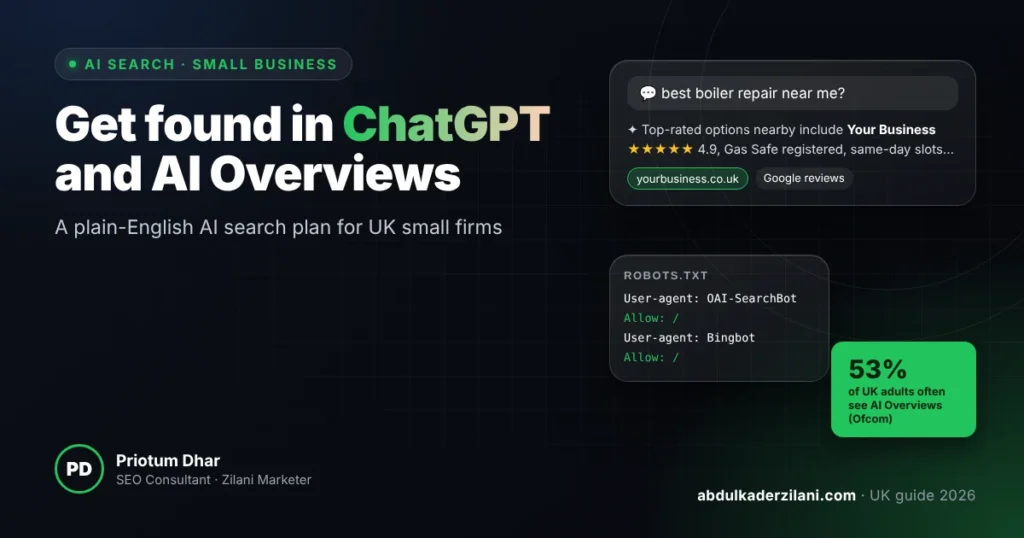
It matters because AI answers are now a normal part of searching in the UK. Ofcom’s Online Nation 2025 report says about 30% of searches now show AI Overviews and that 53% of adults say they see these summaries often. Ofcom also reports ChatGPT had 1.8 billion UK visits in the first eight months of 2025, up from 368 million in the same period of 2024.
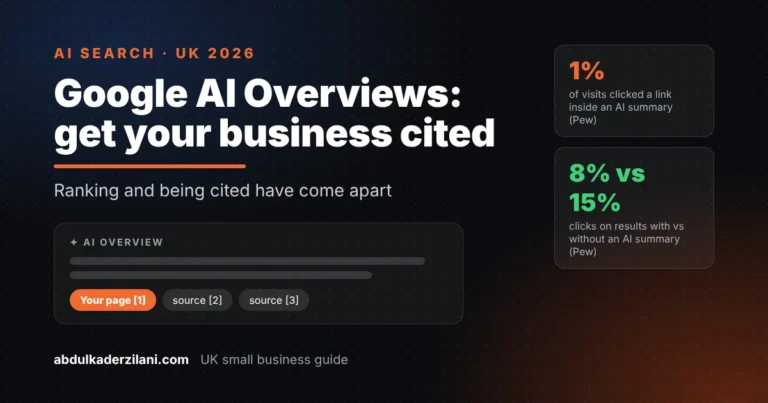
Those answers can reduce clicks. Pew Research found in a US study, reported by The Register in July 2025, that users clicked a traditional result 8% of the time when an AI summary appeared, against 15% when it did not. So the goal is not only traffic: it is being the business named in the answer. We looked at the click side in more detail in our post on Google AI Overviews.
How AI search tools choose which businesses to mention
Each tool works differently, but they share a pattern: they search the web (or their own index), pull several sources, and write an answer from them.
| Tool | Where it gets web information | What that means for you |
|---|---|---|
| Google AI Overviews and AI Mode | Google’s own search index, using a “query fan-out” that runs several related searches across subtopics | Normal Google SEO and your Business Profile matter most |
| ChatGPT search | OpenAI’s OAI-SearchBot crawler and third-party search providers | Your site must not block OAI-SearchBot |
| Gemini | Google Search grounding | Same foundations as Google Search |
| Microsoft Copilot | Bing’s web index | Verify your site in Bing Webmaster Tools and check it is indexed |
Google’s documentation describes query fan-out as issuing multiple related searches across subtopics and data sources. In practice, a question like “best physio near me for a running injury” may trigger searches about physios in your area, reviews, sports injury treatment and prices. A business with a clear page for each of those sub-questions has more chances to be pulled in.
AI search optimisation step 1: make sure the bots can reach you
A common technical problem on small WordPress and Shopify sites is a security plugin, CDN setting or copied robots.txt that blocks AI crawlers without the owner knowing.
| Crawler | Owner | What it does | Should a small business allow it? |
|---|---|---|---|
| Googlebot | Crawls for Search, including AI Overviews and AI Mode | Yes, always | |
| Google-Extended | Controls use for training and grounding in other Google AI systems, not Search ranking | Your choice; blocking it does not remove you from Search | |
| OAI-SearchBot | OpenAI | Finds pages to show in ChatGPT search | Yes, if you want to appear in ChatGPT answers |
| GPTBot | OpenAI | Collects content that may be used to train OpenAI models | Your choice; OpenAI says this setting is independent of search |
| Bingbot | Microsoft | Crawls for Bing, which feeds Copilot | Yes |
OpenAI’s crawler documentation says sites that opt out of OAI-SearchBot will not be shown in ChatGPT search answers, and that it can take around 24 hours after a robots.txt update for its systems to adjust. It also says each bot setting is independent, so you can allow OAI-SearchBot for search while blocking GPTBot for training.
To check, open yourdomain.co.uk/robots.txt and look for Disallow: / under any of the user agents above. Then check your firewall or CDN (Cloudflare, for example, has AI-bot blocking options) and any WordPress security plugin settings.
Clear service pages: the core of AI search optimisation
AI tools can only recommend you for things your website clearly says you do. Vague pages like “Our Services” with one paragraph each give them little to work with.
For each main service, a strong page has:
- A plain heading that matches how customers ask, for example “Boiler repair in Bristol” rather than “Heating solutions”.
- A direct answer near the top: what you do, for whom, where, and roughly how it works.
- Specifics a customer would ask about: areas covered, opening hours, how pricing works, how fast you can come out, qualifications or registrations.
- A short FAQ section using the questions customers actually ask you on the phone.
- Your business name, address and phone number matching your Google Business Profile exactly.
Google’s own guidance on AI search says to focus on “unique, non-commodity content” that people find helpful. It also warns that creating separate pages for every query variation mainly to manipulate rankings or AI answers breaks its scaled content abuse policy. So one strong page per real service beats fifty thin location pages.
If you need a starting point for which pages to build first, our small business SEO guide sets out the priority order.
Reviews, listings and mentions beyond your website
AI answers often draw on what other sites say about you, not just what you say about yourself. For a local business that means:
- Google Business Profile: complete categories, services, hours, photos and regular genuine reviews. Google ranks local results on relevance, distance and prominence. Our guide to getting your business on Google covers setup.
- Industry and local directories that customers actually use, with consistent details.
- Genuine reviews on Google and relevant platforms. Do not buy or fake them: fake reviews and undisclosed incentivised reviews have been unlawful in the UK since 6 April 2025 under the Digital Markets, Competition and Consumers Act 2024.
- Local press, trade bodies and partners that mention you by name, for example a supplier’s “find an installer” page or a local business award.
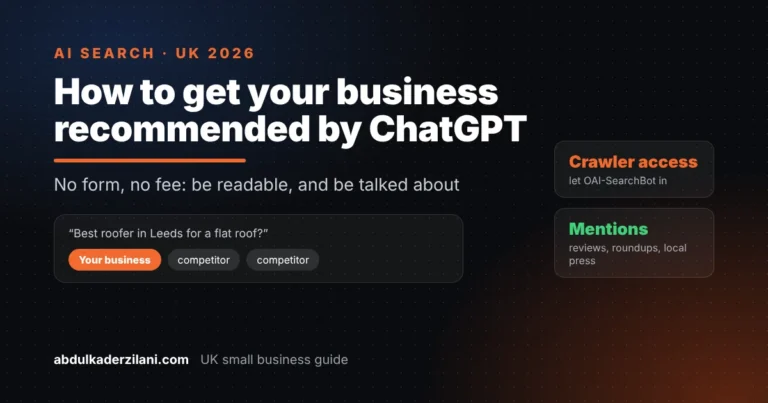
Our post on getting recommended by ChatGPT goes deeper into third-party mentions for ChatGPT specifically.
What to ignore: AI search optimisation myths
There is a lot of hype in this space. These are the claims Google’s own documentation directly contradicts.
| Claim you may hear | What the official guidance says |
|---|---|
| “You need an llms.txt file to appear in AI answers” | Google says you do not need to create new machine-readable files or AI text files, and its AI optimisation guide says Google Search does not use llms.txt |
| “You need special AI schema” | Google says there is no special schema.org structured data needed for AI features; normal structured data should match visible content |
| “Chop your content into short chunks for AI” | Google’s AI optimisation guide says there is no ideal page length and discourages rewriting content just for AI |
| “We can guarantee you appear in ChatGPT” | No one controls AI answers; be wary of tools or providers promising specific placements |
| “AI search replaces SEO” | Google says optimising for generative AI search is still SEO |
Structured data such as LocalBusiness and FAQ markup is still useful for normal search features. Just do not pay for it as an “AI hack”.
Measuring AI search optimisation honestly
Measurement is the weak spot, and anyone who claims precise “AI visibility scores” for a small business is overselling.
What you can do:
- Google Search Console: Google says traffic from AI features is included in the Performance report under the “Web” search type. You cannot separate it neatly, but you can watch impressions and clicks for your service queries.
- Analytics referrals: in GA4, look for referral traffic from chatgpt.com, perplexity.ai, copilot.microsoft.com and gemini.google.com.
- Manual spot checks: once a month, ask ChatGPT, Gemini and Google the five questions your customers ask most, in a private browser window, and note whether you appear and what is said.
- Ask new customers how they found you, and add “ChatGPT or AI assistant” as an option on your enquiry form.
AI answers vary from one user and moment to the next, so treat spot checks as a trend over months, not a score.
A 30-day AI search optimisation plan for a small site
| Week | Task | Time needed (our estimate) |
|---|---|---|
| 1 | Check robots.txt, CDN and security plugin for blocked bots; verify Bing Webmaster Tools | 1 to 2 hours |
| 1 | Run the five-question spot check and record results | 1 hour |
| 2 | Rewrite your top 3 service pages with direct answers, specifics and FAQs | 4 to 8 hours |
| 3 | Complete your Google Business Profile; set up a simple review request after each job | 2 to 3 hours |
| 4 | Fix inconsistent details on the main directories; list one or two partner or trade-body mentions to pursue | 2 to 4 hours |
After the first month, keep adding reviews, refresh service pages when prices or services change, and repeat the spot check monthly.
Frequently asked questions
What is AI search optimisation?
It is making your business easy for AI tools such as ChatGPT, Gemini, Copilot and Google AI Overviews to find, understand and recommend. It overlaps heavily with SEO and local SEO.
Do I need an llms.txt file?
Not for Google. Google says you do not need AI text files to appear in AI Overviews or AI Mode, and that Google Search does not use llms.txt.
Will blocking GPTBot remove me from ChatGPT?
No. OpenAI says GPTBot (training) and OAI-SearchBot (search) are controlled separately. To appear in ChatGPT search, do not block OAI-SearchBot.
Can I see how much traffic comes from AI Overviews?
Not separately in most cases. Google includes AI feature traffic in the Search Console Performance report under the Web search type. ChatGPT and other assistants show up as referrals in analytics.
Is AI search optimisation different from local SEO?
For a local business, most of the work is the same: a complete Google Business Profile, genuine reviews, clear service pages and consistent listings. The extra steps are checking AI crawler access and testing AI answers.
How long does AI search optimisation take to work?
Technical fixes like unblocking OAI-SearchBot can take effect within days; OpenAI mentions about 24 hours for robots.txt changes. Reviews, mentions and stronger pages usually take months to show in answers.
The bottom line
AI search optimisation for a small business is mostly good SEO done properly, plus making sure you are not accidentally blocking the bots that feed ChatGPT and Copilot. Clear service pages, a complete Google Business Profile, genuine reviews and real third-party mentions will do more than any AI trick.
If you want help, see our generative engine optimisation service or our answer engine optimisation service. Or book a strategy call and we will check your bot access and run the five-question test with you.
Sources
- Google Search Central: AI features and your website
- Google Search Central: Optimizing your website for generative AI features on Google Search
- Google Search Central blog: Top ways to ensure your content performs well in Google’s AI experiences on Search (May 2025)
- OpenAI: Overview of OpenAI crawlers
- Ofcom: From apps to AI search, how the UK goes online in 2025
- The Register: Google AI Overviews suppress clicks, Pew study (July 2025)
- Google Business Profile Help: How Google determines local ranking
- Bing Webmaster Tools
- Digital Markets, Competition and Consumers Act 2024 (legislation.gov.uk)