How to Scale an Ecommerce Brand to $1M a Month (Meta Ads Case Study)
 By Abdul Kader Zilani
·
· Updated 13 Nov 2026 · 6 min read
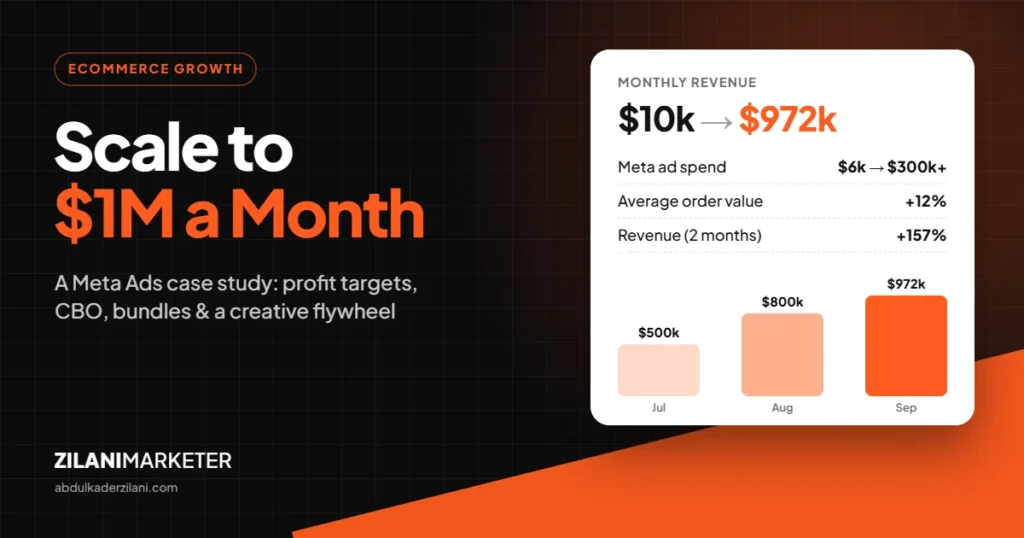
Scaling an ecommerce brand from almost nothing to nearly $1 million in monthly revenue is rarely about one clever ad. In this case study, a direct-to-consumer brand went from under $10,000 a month in sales to around $972,000 a month by combining a profit-based ROAS target, a new CBO campaign structure, better bundle merchandising, a creative testing flywheel and an aggressive peak-season push.
Below is a step-by-step breakdown of what changed, the numbers behind each step, and how you can apply the same principles to your own Shopify or WooCommerce store — whatever your budget.
- Set a target based on profit, not the highest possible ROAS.
- Launch a new structure alongside existing campaigns instead of switching them off.
- Small merchandising changes (like visible bundles) can lift AOV and revenue fast.
- A repeatable creative testing process beats making ads from scratch.
- Pause to protect margin, then scale hardest when demand peaks.
The results at a glance
| Metric | Before | After |
|---|---|---|
| Monthly sales | Under $10,000 | ~$972,000 (September) |
| Monthly Meta ad spend | Up to $6,000 | Over $300,000 |
| Platform ROAS | Often below 1x | Managed against a 2x revenue-to-spend target |
| Average order value | Baseline | +12% |
| Revenue over a two-month period | ~$172,000 | ~$444,000 (+157%) |
Figures are as reported for this brand. Results depend on product, margin, market and execution — treat them as a framework, not a promise.
Where did the brand start?
The business was stuck. Facebook and Instagram campaigns often returned less than $1 for every $1 spent, monthly ad spend never went above $6,000, and total sales struggled to pass $10,000 a month. Spending more simply meant losing more, so the brand could not scale.
Step 1: Set a profitability target instead of chasing ROAS
The first change was strategic. Instead of trying to hit the highest possible ROAS, the team aligned advertising with real business profitability and set a 2x revenue-to-ad-spend target based on the overall numbers of the business.
This matters because a high ROAS on a tiny budget can produce less profit than a slightly lower ROAS on a much larger one. If you have not worked out your own floor yet, start with how to calculate break-even ROAS or use the free break-even ROAS calculator.
Step 2: Launch a new CBO structure without switching off what works
Next, a new Campaign Budget Optimisation (CBO) structure was introduced — but the existing campaigns were left running. Running both side by side meant the team could test new creatives and push budget into winning ads while protecting the revenue already coming in.
Over comparable two-month periods, ad spend rose from about $48,000 to $106,000. Platform ROAS dipped slightly from 1.8x to 1.6x, but the business generated significantly more revenue and more contribution profit. That is the trade-off most brands miss: a small drop in ROAS is fine if total profit grows.
Step 3: Make bundles easy to find to raise average order value
One of the biggest wins had nothing to do with ads. The brand already sold product bundles, but they were hidden near the bottom of the third page of a collection. Very few shoppers ever saw them.
Moving the bundle offers to prominent positions on the homepage and collection pages made them easy to discover. Without launching a single new product, average order value rose by around 12% and revenue grew from roughly $172,000 to nearly $444,000 over two months — a 157% increase.
Higher AOV also changes the maths of advertising: every customer is worth more, so you can afford to pay more to acquire them and still stay profitable.
Step 4: Build a creative testing flywheel
Instead of constantly creating ads from scratch, the team built a repeatable process around what was already working:
- Analyse the current winning creatives to understand why they perform.
- Test new headlines and opening hooks on those winners.
- Identify the messaging angles that consistently convert.
- Turn those insights into new image and video ads.
- Feed the new winners back into step one.
Each cycle produces better-informed ads, so performance improves over time rather than depending on lucky one-off hits.
Step 5: Hold steady at $500k a month to protect margin
At around $500,000 in monthly revenue, the focus shifted from growth at any cost to protecting profitability. Rather than forcing bigger numbers every month, the brand used this period to secure its margins, strengthen operations and prepare for peak season.
Step 6: Scale aggressively into peak season
When peak season arrived, the brand increased ad investment hard. With a stronger campaign structure, higher AOV and better creatives in place, demand was turned into revenue efficiently:
| Month | Shopify revenue |
|---|---|
| July | ~$500,000 |
| August | ~$800,000 |
| September | ~$972,000 |
Monthly revenue almost doubled in two months, while Meta ad spend eventually passed $300,000 a month.
Step 7: Look beyond first-purchase ROAS
The brand also saw customer lifetime value (LTV) improve, helped by higher order values and repeat purchases. Judging every campaign only on first-purchase ROAS would have hidden this. A complete acquisition and retention strategy — including email and repeat-purchase offers — is what made the growth sustainable.
What can smaller ecommerce brands learn from this?
You do not need a six-figure ad budget to use the same principles. If you are spending $1,000–$10,000 a month on Meta Ads, start here:
- Know your numbers: calculate break-even and target ROAS from your real margins.
- Fix tracking first: make sure Meta Pixel and Conversions API report purchases accurately, or scaling decisions will be based on bad data.
- Test new structures alongside old ones rather than switching everything off at once.
- Audit your store for hidden offers: bundles, upsells and free-shipping thresholds that shoppers cannot easily see.
- Create a weekly creative testing routine built on your current winners.
- Plan your peak season months in advance so you can scale when demand is highest.
Frequently asked questions
How do you scale an ecommerce brand with Meta Ads?
Set a profit-based target first, then increase budget through a structure that lets you test new creatives without switching off what already sells. Raise average order value with bundles, keep a steady creative testing process, and judge success on total revenue and contribution profit rather than platform ROAS alone.
Is a lower ROAS ever better when scaling?
Yes. In this case study platform ROAS fell from 1.8x to 1.6x while ad spend more than doubled, yet total revenue and contribution profit grew. A slightly lower ROAS on a much bigger budget can produce more profit, as long as it stays above your break-even point.
What is a good ROAS target for scaling?
There is no universal number. Work out your break-even ROAS from your contribution margin, then add the profit you want to keep. This brand used a 2x revenue-to-ad-spend target based on its overall business numbers, not a target copied from someone else.
How do bundles increase average order value?
Bundles give shoppers a reason to buy more in one order. Here the bundles already existed but were buried on the third page of a collection. Moving them to the homepage and the top of collection pages lifted average order value by around 12% without any new products.
When should you stop pushing growth?
When growth starts to squeeze margin or operations. After reaching about $500,000 a month, this brand held spend steady to protect profit, then scaled hard again in peak season when demand and conversion rates were naturally higher.
Want help scaling your store?
If your ads are stuck at the same spend level or your ROAS falls every time you increase budget, the fix is usually a combination of targets, structure, offer and tracking — not just more ad spend. Book a free consultation and I will review your store and campaigns and show you the first priorities worth fixing, or explore my Meta Ads management and ecommerce marketing services.