Meta Andromeda Update 2026: What Changed for Advertisers
 By Abdul Kader Zilani
·
· Updated 23 Nov 2026 · 17 min read
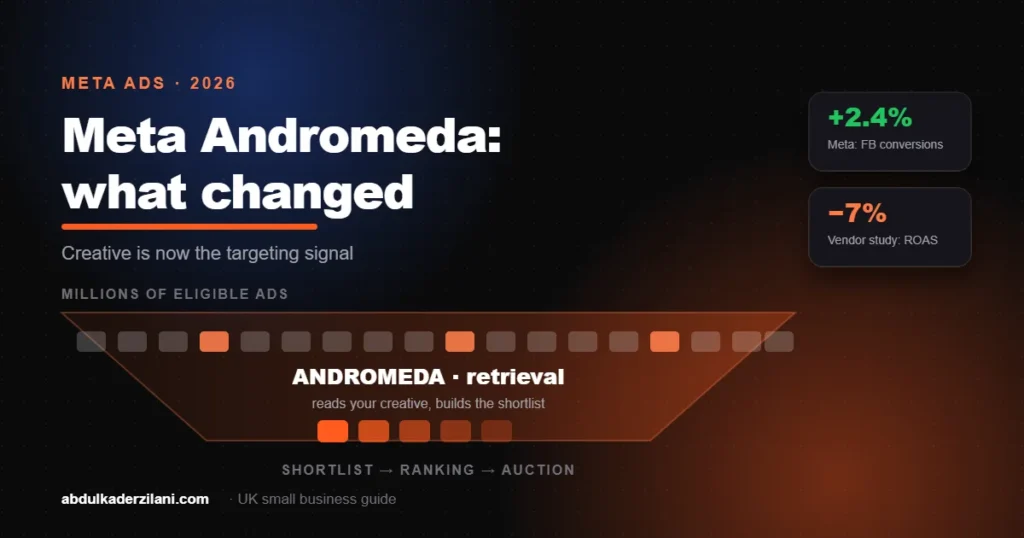
Your best ad stopped working. Your cost per purchase doubled. Someone on LinkedIn told you it was Andromeda. Meanwhile Meta says Andromeda has delivered a 2.4% increase in conversions on Facebook since 2025, and the largest independent dataset of the period found average advertiser ROAS down 7%.
Both of those numbers can be true at the same time, and understanding why is the difference between fixing your account and rebuilding it for nothing. This guide explains what Andromeda actually is, what Meta has and has not said about it, and what a UK small business should do on a realistic budget. Every figure below is labelled with its source, because most of the numbers circulating about Andromeda are agency rules of thumb being passed off as Meta rules.
- Andromeda is not a campaign type, a setting or a one-off update. It is the retrieval stage of ad delivery, and it runs for every advertiser.
- Creative is now a targeting signal. Andromeda reads what is in your ad and matches it to people, so ten near-identical ads buy roughly one chance at delivery.
- Meta publishes no creative quota. There is no required number of ads, no weekly minimum and no similarity threshold. Those numbers come from agencies and vendors.
- If your ROAS fell in March 2026, check attribution first. Meta changed how clicks are counted; rebuilding your account will only reset learning.
- On £25 to £50 a day, three to five genuinely different ads beats twenty near-copies. Budget, not ambition, decides how much you can test.
What is Meta Andromeda, in plain English?
Meta Andromeda is Meta’s personalised ads retrieval engine. When someone opens Facebook or Instagram, tens of millions of ads are technically eligible to be shown to them. Andromeda is the stage that narrows that pool down to a shortlist of a few thousand before anything else happens.
It does not decide who wins the auction. It decides who gets to compete. If your ad never makes the shortlist for a person, your bid, your offer and your landing page never get a chance to matter for that impression.
How a Meta ad actually reaches someone
| Stage | What happens |
|---|---|
| 1. Eligibility | Your targeting rules, budget, schedule and policy status decide whether the ad can be shown to this person at all. |
| 2. Retrieval (Andromeda) | A fast model picks a shortlist of a few thousand ads most likely to be relevant to this person. |
| 3. Ranking | Larger models predict how likely this person is to take the action you optimise for, plus ad quality. |
| 4. Auction | Bid, predicted action rate and quality decide the winner. |
The practical shift Meta states in its own words is a move from niche targeting to creative diversification as the best lever for finding relevant audiences (Meta for Business, April 2025). In December 2025 Meta clarified what that means in practice: ads that look or feel alike are treated as variations of the same creative. Changing a headline colour or a call-to-action does not give you a second entry.
The Andromeda timeline: December 2024 to October 2026
There was never an “Andromeda launch day” for advertisers. It arrived gradually, and the most recent engineering post describes a system that was already running in production.
| Date | What happened |
|---|---|
| 2 Dec 2024 | Andromeda introduced as the next-generation personalised ads retrieval engine behind Advantage+ automation. Meta reported a 10,000x increase in retrieval model capacity, +6% recall and +8% ads quality on selected segments. Meta self-reported |
| 22 Apr 2025 | Meta states the focus has shifted from niche targeting to creative diversification. |
| Oct 2025 | Global rollout completed, according to vendor rollout tracking. Vendor |
| 16 Dec 2025 | Meta clarifies that ads which look or feel alike count as variations of one creative. |
| 13 Oct 2026 | GEM 2026 generation published: +18.9% conversions and +12% CTR across surfaces. Meta self-reported |
| 21 Oct 2026 | Q3 2026 earnings: Andromeda improvements credited with +1.4% Facebook conversions in the quarter. Meta self-reported |
| 28 Oct 2026 | Next-generation Andromeda described: over one billion ads scored per second on a single GPU server, roughly 100x the 2024 system, around 300x fewer inference FLOPs, and +2.4% conversions on Facebook since 2025. Meta self-reported |
Two things worth noting. Meta does not use the name “Andromeda 2.0”; that label comes from practitioners. And the October 2026 post is an engineering paper with no advertiser advice and no new Ads Manager setting in it.
Andromeda vs GEM vs Lattice vs Advantage+
Most posts about Andromeda blur these together, which is why the advice in them contradicts itself. They do different jobs.
| System | Job | What it means for you |
|---|---|---|
| Andromeda | Retrieval | Builds the shortlist. Reads your creative and matches it to people. |
| GEM | Ranking | Meta’s largest ads model. Too big to serve ads directly, so it teaches the smaller models that do. |
| Lattice | Ranking architecture | Published in 2023, not a 2026 change. Replaced hundreds of siloed models with one. |
| GenRecs | Understanding | Reads your ad’s images and text into shared meaning tokens: brand, colour, style, use case. |
| Advantage+ | Campaign automation | The settings layer you actually touch. Not a model. It sits on top of the systems above. |
What actually changed for advertisers
The short version: creative became a targeting signal. Andromeda reads the visuals, the hook, the copy tone, the product context and who appears on screen, then matches that to individuals. A founder video and a product screenshot will reach different people inside the same broad ad set.
That is why “creative is the new targeting” is mostly true. It is not entirely true: the October 2026 engineering post confirms advertiser targeting rules are still enforced inside retrieval, with index matching moved onto the GPU alongside scoring. Targeting is now a boundary rather than a precision tool.
What stopped working
- One winning ad running for months. Effective creative lifespan compressed from roughly six to eight weeks down to two to four weeks. Vendor study
- Narrow interest stacking across many tiny ad sets. Each small ad set starves the system of conversion signal, and none of them exit the learning phase.
- Near-duplicate testing. A new headline colour or crop is a variation of the same creative, and learnings are shared at creative level.
- Sending cold traffic to category pages. Category landing pages fell 24% in ROAS while product pages and homepages improved slightly. Vendor study
- Single-format accounts. Accounts running single image or video only were down 17% in ROAS. Vendor study
- Pixel-only tracking. Weak conversion signal now costs you more than it used to, because the ranking models learn from it.
What works better now
- Consolidated structure. One prospecting campaign per goal, one to three broad ad sets, campaign budget optimisation, Advantage+ placements. Enough budget in one place to clear Meta’s documented floor of roughly 50 optimisation events per ad set per week.
- Advantage+ Sales (renamed from Advantage+ Shopping in February 2025). It allows more than one ad set and no longer caps existing-customer spend for you, so put past customers in their own ad set with a spend cap.
- Broad audiences as the default. Location, minimum age, language and excluded custom audiences are hard limits. Age, gender, interests and lookalikes are suggestions Meta may go beyond.
- Several genuinely different formats. Collection and carousel held up best; single image or video alone did worst. Vendor study
- Retargeting. It stayed relatively stable while prospecting fell 13%, but gutting prospecting to protect retargeting ROAS starves the warm pool within a few months. Vendor study
What Meta says vs what advertisers are experiencing
This is the part most guides skip, and it is the most useful thing on this page.
Meta’s figure: a 2.4% increase in conversions on Facebook since 2025, attributed to the next-generation Andromeda, plus 1.4% in Q3 2026 alone. These are self-reported, platform-wide averages from different scopes and periods, with no published method. They do not add together, and they are not a promise for any individual account.
The independent figure: average advertiser ROAS down 7% across 3,014 ecommerce advertisers and $834m of spend, with landing page conversion rate down 17% and the top performers down 31%. This comes from Confect, a catalogue tooling vendor, and every advertiser in the dataset was one of its users. That is a real limitation, and correlation is not causation.
Both can be true because they measure different things. Meta measures its own system across every advertiser on the platform, including the enormous ones. The vendor study measures revenue for a specific slice of mid-market ecommerce. A platform-wide average of +2.4% is entirely compatible with a lot of individual accounts going backwards.
| Segment | Reported change in ROAS |
|---|---|
| Overall average | −7% |
| Low average order value shops | −35% |
| Mid-priced shops | +19%, the only price segment to improve |
| High-end and luxury shops | −17% |
| Mid-sized advertisers | Improved, the only size segment to do so |
| Category landing pages | −24% |
| Single image or video only | −17% |
Source: Confect, 2025 data, all respondents are catalogue tool users. Treat as directional.
The useful reframe for a UK small business: Andromeda does not simply punish small advertisers. The squeezed ends were very cheap and very expensive products. Mid-priced shops and mid-sized spenders were the only groups that improved. If you sell a £40 to £150 product with a decent margin, the data does not say you are doomed.
The March 2026 attribution change most people blame on Andromeda
Two measurement changes landed in early 2026 and they explain a large share of the “my ROAS collapsed” posts.
- 12 January 2026: the 7-day and 28-day view-through windows stopped being returned from the Ads Insights API.
- 3 March 2026: click-through attribution became link clicks only. Likes, shares, saves, comments and other non-link clicks moved out. Engaged video views moved to a one-day engage-through bucket, with the threshold cut from 10 seconds to 5.
The 2026 default setting is 7-day click, 1-day engage-through, 1-day view. Agencies reported conversions in Ads Manager falling 15% to 40% for view-leaning advertisers and 20% to 35% on remarketing, with backend sales unchanged. Agency reports, not Meta figures.
In plain terms: if your reported ROAS dropped in spring 2026 but your Shopify or GA4 revenue stayed flat, you most likely had a reporting change, not a performance problem.
Diagnose in this order before you change anything
- Tracking. Is the Pixel and Conversions API still firing and deduplicating correctly?
- Attribution. Are you comparing like with like after March 2026?
- Seasonality. Meta’s average price per ad rose 14% year on year in Q3 2026, and Q4 auctions are always more expensive.
- Creative fatigue. Check frequency and CTR per ad, not a general feeling.
- Edits. Frequent significant changes push ad sets back into learning.
- Landing page or offer. Did anything change on the page behind the ad?
Rebuilding the account resets learning and usually makes things worse. Work through the list first.
How to adapt: a UK small business playbook
Eight steps, in this order. Signal comes first, because there is no point feeding better creative into a system that cannot see your conversions.
- Fix tracking before creative. Run the Pixel and the Conversions API together, deduplicated with a shared event ID so Events Manager shows one event from two sources. Watch Event Match Quality: above 7 is a working standard, below 6 is a defect. Optimise for the real event, a purchase or a qualified lead, never PageView. A weak optimisation event teaches the ranking models to find more weak converters.
- Respect UK consent rules. Under UK GDPR and PECR the Pixel cannot fire until a visitor gives consent, and the Conversions API must follow the same decision. Refusals shrink the signal the models learn from, which is a UK-specific reason to prioritise first-party data and server-side tracking over simply making more ads.
- Consolidate. One Advantage+ Sales campaign for prospecting, one broad ad set covering the UK, campaign budget optimisation. Keep retargeting in its own small ad set with its own cap. Keep budget edits under about 20% and infrequent.
- Build concepts, not files. Map four to six concepts to different buying motivations before you produce anything: problem, outcome, proof, comparison, offer, use in context. One concept is one reason to buy, in a distinct visual, hook and format.
- Test in a separate tester campaign. Losers die cheaply and winners get promoted into the main campaign without rebuilding it. If an ad has not performed in week one, it is unlikely to improve. Replace it with something genuinely different, not a tweak.
- Refresh on frequency, not the calendar. Add 7-day frequency and CTR columns per ad. Prospecting frequency above 2.5 is where decline usually begins. Aim to always have at least one ad under 14 days old carrying real spend.
- Send cold traffic to the right page. The product page matching the exact item in the ad, or a homepage with story, social proof and bestsellers. For a service business, a single-offer landing page that matches the ad’s promise, not your services list.
- Judge on backend revenue. Reconcile Meta’s reported purchases against Shopify, GA4 or your CRM weekly. Do not compare this year’s Black Friday ROAS with last year’s: the attribution definitions changed in between.
Steps one and two are where most UK accounts are actually losing money. If you want them checked properly, that is the core of my Meta Ads management work.
How many creatives do you actually need on £25 to £50 a day?
Every guide says “20 diversified ads”. Almost none of them does the arithmetic for a small budget, so here it is.
Meta’s documented learning-phase floor is 50 optimisation events per ad set per week. At a £20 cost per action, that is roughly £143 a day in one ad set to exit learning cleanly. On £25 to £50 a day, which is a realistic UK small business test budget of £750 to £1,500 a month, 50 events takes two to three weeks rather than one. This is arithmetic, not a Meta rule.
Three consequences follow:
- Do not split £30 a day across six ad sets. Nothing learns at £5 each.
- Run three to five genuinely different ads in the main ad set, and introduce one or two new concepts a week.
- Judge over two to three weeks, not three days. A click yesterday and a purchase on Saturday is credited back to yesterday, so this morning’s dashboard is never final.
There is an honest conflict here that other posts tend to hide. Practitioners recommend 10 to 20 creatives per ad set. Meta’s own structure guidance still says no more than five ads per ad set for optimal delivery, and that they should be distinct from each other. The ad set cap is 50. Both camps are describing different budget levels. On £30 a day, follow Meta’s number; the practitioner advice assumes spend that can actually service 20 ads.
If you are not sure what your cost per action needs to be before any of this pays back, work out your break-even ROAS first, or use the free marketing calculators.
Five mistakes that make Andromeda worse
- Rebuilding the whole account after one bad week. You reset learning on everything that was working, and you still have not found the actual cause.
- Refreshing a winner by changing its background colour. Meta treats that as a variation of the same creative. Keep the angle, change the person, the moment or the format instead.
- Turning Advantage+ audience suggestions into hard limits. Lock enough of them and you have effectively switched the automation off.
- Optimising for PageView or cheap form fills. You will get exactly what you asked for: cheap, low-intent actions.
- Comparing 2026 numbers with 2025 without mentioning attribution. The definitions changed in March 2026, so the comparison is not valid.
Andromeda myths, debunked
| Claim you will see online | Verdict |
|---|---|
| “Andromeda 2.0 launched on 28 October 2026” | False as a launch date. That is the date of an engineering post describing a system already in production. Meta does not use the name “2.0” and gave no switch-on date. |
| “You need 50, 20 or 15 ads per ad set” | No such Meta rule. The only published count was at least 20 diversified ads for Advantage+ Shopping in November 2024. Meta’s structure guidance still says no more than five ads per ad set. |
| “Similarity above 60% collapses your ads” | Not a Meta threshold. Meta publishes no similarity score. The 60% figure comes from a third-party tool. Ads Manager’s Creative Diversity label is high, medium or low, estimated, with unpublished thresholds. |
| “Targeting is dead” | False. Targeting rules are still enforced in retrieval. Location, minimum age, language and exclusions remain hard limits; interests and lookalikes became suggestions. |
| “Andromeda is a new campaign type you can switch off” | False. No setting, no toggle, no migration. It runs for every advertiser. |
| “More ads always helps” | False. Fifty near-copies count as roughly one creative entity, so you have paid for production five times over and bought one ticket. |
| “Andromeda punishes small advertisers” | Unproven. Mid-sized advertisers were the only size segment to improve. The squeezed ends were cheap and luxury products, not small budgets. |
| “AI creative tools will handle it” | False. Advantage+ creative generates variations, not concepts. The angle, hook and offer are still your job. |
What Meta ads cost in the UK right now
Almost every Andromeda article uses US dollar benchmarks, which are not much use if you are buying in pounds. These are UK medians from Superads, an ad software company that publishes benchmarks from more than $3bn of ad spend, covering roughly the last 12 months. They are not Meta numbers, so treat them as a guide.
| Metric | UK median |
|---|---|
| CPC | About £1.18 |
| Click-through rate | About 1.59% |
| Cost per lead | About £37.80 |
| Cost per purchase | About £53 |
| Seasonality | Cost per purchase about £36.50 in April 2026 vs £85.50 in December 2025 |
Two UK-specific things to budget for:
- UK Digital Services Tax. Meta adds a 2% location fee on UK ad delivery as a separate invoice line, so your actual spend can exceed your set budget. Check your invoice, not just Ads Manager.
- Q4 auction pressure. In Superads’ UK data, CPM roughly doubled from October to December 2025, and the median cost per purchase in December was more than double the spring low. Launch festive creative before the peak, and never judge a new concept on Black Friday CPMs. Agency benchmarks
One honest caveat on all of this: there is no published UK-specific Andromeda performance study. The ROAS and creative findings above are global or US-weighted. The UK figures here are cost and compliance benchmarks, not UK Andromeda outcomes.
Frequently asked questions
What is the Meta Andromeda update?
Andromeda is Meta’s personalised ads retrieval engine. It is the stage of ad delivery that narrows tens of millions of eligible ads down to a shortlist of a few thousand for each person, before ranking and the auction decide which one is shown. It is not a campaign type or a setting, and it runs for every advertiser automatically.
When did Meta Andromeda launch?
Andromeda was introduced on 2 December 2024 and rolled out globally through 2025, with vendor tracking putting full deployment around October 2025. A next-generation version was described in a Meta engineering post on 28 October 2026, although that post describes a system already in production rather than announcing a launch date. Meta does not use the name “Andromeda 2.0”.
Is targeting dead on Meta ads?
No. Targeting rules are still enforced during retrieval. Location, minimum age, language and excluded custom audiences remain hard limits. What changed is that interests, age, gender and lookalikes now act as suggestions under Advantage+ audience, which Meta may go beyond, and your creative has become the stronger signal for who sees the ad.
How many ad creatives do I need on a small budget?
Meta publishes no required number. On £25 to £50 a day, three to five genuinely different ads in one broad ad set, with one or two new concepts a week, is realistic. The limit is budget: Meta’s learning-phase floor is around 50 optimisation events per ad set per week, so a small budget cannot service 20 ads properly. Different concepts matter far more than more files.
Why did my Facebook ads ROAS drop in March 2026?
Most likely attribution rather than performance. On 3 March 2026 click-through attribution became link clicks only, and engaged video views moved to a one-day bucket. The default became 7-day click, 1-day engage-through, 1-day view. If your reported ROAS fell while your Shopify or GA4 revenue stayed flat, compare like with like on the new setting before changing anything in the account.
Does Andromeda affect Instagram as well as Facebook?
Yes. Andromeda handles retrieval across Meta’s surfaces, including Instagram and Reels. Meta’s published conversion figures focus on Facebook, and no Instagram-specific figure has been shared, so treat the headline percentages as Facebook numbers rather than platform-wide guarantees.
Do I need to change anything in Ads Manager because of Andromeda?
There is nothing to switch on. The practical changes are structural: consolidate into fewer ad sets, make sure the Pixel and Conversions API are both firing and deduplicated, optimise for a real purchase or qualified lead, build genuinely different creative concepts rather than variations, and send cold traffic to a product or single-offer page rather than a category page.
Want this set up properly?
Andromeda rewards two things: a clean conversion signal and genuinely different creative. Most accounts I review are losing money on the first one long before creative is the problem.
If your costs have risen and you are not sure whether it is tracking, attribution, fatigue or structure, book a free consultation and I will review your account and tell you which of the six it actually is. You can also read how I scaled an ecommerce brand with Meta Ads, or see my Meta Ads management and ecommerce marketing services.
Sources
- Engineering at Meta, Meta Andromeda: Powering the Next Generation of Ads Retrieval Through Model-System Co-Design, 28 October 2026.
- Engineering at Meta, Meta Andromeda: Supercharging Advantage+ automation, 2 December 2024.
- Confect, Meta Andromeda: the ultimate guide to Meta Ads in 2026. Vendor study, 3,014 advertisers and $834m of spend, all catalogue tool users.
- Meta for Business: The Creative Advantage (April 2025) and guidance on creative diversification (December 2025). Meta Q3 2026 earnings remarks, 21 October 2026.
- UK cost figures: Superads, Facebook ads benchmarks for the United Kingdom, checked 15 November 2026.
Last reviewed 12 November 2026. Meta’s systems change frequently, so re-check any figure before acting on it.