Small Business SEO in the UK: Where to Start on £500 to £1,000 a Month
 By Priotum Dhar
·
· 8 min read
Most small business owners who ask about SEO have the same two questions: “where do I start?” and “is £500 a month enough?” The honest answer to the second is: it can be, if it is spent on the right things in the right order. Spread thinly across everything, it usually is not.
This guide is for UK small businesses with a modest budget: a local service, a clinic, a trade, a small online shop or a B2B firm. It covers what to do before spending anything, what £500 and £1,000 a month realistically buy, a six-month plan, and how to tell whether it is working.
Start with the free work: a complete Google Business Profile, a site Google can crawl, and one strong page per service. Then spend on the few things that move enquiries: service and location pages, reviews, and local mentions. At £500 a month, focus on one service and one area. At £1,000, you can add steady content and outreach. Expect early movement in weeks and steady enquiries in six to twelve months.
First, the free work (do this before you spend anything)
These cost time, not money, and every paid SEO effort depends on them.
- Claim and complete your Google Business Profile. Google says it ranks local results on relevance, distance and prominence, and that a complete, accurate profile is more likely to show. Fill in every field, choose the right primary category, add your services, opening hours, real photos and the areas you cover.
- Connect Google Search Console. It is free and shows which searches you appear for, which pages Google has indexed and any problems it found.
- Check Google can see your pages. Search
site:yourdomain.co.ukon Google. If important pages are missing, Search Console’s Pages report will usually tell you why. - Write one clear page per service. Not one “Services” page listing everything. A page for each main job you want to be found for, saying what it is, who it is for, where you do it and roughly what it costs.
- Start asking for reviews. Every happy customer, with a direct link. Never buy, write or reward reviews: fake and undisclosed incentivised reviews have been unlawful in the UK since 6 April 2025.
Our step-by-step guide to getting your business on Google covers this in detail.
What £500 to £1,000 a month actually buys
SEO is paid for in time. Whether you hire a freelancer, a consultant or an agency, your monthly fee buys a number of hours of someone’s work. Ask any provider how many hours your fee covers and what they will deliver with them.
As an illustration only, at an hourly rate of £60 to £100:
| Monthly budget | Roughly buys | Realistic focus |
|---|---|---|
| £500 | 5 to 8 hours | One service, one area: fixes, one or two pages, Business Profile and review routine |
| £750 | 7 to 12 hours | Two or three services, monthly content, some local outreach |
| £1,000 | 10 to 16 hours | Several services and areas, steady content, outreach for mentions and links |
Those hours do not stretch. A plan that promises “technical SEO, content, links, local, AI search and reporting” for £500 is either very thin on each item or not doing some of them. Ask for a list of deliverables, not just a price.
Where the money should go (and where it should not)
Spend on:
- Service and location pages that match how customers search: “boiler repair Leeds”, “private physiotherapy Bristol”, “accountant for landlords Manchester”.
- Technical fixes that block pages, such as pages Google cannot index, broken links and very slow mobile pages. Usually a one-off job, not a monthly one.
- Reviews and your Business Profile: a weekly post, new photos and a reply to every review.
- Local mentions and links from places that make sense: your trade association, local business groups, suppliers, local news and sponsorships.
- One genuinely useful article a month answering a question customers actually ask you, with your own prices, photos or examples.
Do not spend on:
- Hundreds of directory listings, link packages or “guaranteed page one” promises.
- Ten thin blog posts a month written to fill a quota.
- Ranking reports on vanity keywords nobody buys from.
- Expensive tools before you have the basics in place.
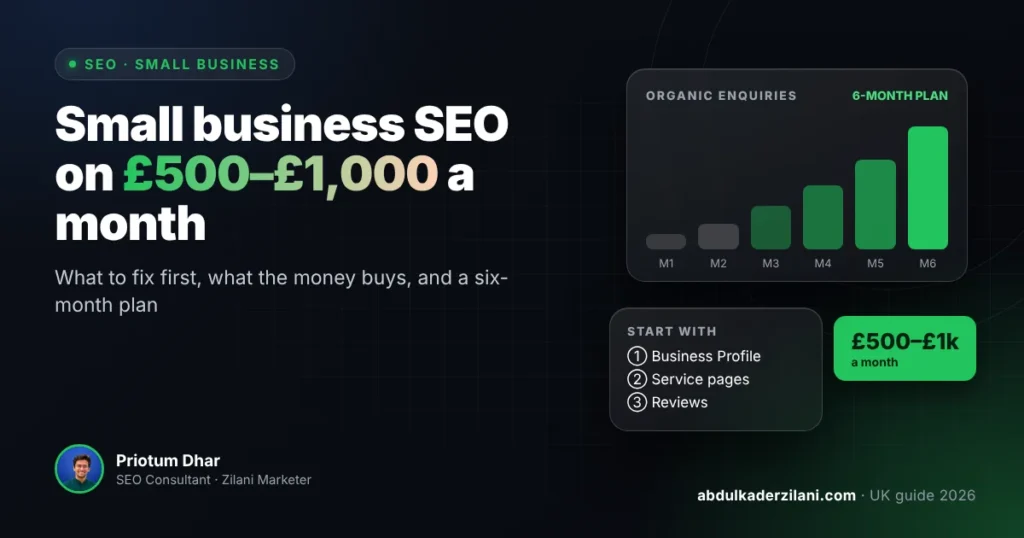
A six-month plan on £500 to £1,000 a month
| Month | Focus | What you should see |
|---|---|---|
| 1 | Fix the basics: Business Profile, Search Console, technical problems, tracking of calls and forms | Pages indexed, profile complete, enquiries tracked |
| 2 | Rewrite or create your most valuable service page; start the weekly review routine | Impressions starting to rise in Search Console |
| 3 | Add a second service or location page; first local mentions | First long-tail searches bringing visits |
| 4 | One helpful article; improve titles on pages with impressions but few clicks | Clicks rising for service-plus-town searches |
| 5 | Third page; more local mentions; refresh photos and posts on your profile | Map pack appearances for nearby searches |
| 6 | Review what is working; double down on the pages that bring enquiries | First steady organic enquiries for some businesses |
Google’s SEO Starter Guide says some changes take effect within hours and others take months, and suggests waiting a few weeks before judging a change. A local business with a complete profile and good service pages can see enquiries sooner; competitive searches take longer.
Local businesses: the map pack comes first
If customers come to you, or you go to them within an area, your Business Profile and the map results usually matter more than ranking an article. Three things help most:
- Relevance: the right categories, services and a description that says plainly what you do.
- Prominence: reviews (how many, how recent, and your replies), mentions on other local sites, and a website that backs up your profile.
- Consistency: the same business name, address and phone number on your website, profile and every listing.
Distance you cannot change, which is why good location pages and a clear service area help you show up across the towns you actually cover.
Online shops and B2B firms
If you sell nationally, the priorities shift:
- Online shops: unique product and category descriptions (not the manufacturer’s copy), fast mobile pages, product details Google can read, and reviews. Category pages often bring more search traffic than individual products.
- B2B services: one page per service and per industry you serve, case studies with real numbers, and articles that answer the questions buyers ask before they call.
AI answers and SEO in 2026
Google now shows AI summaries above many results, and people use ChatGPT to find businesses. In a Pew Research Center study of US browsing, people clicked a traditional result on 8% of visits to a results page with an AI summary, against 15% without one.
For a small business, the response is not a separate budget. It is the same work done well: clear service pages that answer questions directly, consistent details everywhere, and reviews and mentions that show other people vouch for you. See how to get cited in Google AI Overviews and how to get recommended by ChatGPT.
How to tell it is working
Check these monthly, not daily:
- Search Console: impressions and clicks for searches that include your service or town.
- Business Profile: calls, direction requests and website clicks.
- Enquiries: how many calls and forms came from organic search and the map. Ask new customers how they found you.
- Pages indexed: your important pages should all be on Google.
If impressions are rising but enquiries are not, the problem is usually the page (offer, price, trust, how easy it is to contact you) rather than the SEO.
Should you spend on SEO or Google Ads first?
If you need enquiries this month, Google Ads is faster. If you can wait six months or more, or your clicks are expensive, SEO usually wins on cost per enquiry over time. Our guide to SEO vs PPC shows how to decide with your own numbers.
Frequently asked questions
Is £500 a month enough for SEO in the UK?
It can be, if it is focused. £500 typically buys a handful of hours of work a month, which is enough for one service in one area: fixes, one or two strong pages, your Business Profile and a review routine. It is not enough to do everything at once, so be wary of anyone promising that.
How long does SEO take for a small business?
Small fixes and a completed Business Profile can show results within weeks. Most small businesses see steady enquiries from SEO within six to twelve months, sooner for local searches with little competition and longer for competitive national ones.
Can I do SEO myself?
Much of the most valuable work, yes: your Business Profile, reviews, service pages written in your own words and asking local partners to mention you. Technical problems, site structure and outreach are where paid help usually saves the most time.
What should I ask an SEO provider before hiring?
Ask how many hours your fee buys, what will be delivered each month, which pages they will work on first, how they will report enquiries rather than just rankings, and what happens to the work if you leave. Avoid anyone who guarantees rankings or sells link packages.
Do I need a blog for small business SEO?
Not before you have strong service pages. Once you do, one genuinely useful article a month, answering a real customer question with your own examples and prices, is worth more than many short posts.
Does SEO still matter with AI search?
Yes. Google’s AI summaries and ChatGPT both draw on pages they can find and trust. Clear service pages, consistent business details, reviews and mentions help you in normal search results and in AI answers.
The bottom line
On £500 to £1,000 a month, small business SEO works when it is focused: free basics first, then service pages, reviews and local mentions, one area at a time. Judge it on enquiries over six to twelve months, not rankings in week three.
If you would like help planning or doing the work, see our SEO service and local SEO service, or book a free 30-minute call.
Sources
- Google Business Profile Help: How to improve your local ranking on Google
- Google Search Central: SEO Starter Guide
- The Register: Pew study on Google AI summaries and clicks (22 July 2025)
- Digital Markets, Competition and Consumers Act 2024 (fake review rules in force 6 April 2025)