SEO vs PPC: Which Should a UK Small Business Start With?
 By Abdul Kader Zilani
·
· 11 min read
“Should I spend my marketing budget on SEO or Google Ads?” is one of the most common questions a small business owner asks, and most answers end with “do both”. That is no help if you have £500 a month.
The better question is which first, and when to switch. This guide gives you a way to decide in ten minutes, using your own numbers rather than someone else’s averages, then a test-first plan that buys proof before you commit to either channel.
Start with PPC (Google Ads) if you need enquiries in the next few weeks and a paid click is worth less to you than a customer. Start with SEO (and your Google Business Profile) if you can wait six months or more, your clicks are expensive, or you are already busy. Before either, make sure your website and tracking can turn visits into enquiries.
What SEO and PPC actually are
SEO (search engine optimisation) is the work of earning a place in Google’s unpaid results, including the map results for local searches. You do not pay per click; you pay for the work: your time, a freelancer, an agency, tools. A page that ranks keeps bringing visits after the work is done.
PPC (pay per click), for most UK small businesses, means Google Ads search ads. You pay each time someone clicks your ad, you control the budget and keywords, and you can appear the same day your campaign is approved. When you stop paying, the visits stop.
Two corrections worth making early:
- Paying for ads does not improve your organic rankings. Google is clear that its unpaid results cannot be bought, and that there is no way to pay for a better local ranking. Ad data can tell you which keywords to target with SEO, but ad spend does not cause rankings.
- SEO is not free. “Free traffic” means no charge per click. It does not mean no cost. The cost is months of work.
What each one costs a UK small business
| SEO | PPC (Google Ads search) | |
|---|---|---|
| How you pay | Monthly work: your time, a freelancer or an agency | Per click, plus management (yours or someone else’s) |
| Typical click price | Nothing per click once you rank | From under £1 to £50 or more, depending on the industry (see below) |
| Extras on the bill | Content, tools, one-off technical fixes | 2% UK surcharge on ads shown in the UK; VAT if you are not VAT-registered |
| When you stop paying | Rankings fade slowly over months | Visits stop the same day |
Click prices vary hugely by industry. These are Google Keyword Planner’s top-of-page bid ranges for the UK, from our guide to Google Ads costs in the UK:
| Search | Top-of-page bid range (UK) |
|---|---|
| personal injury solicitor | £16.99 to £50.87 |
| accountant near me | £3.91 to £13.94 |
| plumber near me | £1.51 to £9.73 |
| emergency plumber | £5.39 to £28.07 |
| dentist near me | £1.46 to £5.76 |
| wedding photographer | £1.06 to £2.95 |
Source: Google Keyword Planner, United Kingdom, checked November 2026.
A £500 ad budget is not a £500 bill: Google adds a 2% UK surcharge, and a business that is not VAT-registered also pays 20% VAT. The full breakdown is in How much do Google Ads cost in the UK?
SEO prices vary just as widely, from a few hundred pounds a month for a single-location local business to several thousand for competitive national work. Whatever you are quoted, ask for a list of deliverables (pages, fixes, Business Profile work, reporting), not just a monthly price. A cheap retainer is usually a few hours of work a month.
How long each one takes
| Milestone | SEO | PPC |
|---|---|---|
| First sign anything is happening | Weeks: pages indexed, impressions rising, Business Profile views up | Hours to days: ads live once approved |
| First enquiries | Often 3 to 6 months; local service pages can be faster | First week |
| Steady results | Typically 6 to 12 months; longer for competitive searches | 2 to 4 weeks to settle |
| When you stop paying | Results fade over months | Everything stops |
Google’s SEO Starter Guide says some changes take effect within hours and others take months, and suggests waiting a few weeks before judging whether a change worked. Fixing a page title or completing your Business Profile can move things in weeks; ranking for a competitive term takes much longer.
New websites face the steepest climb. In Ahrefs’ study of page age, only a small fraction of new pages reached Google’s top ten within a year, and most top-ranking pages were years old. That is across every page on the web, most of which get no real SEO work. It is not a prediction for a focused local service page, but it is why a brand-new site should not expect to outrank a five-year-old competitor in month two.
AI answers have changed the SEO side
Google now shows AI-written summaries above many results. In a Pew Research Center study of US browsing, people clicked a traditional result on 8% of visits to a results page with an AI summary, against 15% without one.
AI summaries appear far more often on information searches (“how to”, “what is”) than on searches where someone is ready to buy (“emergency plumber Leeds”). So:
- Information content still builds trust and gets you cited in AI answers, but sends fewer clicks than it used to. See how to get your business cited in Google AI Overviews.
- High-intent searches, the ones Google Ads charges for, still show ads and still get clicked.
- For a local business, the map results and your Google Business Profile matter more than ever.
The decision: three questions and one calculation
1. When do you need enquiries?
- This month: PPC, plus your Google Business Profile.
- In 3 to 6 months: a small PPC test now, SEO built alongside it.
- In 6 to 12 months, and existing work covers you until then: SEO first.
2. What is a click worth to you?
This is the most useful calculation in the whole decision:
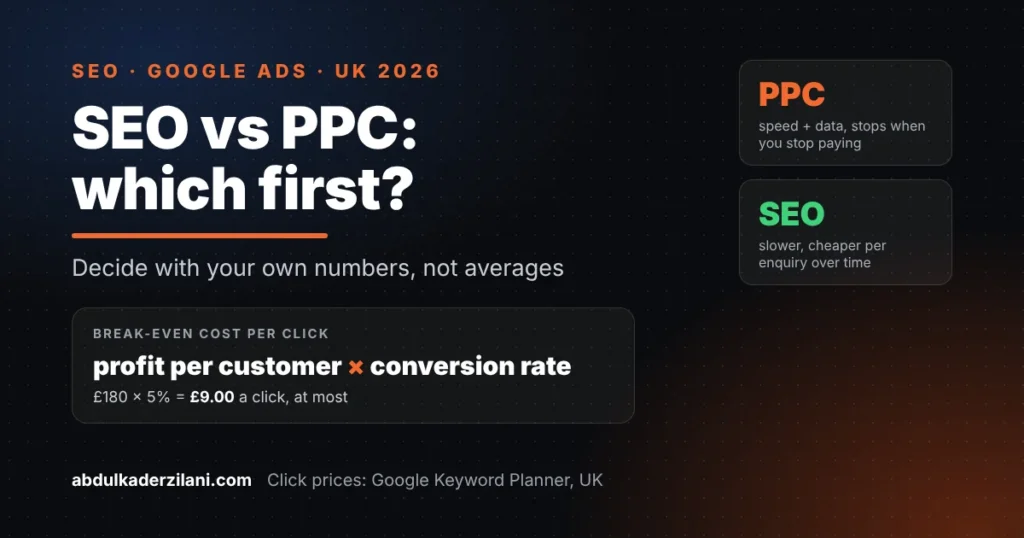
Break-even cost per click = gross profit per customer × share of clicks that become customers
| Business | Gross profit per customer | Clicks that become customers | Break-even cost per click |
|---|---|---|---|
| Boiler repair | £180 | 1 in 20 (5%) | £9.00 |
| Online shop, £45 order at 30% margin | £13.50 | 1 in 50 (2%) | £0.27 |
| Kitchen fitting | £1,200 | 1 in 25 (4%) | £48.00 |
These are illustrative; use your own figures. Use gross profit, not revenue, and your own conversion rate from Google Analytics. If clicks in your market cost more than your break-even figure, Google Ads cannot pay, however good the ads are. The online shop above would need to raise its order value, margin or conversion rate, or use SEO, email or social ads instead.
If you do not know your conversion rate yet, the four-week test below is how you find out.
3. Can you realistically rank?
Search your five most important terms in a private browser window. If page one is national brands and big comparison sites, you will not outrank them in six months. If it is local competitors with thin pages and few reviews, you can. And if nobody searches for what you sell in the way you describe it, SEO has nothing to rank for.
The answer grid
| Your situation | Start with | Why |
|---|---|---|
| Diary empty this month | PPC and Google Business Profile | Only ads bring enquiries this week |
| New business, no reviews | PPC while you build your Profile and pages | You will not appear organically for months |
| Booked up for weeks | SEO | Ad money buys enquiries you cannot take |
| Small budget, no deadline | Local SEO and Google Business Profile | PPC needs ongoing spend; SEO compounds |
| Expensive clicks (£10 or more) | SEO, with PPC only on terms that still pay | The click price breaks the maths |
| High-value work that customers research | SEO first, PPC to fill gaps | Reviews and visibility build trust over time |
| Launching something new | A four-week PPC test, then decide | Fast proof before months of content |
The test-first plan for a small budget
Step 0: before either channel (one week, mostly free). Claim and complete your Google Business Profile. Make sure your website says clearly what you do and makes it easy to call or enquire. Set up Google Analytics, Search Console and conversion tracking so you can count enquiries. Work out your break-even cost per click.
Step 1: a four-week PPC test. Around £500 of ad spend on 5 to 10 high-intent keywords, the terms a buyer types (“boiler repair Leeds”, not “how does a boiler work”). Exact and phrase match only, one relevant landing page, no Display or Performance Max yet. After four weeks you know what a click and an enquiry really cost, and which keywords produce enquiries.
Step 2: decide with the data.
- If enquiries cost less than a customer is worth, keep PPC running on the winning keywords. It now pays for itself while SEO builds.
- If they cost more, pause it. The test has saved you months of wasted spend.
- Either way, export the search terms report. Keywords that produced enquiries get SEO pages first. Keywords that got clicks but no enquiries do not get a page at all.
Step 3: build SEO on the proven terms (months 2 to 12). Write a service page for each proven term, keep your Business Profile active (a weekly post, fresh photos, reply to every review), and publish one genuinely useful page a month rather than ten thin ones.
Step 4: rebalance every quarter. When a term ranks in the top three organically for a month, cut PPC spend on it and move the budget to the next gap. Do not automatically stop all ads on that term: on your most valuable searches, appearing in both the ads and the organic results can win more clicks than either alone. When you launch a new service or area, move some budget back to PPC for four weeks to test it.
Before either channel: the free work that pays first
- Google Business Profile. Google ranks local results on relevance, distance and prominence, and a complete, accurate profile is more likely to show. It costs nothing but time. See how to get your business on Google.
- Reviews. Ask every happy customer, with a direct link, and reply to every review. Never buy or reward reviews: fake and undisclosed incentivised reviews have been unlawful in the UK since 6 April 2025.
- A website that converts. One clear offer per page, a visible phone number, a short enquiry form, and tracking that counts enquiries. Both channels waste money sending people to a page that does not convert.
Mistakes that waste money on both channels
- Running ads with no conversion tracking, so you cannot tell which keywords bring enquiries.
- Broad match keywords on day one of a small-budget campaign.
- Comparing a £500 SEO retainer with a £500 ad budget in month one. They pay back on completely different timelines.
- Stopping PPC the week you rank first, or never reviewing it at all.
- Choosing a channel without knowing what a customer is worth.
- Judging SEO after six weeks, or PPC after six days.
Frequently asked questions
I have about £500 a month. Should I spend it on SEO or Google Ads?
£500 can fund a focused local SEO effort or a small Google Ads test, but not both properly. If you need enquiries soon and your break-even cost per click is above what clicks cost in your area, start with a four-week Google Ads test. If you can wait or clicks are expensive, put it into your Google Business Profile, service pages and reviews first.
How long does SEO take to bring in customers?
Most small businesses see early movement within three to six months, and steady enquiries within six to twelve. Local businesses with a complete Google Business Profile and good service pages can see results sooner. Competitive national searches take longer.
Do Google Ads help my SEO rankings?
No. Paying for ads does not improve your position in Google’s unpaid results. What ads can do is show you, quickly, which keywords bring enquiries, so you know which pages to build for SEO.
I tried Google Ads once and it wasted money. Does PPC not work for my business?
Not necessarily. Check two things separately. First, the maths: is your break-even cost per click higher than what clicks cost in your market? If not, PPC cannot work until your offer or conversion rate changes. Second, the setup: campaigns without conversion tracking, with broad keywords and sending people to the homepage often fail even when the maths works.
If I stop paying for SEO, do I lose everything?
Not overnight. Rankings usually fade over months rather than vanishing the day you stop, unlike ads. But they do fade if competitors keep improving while you stand still, so SEO needs ongoing maintenance, just less than the initial build.
Should I do SEO and PPC at the same time?
Eventually, most growing businesses do. The order matters more than the split: use PPC to get enquiries and keyword data quickly, build SEO on the terms that proved they convert, and move budget from PPC to SEO as your organic rankings grow.
The bottom line
PPC buys speed and data; SEO builds an asset that gets cheaper per enquiry over time. Start with the one your deadline and your numbers point to, test before you commit, and rebalance every quarter.
This week: complete your Google Business Profile, work out your break-even cost per click, and search your five main terms to see who you are up against. If you would like help deciding, see our Google Ads management and SEO services, or book a free 30-minute call.
Sources
- Google Keyword Planner, United Kingdom, checked November 2026 (click prices)
- Google Search Central: SEO Starter Guide
- Google Business Profile Help: How to improve your local ranking on Google
- Ahrefs: How long does it take to rank in Google?
- The Register: Pew study on Google AI summaries and clicks (22 July 2025)
- Digital Markets, Competition and Consumers Act 2024 (fake review rules in force 6 April 2025)