‘Dentist Near Me’ in the UK: How Dental Practices Win Private Patients Online
 By Abdur Rahman
·
· Updated 28 Nov 2026 · 8 min read
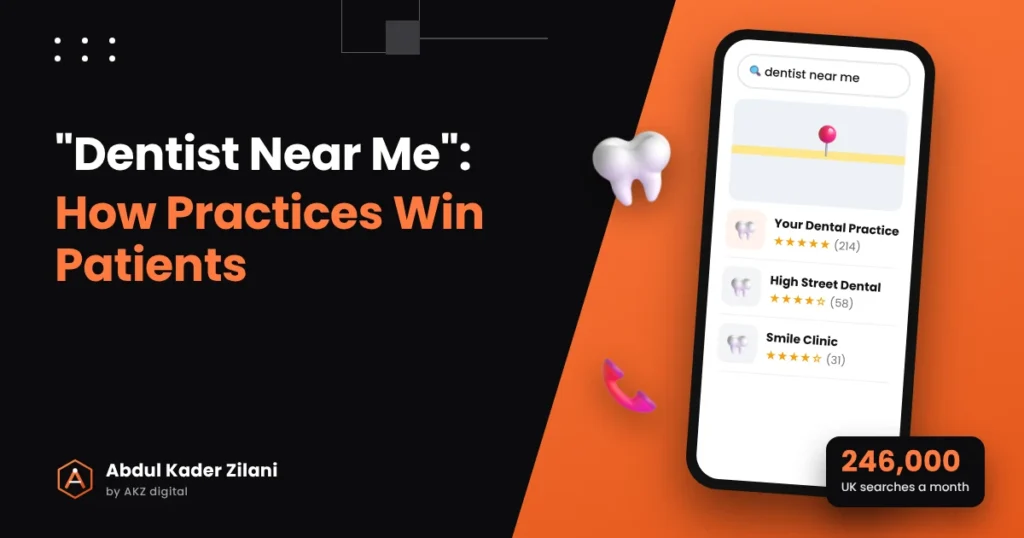
“Dentist near me” is one of the biggest local searches in the UK. Google Keyword Planner shows about 246,000 UK searches a month for it. Most of those people want a practice that is close, has availability, takes the kind of patient they are (NHS or private), and looks trustworthy. The practices that win them are rarely the ones with the biggest budgets; they are the ones Google, and the patient, can understand at a glance.
This guide explains how a UK dental practice shows up for “dentist near me” and similar searches, what Google Ads cost for dental terms, how to use reviews properly, and the General Dental Council (GDC) rules every piece of marketing must follow.
For “near me” searches, the map results matter most, and they come from your Google Business Profile: right categories, accurate hours, real photos, and a steady flow of reviews. Back it with a page for each main treatment on your website. Add Google Ads for high-value private treatments where a patient is worth far more than the click. Everything must follow the GDC’s advertising guidance: accurate, not misleading, and with your GDC details shown.
How “dentist near me” results work
When someone searches “dentist near me” on a phone, Google usually shows:
- Sponsored results (Google Ads) at the top.
- The map pack: three practices on a map, with ratings, opening hours and buttons to call or get directions.
- Normal website results below.
For most practices the map pack is where new patients come from. Google says it ranks local results on relevance, distance and prominence. You cannot change distance, but you can control relevance (what your profile and website say you do) and prominence (reviews, mentions on other sites, and how well-known your practice is).
Step 1: Get your Google Business Profile right
- Categories. Choose “Dentist” or the most accurate primary category, then add secondary categories that genuinely apply (for example “Cosmetic dentist” or “Emergency dental service” only if you offer it).
- NHS or private, stated plainly. Patients searching “dentist near me” often want to know first whether you take NHS patients. Say so in your description, and keep it up to date.
- Services and treatments. Add each treatment you offer, with a short plain description.
- Accurate hours, including late evenings, Saturdays and emergency appointments if you have them. Wrong hours lose patients and trust.
- Real photos of the practice, reception, treatment rooms and team. Not stock images.
- Booking link straight to your online booking, if you have one.
- Questions and answers: add the questions patients ask most, such as parking, wheelchair access and payment plans.
Step 2: A page for each treatment
Your Business Profile links to your website, and Google uses the website to understand what you offer. One “Our services” page listing everything is not enough. Create a page for each treatment people search for and book: check-ups, hygienist, emergency appointments, implants, Invisalign or clear aligners, whitening, veneers, and anything else you want more of.
Each page should cover:
- What the treatment is and who it suits, in plain English.
- What happens at the appointment and how many visits it takes.
- Prices or “from” prices, and payment plans if you offer them. Patients compare prices before they call.
- Who carries out the treatment, with their GDC number and qualifications (see the rules below).
- Before-and-after photos only of your own patients, with consent, and without implying everyone gets the same result.
- A clear way to book or call, visible on a phone without scrolling.
Step 3: Reviews, done properly
Reviews are one of the strongest signals of prominence, and they are what patients read before choosing.
- Ask every patient after a good appointment, with a direct link, by text or email.
- Reply to every review, good or bad, politely and without confirming that the reviewer is a patient or discussing their treatment: patient confidentiality applies to review replies too.
- Never buy, write or reward reviews. Fake and undisclosed incentivised reviews have been unlawful in the UK since 6 April 2025.
Step 4: Google Ads for private treatments
Paid ads make most sense where a new patient is worth far more than the clicks it takes to win them, which usually means private treatments. Here is what Keyword Planner shows for the main local search:
| Search | UK searches a month | Top-of-page bid range |
|---|---|---|
| dentist near me | 246,000 | £1.46 to £5.76 |
Source: Google Keyword Planner, location United Kingdom, last 12 months, checked 15 November 2026. Bids converted from US dollars at $1 = £0.757. The high end of the range is what advertisers pay at the busiest times and in big cities.
The general term “dentist near me” attracts a lot of people looking for NHS availability. If you are mainly private, you will usually get better value bidding on treatment plus place: “dental implants Leeds”, “Invisalign Manchester”, “emergency dentist Bristol”, and adding negative keywords for searches you cannot serve.
To check whether ads can pay, work out what a click is worth to you:
| Step | Example | Your figure |
|---|---|---|
| Gross profit from a new private patient in year one | £600 | Your own figure |
| Clicks that become a booking | 1 in 25 (4%) | From your tracking |
| Most you can pay per click and break even | £24 | £600 × 4% |
If your break-even figure is well above what clicks cost in your area, Google Ads can work. If it is below, fix the landing page or focus on higher-value treatments first. Our guide to Google Ads costs in the UK explains the full bill, including Google’s 2% UK surcharge and VAT.
Track bookings, not clicks. Set up call tracking and online booking as conversions so you can see which keywords bring patients.
Step 5: The GDC rules every dental advert must follow
The GDC’s guidance on advertising applies to your website, ads, social media and Business Profile. Advertising must be accurate and not misleading; advertising that could mislead can lead to a fitness to practise investigation. Key points from the guidance:
- GDC registration numbers. Information that names a dental professional must include their GDC number. If you list team members on your website as providing care, show their professional qualification, the country it came from, and their GDC number.
- Practice websites should show the practice name and address, contact details, GDC contact details or a link to the GDC, your complaints procedure, and the date the site was last updated.
- NHS, mixed or private. Your website must say which.
- Specialist titles. Only dentists on a GDC specialist list may call themselves a specialist (for example “Specialist in orthodontics”). Others must not use titles such as “Orthodontist” or claim to be “specialising in” something, but may say “special interest in” or “experienced in”.
- No comparisons of the skills or qualifications of dental professionals.
- Social media and offers. Adverts on social platforms must state that the treatment may not suit every patient and depends on a satisfactory assessment.
Advertising is also covered by the UK advertising codes enforced by the Advertising Standards Authority, which require health claims to be backed by evidence. If you are unsure about a claim, leave it out or take advice.
Social media: useful, but not for “near me”
Facebook and Instagram are not where people search for a dentist; they are where people discover a practice and treatments like whitening or aligners. They work best for showing your team, your practice and real patient stories (with consent), and for promoting specific private treatments. Keep the GDC wording on every treatment advert.
What to measure each month
- Business Profile: calls, website clicks, direction requests and booking clicks.
- Search Console: impressions and clicks for searches with your town or treatments.
- Google Ads: cost per booking, not cost per click.
- New patients: ask how they found you, and record it.
Frequently asked questions
How do I get my dental practice to show up for ‘dentist near me’?
Complete your Google Business Profile with the right categories, accurate hours, services and real photos, and keep a steady flow of reviews. Back it with a website page for each treatment, consistent practice details everywhere, and mentions on local and dental sites. Distance matters too, so the map results favour practices close to the searcher.
How much does Google Ads cost for a dental practice?
Keyword Planner puts top-of-page bids for ‘dentist near me’ at about £1.46 to £5.76 across the UK, with big cities at the top of the range. Treatment searches such as implants or aligners can cost more. What matters is cost per booked patient, which depends on your landing page, how quickly you answer and the value of the treatment.
Do dental adverts need to show a GDC number?
Yes. The GDC’s guidance says information that names a dental professional must include their GDC registration number, and websites listing professionals providing care should show their qualification, the country it came from and their GDC number.
Can a dentist call themselves a specialist in their marketing?
Only if they are on one of the GDC’s specialist lists. Others must not use specialist titles or say they are specialising in a treatment, but can say they have a special interest in it or are experienced in it.
Can dental practices use patient reviews in marketing?
Yes, if they are genuine. Ask patients for reviews with a direct link, never buy, write or reward them, and do not confirm in your replies that a reviewer is a patient. Fake and undisclosed incentivised reviews have been unlawful in the UK since April 2025.
Should a dental practice use Facebook or Instagram ads?
They work for promoting specific private treatments and showing your practice and team, but people rarely use them to search for a dentist. Use them alongside your Business Profile and Google Ads, and include the GDC’s wording that treatment may not suit everyone and depends on an assessment.
The bottom line
To win “dentist near me” patients, make your Google Business Profile the best in your area, give every treatment its own clear page, build reviews steadily, and use Google Ads for the private treatments that pay. Keep every word within the GDC’s advertising rules.
We help UK clinics with exactly this; see our marketing for healthcare clinics page, our local SEO service, or book a free 30-minute call.
Sources
- Google Keyword Planner, United Kingdom, last 12 months, checked 15 November 2026
- General Dental Council: Guidance on advertising
- Google Business Profile Help: How to improve your local ranking on Google
- Digital Markets, Competition and Consumers Act 2024 (fake review rules in force 6 April 2025)