How to Choose a PPC Agency in the UK: Fees, Ad Spend and Warning Signs
 By Abdur Rahman
·
· 9 min read
When you hire a PPC agency you are trusting someone else to spend your money, every day, in an auction you cannot see. Most owners only find out something was wrong months later, when they ask for the account and discover it was never in their name.
The good news is that Google has rules about what agencies must tell you, and you can check most of them in a single call. This guide covers how PPC agencies charge, how to separate the fee from the ad spend, who should own the account, what Google’s own policies require, and the warning signs that should end the conversation.
Choose a PPC agency that sets the Google Ads account up in your name with you as admin, shows the management fee separately from ad spend in writing, reports the actual cost Google charged, and sets targets in cost per enquiry or return on ad spend. Walk away from anyone who guarantees top position, claims to be from Google or will not show you the account.
Fees vs ad spend: two separate costs
Every PPC engagement has at least two costs, and good agencies keep them clearly apart.
- Ad spend: what Google charges for clicks. It goes to Google, not the agency.
- Management fee: what the agency charges for running the account.
- Sometimes, a setup fee: a one-off charge for building or rebuilding the account, tracking and landing pages.
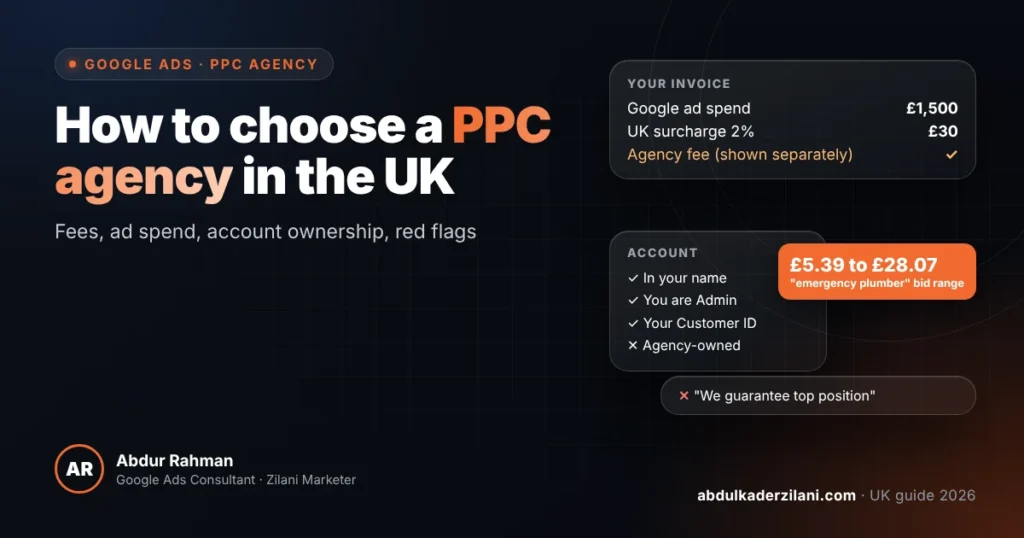
Google’s policies back this up. Its transparency requirements for third parties say that if a fee is charged on top of Google Ads costs, the customer must be told clearly, in writing, before the first purchase, and the fee must appear on invoices. If your agreement includes monthly reports, those reports must show the cost actually charged by Google, separately from the agency’s fees.
Ad spend in the UK also has two extras an agency should explain: Google adds a 2% surcharge to ads served in the UK, and VAT is handled differently depending on whether you are VAT registered (registered businesses use the reverse charge; non-registered businesses pay 20% VAT). Our guide to what Google Ads costs in the UK walks through those sums.
How PPC agencies charge
We are not going to quote other agencies’ rates. What matters is understanding what each fee model rewards, because that shapes the advice you get.
| Fee model | How it works | What it rewards | Ask this |
|---|---|---|---|
| Percentage of ad spend | Fee rises and falls with your budget | Spending more | “Would you ever recommend I cut my budget?” |
| Flat monthly fee | Same fee whatever you spend, within agreed limits | Keeping you as a client | “What is included, and what triggers a higher tier?” |
| Hybrid | Flat base fee plus a percentage above a spend level | A mix of both | “At what spend does the percentage start?” |
| Performance based | Fee tied to leads or sales | Volume of leads, sometimes at the expense of quality | “How do you define a lead, and who checks it?” |
| Hourly or day rate | You pay for time used | Time spent, not results | “How many hours a month will this account need?” |
None of these is automatically wrong. A percentage fee is common and simple, but it means the agency earns more when you spend more, so watch for budget advice that only goes one way. A flat fee removes that pull, but check the scope carefully.
How much ad spend do you need?
This depends on what clicks cost in your sector. Google Keyword Planner gives a top-of-page bid range for each search term. Here are some UK examples from Keyword Planner (United Kingdom, last 12 months, checked 15 November 2026).
| Search term | Top-of-page bid range | UK searches a month |
|---|---|---|
| emergency plumber | £5.39 to £28.07 | 9,900 |
| locksmith near me | £5.06 to £21.19 | 74,000 |
| accountant near me | £3.91 to £13.94 | 12,100 |
| conveyancing solicitor | £8.29 to £16.87 | 9,900 |
| personal injury solicitor | £16.99 to £50.87 | 1,900 |
| wedding photographer | £1.06 to £2.95 | 8,100 |
As a worked example: if clicks in your sector average £8 and one in ten clicks becomes an enquiry, each enquiry costs about £80 in ad spend before the agency fee. Ask any agency to run this sum with you for your own sector before you agree a budget. If the answer is that you cannot afford enough clicks to learn anything in a month, a good agency will say so. For trades, our guide to Google Ads for tradespeople shows how this plays out.
Who should own the Google Ads account
This is the single most important point in this guide. The account should be yours.
Google’s advertiser guide to working with third parties says the agency must set up a separate Google Ads account for you. In practice that means:
| Check | What good looks like | Why it matters |
|---|---|---|
| Account owner | Created in your business name, billed to your payment method | You keep the history, data and learnings |
| Your access | You have Admin access | Google says only admins can manage user access and unlink manager accounts |
| Agency access | Linked through their manager account, or added as a Standard user | They can run campaigns without owning the account |
| Customer ID | You know your 10-digit Google Ads customer ID | Google requires third parties to give it to you on request |
| Tracking | Conversion actions, Analytics and tag manager in your name | Tracking is often what is lost when agencies leave |
Agencies normally manage client accounts through a Google Ads manager account (sometimes called an MCC). Google explains that a manager account lets an agency view and manage several accounts from one place, while client users keep signing in to their accounts as usual. Admins on the client account can end the relationship by unlinking the manager account. That only works if you are an admin, which is why the first check above matters.
What a good agency does in the first 90 days
| Period | What should happen | What you should see |
|---|---|---|
| Weeks 1 to 2 | Access, tracking audit, conversion setup checked, search terms reviewed | A written list of what is broken or wasted |
| Weeks 3 to 6 | Rebuild or tidy campaigns, add negative keywords, fix landing pages | Cost per enquiry baseline you trust |
| Weeks 7 to 12 | Test ads, bids and offers, cut what does not convert | Trend in cost per enquiry or ROAS, with reasons |
If you sell online, the target should be tied to your margins, not just a platform ROAS figure. Our break-even ROAS guide explains how to work that out.
Warning signs
Google’s own advertiser guide lists behaviours to watch out for. These match what we see when we audit inherited accounts.
- Not sharing cost and performance data. Google says you have the right to know your clicks, impressions and total cost.
- Guaranteeing a top position or a set placement for your ads.
- Claiming to be from Google or to have special access.
- Claiming that buying ads will improve your organic rankings. It will not.
- Unclear or deceptive pricing, or no written agreement.
- Running the account in their own name, or refusing you admin access.
- Reporting “conversions” that you cannot match to real enquiries or sales.
What the Google Partner badge does and does not tell you
A Google Partner badge shows that an agency meets Google’s programme requirements. Google lists these as an optimisation score of at least 70% on its manager account, at least US$10,000 of ad spend across managed accounts over 90 days, and at least half its account strategists certified in Google Ads. It tells you the agency has some scale and knows the platform. It does not tell you whether they understand your business, and a high optimisation score means following Google’s recommendations, which are not always right for a small budget. Treat it as a minimum, not a reason to sign.
Checklist before you sign
- Account in your name, you as admin, your payment method on file.
- Management fee, setup fee and ad spend shown separately in writing.
- Monthly report showing Google’s actual cost, clicks and conversions.
- Agreed target: cost per enquiry, cost per sale or ROAS.
- Conversion tracking checked and tested in the first fortnight.
- Notice period and minimum term written down.
- Clear statement of what happens to the account, ads and tracking if you leave.
- Named person who works on the account, not just an account manager.
Frequently asked questions
How do PPC agencies charge in the UK?
Most charge a management fee on top of ad spend, using a percentage of spend, a flat monthly fee, a hybrid of the two, or occasionally a performance-based fee. Some add a one-off setup fee. Google’s policies require any fee on top of ad costs to be disclosed in writing before the first purchase and shown on invoices.
Should I own my Google Ads account or should the agency?
You should own it. Google’s advertiser guide says agencies must set up a separate account for you. Keep admin access yourself and let the agency manage it through their manager account or as a standard user, so you keep the data if you switch.
What questions should I ask a PPC agency?
Ask who owns the account, how the fee is calculated, whether the fee is separate from ad spend on invoices, what target they will report against, who will work on the account day to day, and what the notice period is. Also ask them to estimate cost per enquiry for your sector using Keyword Planner data.
Is a Google Partner agency better?
A Partner badge shows an agency meets Google’s spend, certification and optimisation score requirements. It is a useful minimum, but it does not prove they will be right for your business. Judge them on account ownership, transparency and results.
How long before a PPC agency gets results?
Expect wasted spend to be cut and tracking to be fixed in the first few weeks. A reliable cost per enquiry baseline usually takes four to six weeks of data, and steady improvement comes over the following months.
Can I run Google Ads myself instead?
Yes, if you have the time to learn and check the account weekly. Many small businesses start themselves and bring in help once spend grows. Our guide to SEO vs PPC can help you decide where to put your first budget.
The bottom line
The right PPC agency is transparent about money, leaves you in control of your account, and reports against a target that matches your business. Google’s own rules give you the right to see your costs and get your customer ID, so ask for them in the first conversation.
If you want an honest look at your account, see how our Google Ads management service works, read our guide to choosing a digital marketing agency, or book a strategy call.
Sources
- Google Ads policies: Transparency requirements for third parties
- Google Ads policies: Advertiser guide, working with third parties
- Google Ads Help: About access levels in your Google Ads account
- Google Ads Help: About Google Ads manager accounts
- Google Ads Help: How to become a Google Partner or Premier Partner
- Google Ads Help: Regulatory operating costs surcharge
- Google Keyword Planner (United Kingdom, last 12 months, checked 15 November 2026)