SEO Services Explained: What’s Included, What It Costs in the UK, and What to Avoid
 By Priotum Dhar
·
· 8 min read
“SEO services” is one of the vaguest things a small business can buy. Two packages with the same name can contain completely different work: one fixes the reasons your site is invisible, the other sends you a monthly PDF of rankings and some links from sites nobody reads.
This guide breaks SEO into its parts so you can see what each one is, what it should involve, and how to tell real work from filler. It also covers how to think about cost without relying on anyone’s price list, and the packages and tactics that are more likely to hurt you than help.
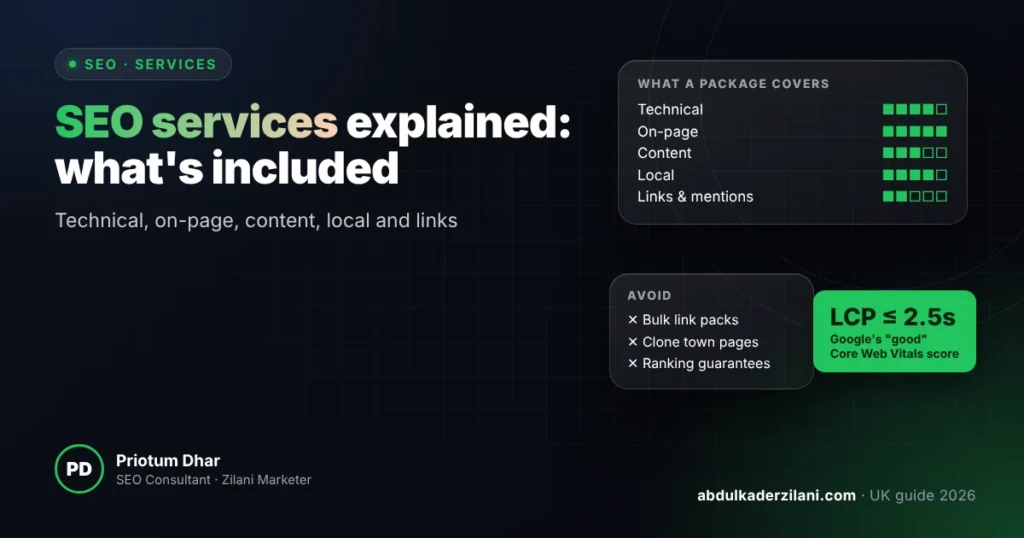
Real SEO services fall into five parts: technical (can Google crawl, index and load your pages), on-page (do your key pages match what people search for), content (do you answer the questions customers ask), local (Google Business Profile, reviews and listings), and reputation (genuine links and mentions). A good package tells you which parts it covers, how many hours go into each, and who does the work. Avoid anything built on guaranteed rankings, bulk links or mass-produced pages.
The five parts of SEO services
| Part | What it covers | Signs it is being done well |
|---|---|---|
| Technical SEO | Crawling, indexing, redirects, speed, mobile, structured data | A ranked list of faults, then fixes you can see in Search Console |
| On-page SEO | Titles, headings, page content, internal links | Key service or product pages rewritten around real searches |
| Content | New pages and articles for customer questions | Fewer, better pieces tied to services, not volume for its own sake |
| Local SEO | Google Business Profile, reviews, listings, local pages | More calls and direction requests from your profile |
| Links and mentions | Earned links, partnerships, PR, directories that matter | Named sources you would be happy for customers to see |
Most small businesses do not need all five at full strength. A single-site plumber needs strong local and on-page work far more than a content programme. An online shop needs technical and category-page work before anything else.
Technical SEO: can Google read your site?
Technical SEO makes sure search engines can find, crawl and understand your pages. Typical work includes:
- Checking which pages are indexed in Google Search Console and why others are not.
- Fixing broken pages, redirect chains and duplicate versions of the same page.
- Making sure important pages are linked from your menu or other pages, not buried.
- Improving loading speed and mobile usability.
- Adding structured data where it helps, such as for local businesses, products or FAQs.
Speed is measured with Core Web Vitals. Google defines good scores as Largest Contentful Paint within 2.5 seconds, Interaction to Next Paint under 200 milliseconds and Cumulative Layout Shift below 0.1 (Google Search Central). These are useful targets, but they are not a magic ranking switch; a fast page that does not answer the search will still struggle.
On-page SEO: do your pages match the search?
On-page work is often where small businesses see the quickest gains. It means making each important page clearly about one thing, in the words customers use.
| Element | What good looks like |
|---|---|
| Title tag | Says the service and place clearly, such as “Boiler Repair in Leeds”, not just the business name |
| Main heading | Matches the title’s intent and reads naturally |
| Opening paragraph | Answers the searcher’s question straight away |
| Body content | Covers prices or how pricing works, process, areas served, proof and next step |
| Internal links | Related services and guides link to each other |
| Call to action | Phone number, form or booking button easy to find on mobile |
Google’s SEO Starter Guide covers these basics and is worth reading yourself. It also says plainly “There are no secrets here that’ll automatically rank your site first in Google” (Google Search Central).
Content: answering real questions
Content is not “a blog post every week”. It is the pages that answer what your customers ask before they buy: how much something costs, how long it takes, how to choose, what can go wrong. A few useful, specific pages tied to your services usually beat a large volume of general articles.
Be careful with mass-produced content. Google’s spam policies describe scaled content abuse as “when many pages are generated for the primary purpose of manipulating search rankings and not helping users” (Google Search Central). That applies whether the pages are written by people or by AI tools.
Content also feeds AI search. Clear, well-structured pages with real expertise are more likely to be used in AI answers. Our guides to Google AI Overviews and getting recommended by ChatGPT explain the overlap.
Local SEO: the map pack and “near me”
For any business that serves a local area, local SEO is often the highest-value part of the package. Google says local results are ranked mainly on relevance, distance and prominence (Google Business Profile Help). Local SEO work focuses on the two you can influence:
- Relevance: correct primary and secondary categories, full services list, accurate hours and service areas, and website pages for each core service.
- Prominence: a steady flow of genuine reviews, replies to reviews, accurate listings and local mentions.
Reviews need care. Fake reviews and undisclosed incentivised reviews have been unlawful in the UK since 6 April 2025 under the Digital Markets, Competition and Consumers Act 2024. A good provider sets up a simple process to ask real customers, never buys or writes reviews. Our guide on how to get your business on Google covers the setup steps.
Links and mentions: quality over quantity
Links from other websites still help Google judge trust, but this is the part of SEO most often sold badly. Google defines link spam as “creating links to or from a site primarily for the purpose of manipulating search rankings” (Google Search Central).
Legitimate link and mention work for a small business usually looks like:
- Supplier, trade body and partner listings where you are a genuine member or customer.
- Local press, sponsorships and community projects.
- Useful resources other sites want to reference, such as a cost guide or checklist.
- Correct, consistent listings on directories your customers actually use.
How to think about the cost
We will not quote other providers’ prices here because they vary widely and change often. Instead, compare proposals on what the fee buys.
| What to ask | What it tells you |
|---|---|
| Hours per month, split by the five parts | Whether the effort goes where your problem is |
| Who does the work, and their experience | Whether you get senior or junior time |
| Is writing included, and how many pages? | Content is time-heavy and often extra |
| Who implements changes on the site? | If it is you, add your own time to the cost |
| Are tools and reporting charged separately? | Hidden extras change the real price |
| Notice period | Whether you can leave if nothing moves |
A simple way to compare: divide each monthly fee by the hours it covers, then look at which parts those hours go into. A package that spends most of its hours on reporting and generic blog posts is weaker value than one that spends fewer hours fixing your most important pages. For how we set fees and notice, see our terms of engagement. For whether SEO is the right spend at all, our comparison of SEO vs PPC helps.
SEO packages and tactics to avoid
- Guaranteed rankings. Google says “No one can guarantee a #1 ranking on Google” (Google Search Central).
- Bulk link packages with a fixed number of links a month and no named sources.
- Hundreds of near-identical town or suburb pages that only swap the place name.
- Submitting your site to “thousands of search engines”. Google names this as something to be wary of.
- Keyword stuffing and other outdated tricks presented as important work. Keyword stuffing is listed in Google’s spam policies.
- “Ranking reports” with no traffic or enquiry data. Rankings alone do not pay bills.
- Keeping you locked out. You should be the owner of your Search Console property and have full access to analytics.
A checklist before you buy SEO services
- I know which of the five parts my business needs most.
- The proposal says how many hours go into each part.
- I know who will do the work and who will make changes on my site.
- I own my Search Console property and GA4 account.
- The provider has explained where links or mentions will come from.
- Reporting will include enquiries or sales, not just rankings.
- There is no guarantee of rankings and no long lock-in.
- I have read Google’s SEO Starter Guide, so I can follow the conversation.
Frequently asked questions
What is included in SEO services?
Usually some mix of technical fixes, on-page improvements, content, local SEO and link or mention work, plus reporting. A good provider tells you which parts are included, how much time each gets, and why.
How much do SEO services cost in the UK?
Prices vary by scope and seniority. Compare proposals on hours per month, who does the work, what is included, and notice period, rather than on headline price alone.
Is local SEO different from regular SEO?
Yes. Local SEO focuses on Google Business Profile, reviews, listings and local service pages to appear in the map pack and “near me” searches, while broader SEO covers national rankings and content.
Are monthly link packages worth it?
Usually not. Google treats links created mainly to manipulate rankings as link spam. Earned links from genuine partners, press and useful resources are safer and longer lasting.
Can I do some SEO myself?
Yes. Google says a small local business can probably do much of the work itself. Many owners handle their profile and reviews and bring in help for technical fixes and key pages.
How quickly will SEO services show results?
Google says some changes take effect within hours and others take several months. Technical fixes and specific searches tend to move first; competitive terms take longer.
The bottom line
Good SEO services are specific: they tell you which parts of SEO they cover, who does the work and how many hours go into the problems that matter for your business. If you want help with the full picture, see our SEO services, or for map and “near me” visibility our local SEO service. For a wider plan across search and ads, read our guide on what an SEO agency actually does, or book a strategy call.
Sources
- SEO Starter Guide – Google Search Central
- Do you need an SEO? – Google Search Central
- Spam policies for Google web search – Google Search Central
- Understanding Core Web Vitals – Google Search Central
- Tips to improve your local ranking on Google – Google Business Profile Help
- Digital Markets, Competition and Consumers Act 2024 – legislation.gov.uk