PPC Management in the UK: What’s Included, Typical Fees and What Good Reporting Looks Like
 By Abdur Rahman
·
· Updated 25 Nov 2026 · 9 min read
“PPC management” is one of those phrases that sounds precise and is not. Two providers can quote you for it and mean completely different things. One will rebuild your account, check tracking every week and test new landing pages. The other will glance at bids once a month and send a screenshot.
If you are paying for Google Ads management, or thinking about it, you should know exactly what the work involves, how fees are usually structured and what a report should prove. This guide sets that out in plain English, so you can compare quotes on what they deliver rather than what they are called.
Good PPC management covers four things: conversion tracking that records real leads and sales, an account structure that matches your services, regular search term and budget checks, and landing pages that turn clicks into enquiries. You should own the account, see the hours behind any fee, and get a monthly report that shows cost per lead or sale, not just clicks.
What is included in PPC management: the four core jobs
Strip away the jargon and PPC management is four jobs done well and repeatedly.
| Core job | What it involves | Why it matters |
|---|---|---|
| Tracking | Setting up and testing conversion actions for calls, forms, bookings or purchases | Without it, Google’s bidding optimises for the wrong thing and you cannot judge results |
| Structure | Campaigns and ad groups organised by service, location and intent | Keeps spend on the searches that make you money |
| Ongoing optimisation | Search terms, negatives, bids, budgets, ads and assets | Stops waste and finds new demand |
| Landing pages | Pages that match the ad and make the next step obvious | Turns paid clicks into enquiries |
Google’s own help pages explain why tracking comes first: conversion tracking shows what happens after someone interacts with your ad, such as a purchase, sign-up or call (Google Ads Help). If a provider starts talking about bids before they have checked your conversion setup, ask them why.
PPC management setup: what should happen in the first month
The first month usually carries the heaviest workload. Here is what should be done, and what you should get to see.
- Access and ownership check. The account sits in your name, with your payment method. The provider gets access through their manager account or a named login.
- Tracking audit. Each conversion action is tested. Duplicate or meaningless conversions (page views counted as leads, for example) are removed or set to secondary.
- Account structure review. Campaigns split by service and, if needed, location. Match types and budgets set to the goals you agreed.
- Search term review. The search terms report shows the real searches that triggered your ads, and it is the main source of negative keyword ideas (Google Ads Help).
- Ads and assets. Fresh responsive search ads, sitelinks, call assets and location assets where relevant.
- Landing page check. Speed, clear offer, phone number, short form, and a message that matches the ad.
- A written plan. What will be tested in months two and three, and what success looks like.
PPC management tasks: weekly and monthly rhythm
After setup, the work settles into a routine. This is a sensible minimum for a small or mid-sized account.
| Frequency | Task | What you should see in the report |
|---|---|---|
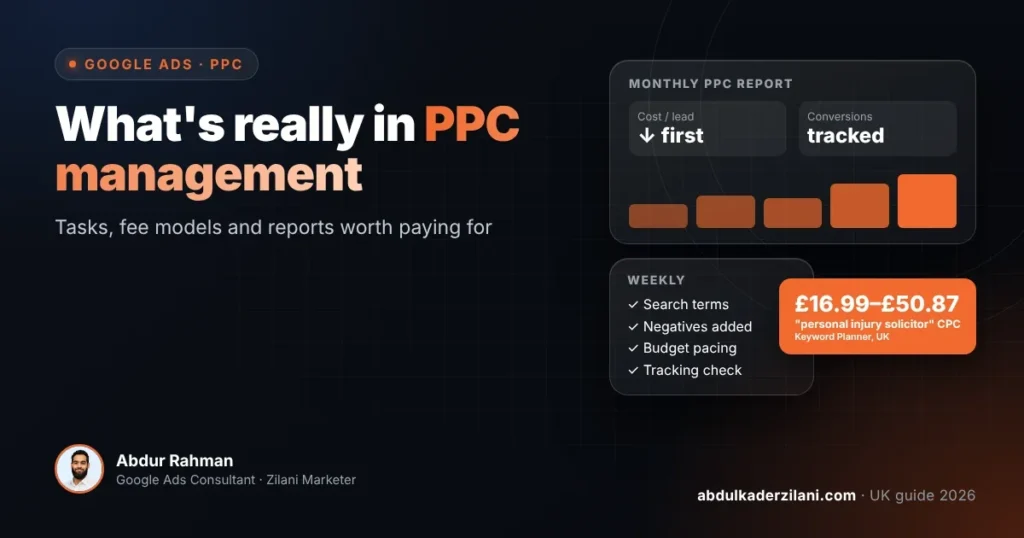
| Weekly | Search terms review and negatives added | A short list of terms blocked and why |
| Weekly | Budget pacing and spend checks | Spend against plan, any campaigns limited by budget |
| Weekly | Tracking sanity check | Conversions still recording, no sudden drops |
| Fortnightly | Ad and asset performance | New ads tested, weak ones paused |
| Monthly | Bid strategy and target review | Targets adjusted against cost per lead or ROAS |
| Monthly | Landing page review | Conversion rate by page, one test idea |
| Quarterly | Structure and strategy review | New services, seasonal plans, wider changes |
If you run Performance Max, ask how they review its search terms too. Google now provides a search terms report for Performance Max campaigns (Google Ads Help).
PPC management fees: how the common models work
We do not quote other providers’ rates, and we would not trust an “average” fee taken from agency blog posts. What you can compare is the fee model and what it rewards.
| Fee model | How it works | Works well when | Watch out for |
|---|---|---|---|
| Percentage of ad spend | Fee rises and falls with your budget | Spend is large and steady | An incentive to raise spend rather than cut waste |
| Flat monthly fee | Fixed price for an agreed scope | Small and mid-sized accounts with clear tasks | Scope creep, or a fixed fee covering very few hours |
| Hourly or day rate | Billed for time used | Audits, one-off fixes, setup projects | Open-ended bills without a cap |
| Setup fee plus monthly | One-off build, then a lower ongoing fee | New accounts or full rebuilds | Paying twice for “setup” that was a template |
| Performance-based | Fee tied to leads or sales | Very clear, trusted tracking | Disputes over what counts as a lead |
Whatever the model, ask one question: how many hours a month does this fee buy, and what will those hours be spent on? A fair quote should be able to answer that in writing. Our own approach to scoping and pricing is on our terms of engagement page.
The costs on top of your ad spend
Business owners are often surprised by charges that have nothing to do with the management fee. Make sure any budget plan includes them.
| Extra cost | What it is | Source |
|---|---|---|
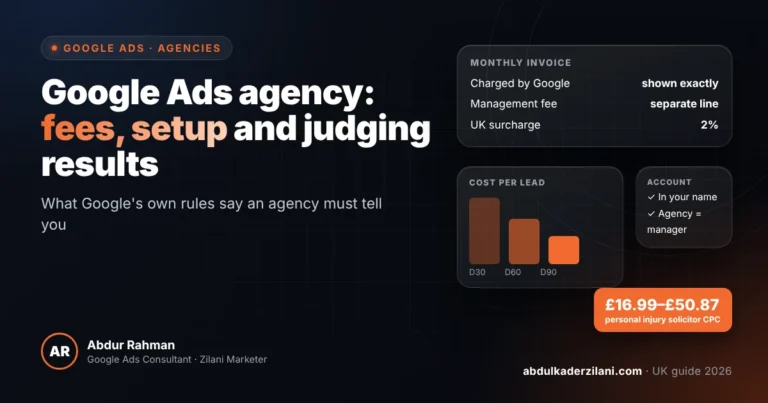
| Google UK surcharge | 2% added to the cost of ads served in the UK since 1 November 2020 | Google Ads Help |
| VAT on Google Ads | VAT-registered UK businesses account for it using the reverse charge; non-registered businesses pay 20% VAT | HMRC rules on services bought from abroad |
| Meta location fee | If you also run Meta ads, a 2% UK location fee since 1 July 2026 | Search Engine Land |
| Landing page work | Design or development for new pages, if not in scope | Your provider’s quote |
| Call tracking or tools | Optional software for call recording or reporting | Your provider’s quote |
For more on what clicks themselves cost, see our guide to Google Ads costs in the UK.
Why click prices change what good management looks like
The same management work means something very different depending on what your clicks cost. Google Keyword Planner shows these UK top-of-page bid ranges (Google Keyword Planner, United Kingdom, last 12 months, checked 15 November 2026):
| Search term | Top-of-page bid range | UK searches a month |
|---|---|---|
| personal injury solicitor | £16.99 to £50.87 | 1,900 |
| emergency plumber | £5.39 to £28.07 | 9,900 |
| locksmith near me | £5.06 to £21.19 | 74,000 |
| mortgage advisor | £4.69 to £15.07 | 14,800 |
| electrician near me | £1.32 to £7.41 | 74,000 |
At £30 a click, one bad search term left running for a week can waste more than a month of fees. At £2 a click, the bigger gains usually come from landing pages and conversion rate. A good provider adjusts where they spend their hours to match. To work out what a lead or sale can cost before you lose money, use our break-even ROAS guide.
What good PPC management reporting looks like
A monthly report should answer one question: is this making money? Everything else is supporting detail.
A simple reporting template
Ask any provider to include these, in this order:
- Headline numbers: spend, conversions, cost per conversion, and revenue or ROAS if you sell online.
- Lead quality: how many leads were real enquiries, if you can feed this back.
- Compared with last month and the same month last year.
- What changed: the specific tasks done, with dates.
- Search terms blocked: the main ones and why.
- Tests running: ads, landing pages or bid strategies, with a stop date.
- Next month’s plan: two or three priorities.
Clicks, impressions and click-through rate belong lower down. They explain performance; they are not performance.
Account ownership and access: protect yourself
Google Ads has clear access levels. Admin users can give access and change other users’ levels; Standard users can edit campaigns; Read only users can view campaigns and reports without changing them (Google Ads Help). Google also recommends granting the minimum access each person needs and removing users who have left (Google Ads Help).
In practice that means:
- You, the business owner, keep Admin access at all times
- Your provider is linked through their manager account or given Standard access
- The account is billed to your card or invoice, not theirs
- If you part ways, you unlink them and keep all data and history
We cover more warning signs in our guide on how to choose a PPC agency and our page on judging a Google Ads agency.
A quick self-check before you sign or renew
- Can the provider show you that tracking records real leads or sales?
- Do you know how many hours the fee buys each month?
- Is the account in your name with you as Admin?
- Does the report show cost per lead or sale first?
- Are search terms reviewed at least weekly?
- Is there a clear plan for landing pages, not just bids?
- Can you leave without losing the account?
If you answer “no” to three or more, ask for changes before you commit further.
Frequently asked questions
What is included in PPC management?
Usually conversion tracking setup and checks, account structure, search term and negative keyword reviews, bid and budget management, ad and asset testing, landing page advice and a monthly report. Always ask for the scope in writing.
How are PPC management fees usually charged in the UK?
The common models are a percentage of ad spend, a flat monthly fee, an hourly or day rate, a setup fee plus monthly fee, or a performance-based fee. Judge each by the hours and tasks it buys, not the headline number.
How often should my PPC account be checked?
Search terms, budgets and tracking should be checked at least weekly. Ads, bids and landing pages need a fortnightly or monthly review, and the overall strategy a quarterly review.
What should a PPC management report show?
Spend, conversions, cost per conversion and revenue or ROAS first, followed by what changed, which search terms were blocked, what tests are running and the plan for next month.
Should I own my Google Ads account if someone else manages it?
Yes. Keep the account in your name with your billing, hold Admin access yourself and give your provider Standard access or a manager account link.
Are there costs on top of ad spend and management fees?
Yes. Google adds a 2% UK surcharge to ads served in the UK, VAT rules apply depending on whether you are VAT-registered, and landing pages or tools may be extra.
The bottom line
PPC management is worth paying for when it covers tracking, structure, steady optimisation and landing pages, and when the report proves cost per lead or sale. Compare quotes on hours and tasks, keep ownership of your account, and budget for the extras on top of spend.
If you would like your account checked or a proposal reviewed, see how our Google Ads management works, or book a strategy call. Trades businesses may also find our home services and trades page useful.
Sources
- Google Ads Help: About conversion tracking
- Google Ads Help: Get negative keyword ideas using the search terms report
- Google Ads Help: About the search terms report in Performance Max
- Google Ads Help: About access levels in your Google Ads account
- Google Ads Help: Review who has access to your Google Ads account
- Google Ads Help: Jurisdiction-specific surcharges
- Search Engine Land: Meta is passing Europe’s digital taxes directly to advertisers
- Google Keyword Planner, United Kingdom, last 12 months, checked 15 November 2026