Shopify Web Design in the UK: Costs, Themes vs Custom, and Conversion Essentials
 By Abdul Kader Zilani
·
· 8 min read
Most Shopify stores that struggle do not have a design problem. They have a clarity problem: shoppers cannot tell quickly enough what is being sold, how much it costs to get it delivered, and why they should trust a shop they have never heard of.
So before you pay anyone to “design” a Shopify store, it helps to know what you are really paying for. This guide breaks Shopify web design cost in the UK into three parts: what Shopify itself charges, what the design work costs in hours, and the conversion and legal basics UK shoppers expect.
A UK Shopify store has three cost layers: Shopify’s plan and card fees (Basic is £25 a month, or £19 a month billed yearly), the theme (free or a one-off paid theme) and the design and build work, which is mainly hours of setup, content and testing. Most small stores should start with a good theme and spend the budget on photos, product pages and tracking. Custom builds make sense only when a theme cannot do something your business depends on.
Shopify web design cost, part one: what Shopify itself charges
These are Shopify’s own UK prices as shown on its pricing page when we checked on 25 November 2026. They change, so confirm on Shopify before you budget.
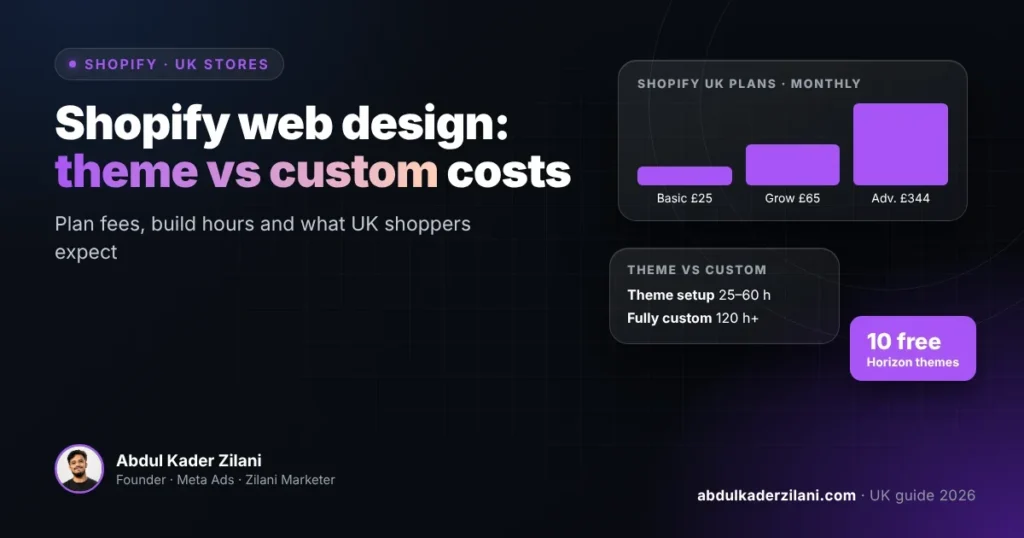
| Plan | Billed monthly | Billed yearly (per month) | Online card rate with Shopify Payments |
|---|---|---|---|
| Basic | £25 | £19 | From 2% + 25p |
| Grow | £65 | £49 | From 1.7% + 25p |
| Advanced | £344 | £259 | From 1.5% + 25p |
| Plus | From £1,800 | Not offered | From 1.3% + 25p |
Two details matter for small stores. First, if you use a third-party payment provider instead of Shopify Payments, Shopify adds its own transaction fee on top (2% on Basic, lower on higher plans). Second, Shopify was advertising a 3-day free trial followed by £1 a month for 3 months, which is enough time to build and test a store on a theme before paying full price.
Apps are the cost people forget. Reviews, subscriptions, bundles, wishlists and email tools are often separate monthly subscriptions, and a store with ten apps can spend more on apps than on its plan. Each app also adds code that can slow pages down.
Shopify theme vs custom design: what each option costs
Shopify’s Theme Store has free themes built by Shopify and paid themes built by third-party designers. In May 2025 Shopify released Horizon, a set of 10 free themes built with theme blocks, which give far more layout flexibility than older free themes. That has narrowed the gap between “free theme” and “custom design” for most small stores.
| Option | What you get | Typical work involved (example hours) | Good for |
|---|---|---|---|
| Free theme, set up yourself | Shopify-built theme, your branding and content | 20 to 40 hours of your own time | First store, small catalogue, tight budget |
| Free or paid theme, professionally set up | Theme configured, pages built, apps and tracking set up | 25 to 60 hours | Most small and growing UK brands |
| Theme with custom sections | Theme base plus bespoke sections (size guides, bundles, comparison tables) | 40 to 100 hours | Stores with one or two unusual needs |
| Fully custom theme | Designed and coded from scratch | 120 hours and up | Large catalogues, complex products, strong brand teams |
The hours are working examples for planning, not quotes. Multiply them by the hourly or day rate you are given to compare proposals on the same basis. For how we scope and price this work, see our terms of engagement.
When a custom Shopify design is worth it
A custom build is worth paying for when a theme cannot do something that directly affects sales, for example:
- A product builder or configurator (made-to-measure items, personalised products).
- Complex bundles or subscriptions that apps handle badly.
- A large catalogue that needs custom filtering and collection logic.
- A brand that is already selling well and needs speed and polish at scale.
If your reason is “we want it to look unique”, a well-chosen theme with strong photography and copy usually gets you most of the way for a fraction of the cost.
Shopify web design for UK shoppers: the conversion essentials
Design should make buying easy. These are the elements we check first on any Shopify store, in rough order of impact.
| Area | What good looks like | Why it matters |
|---|---|---|
| Product photos | Several angles, scale shots, real-life use | Shoppers cannot touch the product |
| Product page copy | What it is, who it is for, sizes, materials, care | Answers questions before they become doubts |
| Delivery and returns | Costs and timings stated on the product page | Surprise costs at checkout lose sales |
| Trust signals | Real reviews, contact details, company info, secure payment | New brands need to earn trust fast |
| Mobile layout | Add to basket visible without hunting; fast loading | Most browsing happens on phones |
| Checkout | Shopify checkout with express payment options | Fewer steps, fewer drop-offs |
| Tracking | Meta Pixel, Conversions API, GA4 and Google Ads conversions tested | You cannot improve what you cannot measure |
Tracking is where many newly designed stores fall down. A store can look perfect and still send broken purchase data to Meta or Google, which makes every ad decision worse. Meta launched a free one-click Conversions API setup on 15 April 2026, and Meta reports a 17.8% lower cost per result for advertisers using it, as covered by PPC Land. Our guides to the Facebook Conversions API and fixing Meta Pixel purchase tracking walk through the checks.
How to brief a Shopify web designer so quotes compare fairly
Most of the difference between two Shopify quotes comes from what each designer assumed you wanted. A one-page brief removes the guesswork and makes hours comparable.
- Catalogue: how many products, how many variants, and whether you need bundles, subscriptions or personalisation.
- Content: who supplies product photos, descriptions and page copy, and whether anything needs writing from scratch.
- Integrations: stock, accounting, couriers, email marketing and reviews tools you already use.
- Migration: whether products, customers and orders need moving from another platform, and whether old URLs need redirects to protect search traffic.
- Tracking: which ad platforms you use, so the build includes tested Meta, Google Ads and GA4 conversions.
- Handover: training, documentation and a short support period after launch.
Ask each designer to break their quote into hours against these headings. If one quote is much cheaper, it usually leaves something out.
UK rules your Shopify store design must follow
Some design choices are not just about conversion; they are about the law.
- Price transparency. Under the DMCC Act 2024, in force since 6 April 2025, mandatory charges must be included in the headline price. Mandatory delivery charges count, and if every delivery option is paid, the headline price must include the cheapest one. Optional charges can be shown separately. The CMA published final price transparency guidance in November 2025.
- Cancellation rights. Under the Consumer Contracts Regulations, most online shoppers can cancel within 14 days of receiving goods. Your returns page and order emails should explain how.
- Cookies and tracking. If you use analytics and ad pixels, you need a cookie banner that lets UK visitors refuse non-essential cookies, in line with ICO guidance.
- Reviews. Fake reviews and undisclosed incentivised reviews have been unlawful in the UK since 6 April 2025. Use a reviews app that collects genuine reviews from verified buyers.
- Business information. Show your business name, address and contact details clearly.
This is general information, not legal advice.
A Shopify web design checklist before launch
- Choose a plan and turn on Shopify Payments if it suits your business.
- Pick a theme from the Theme Store and test it on your phone with real products.
- Write product pages with sizes, materials, delivery and returns on the page.
- Set delivery rates so headline prices are compliant and costs are not a surprise.
- Add returns, privacy, terms and contact pages.
- Install only the apps you need; remove trial apps you are not using.
- Set up Meta Pixel with Conversions API, GA4 and Google Ads conversions, then place a test order.
- Check page speed on mobile and compress large images.
- Ask three people who have never seen the store to buy something and watch where they hesitate.
Once the store works, the next job is getting traffic. Our guides to Meta ads for UK ecommerce and break-even ROAS help you work out what you can afford to pay for a sale.
Frequently asked questions
How much does Shopify web design cost in the UK?
There are three parts: Shopify’s plan (Basic is £25 a month or £19 a month billed yearly), the theme (free or a one-off paid theme), and the design and setup work. As a working example, a professional theme setup is often 25 to 60 hours of work and a fully custom theme 120 hours or more.
Is a free Shopify theme good enough?
For most small UK stores, yes. Shopify’s Horizon themes, released in May 2025, are free and flexible. Photography, product copy and clear delivery information usually matter more than a custom design.
Are paid Shopify themes a monthly cost?
Paid themes in the Shopify Theme Store are sold by third-party designers. Check the theme’s listing for its price, licence and what support is included before you buy.
When should I pay for a custom Shopify build?
When a theme cannot do something that affects sales, such as a product configurator, complex bundles or custom filtering for a large catalogue. Wanting a unique look is rarely enough on its own.
Does Shopify charge transaction fees in the UK?
If you use Shopify Payments you pay card rates (from 2% + 25p on Basic). If you use a third-party payment provider, Shopify adds a transaction fee on top, which is 2% on Basic and lower on higher plans.
Do I need to show delivery costs in the product price?
Mandatory charges must be in the headline price under the DMCC Act 2024. If every delivery option is paid, include the cheapest one. Optional delivery upgrades can be shown separately.
The bottom line
Shopify web design cost in the UK is mostly about hours, not themes. Start with Shopify’s own plan prices, choose a theme that fits your products, and put the budget into photos, clear product pages, compliant pricing and working tracking. Go custom only when a theme stops you selling.
If you want help planning or building a store, see our ecommerce website development service and ecommerce marketing support, or book a strategy call. For a wider view of platforms, read our ecommerce web design costs guide.
Sources
- Shopify UK pricing (checked 25 November 2026)
- Shopify Help Center: Choosing themes
- Shopify Changelog: Horizon, 10 new free themes (21 May 2025)
- RPC: CMA finalises price transparency guidance under the DMCCA
- GOV.UK: Online and distance selling for businesses
- ICO: Guide to cookies
- PPC Land: Meta’s free one-click Conversions API is now live