Meta Ads for UK Ecommerce Brands: A 2026 Playbook (Costs, ROAS & Setup)
 By Abdul Kader Zilani
·
· Updated 15 Nov 2026 · 11 min read
If your Meta ads still bring sales but no longer make money, you are not alone. Click costs have risen, reported ROAS has fallen in several large datasets, and the way Meta decides who sees your ads has changed more in the last two years than in the five before.
This playbook is for UK ecommerce and DTC brands spending, or planning to spend, a few hundred to a few thousand pounds a month on Facebook and Instagram ads. It covers what changed in 2026, what Meta ads cost in the UK, how to set up tracking that works, and a 30-day plan you can follow. We manage Meta ads for ecommerce brands every day, and we will say where the evidence is strong and where it is only a vendor claim.
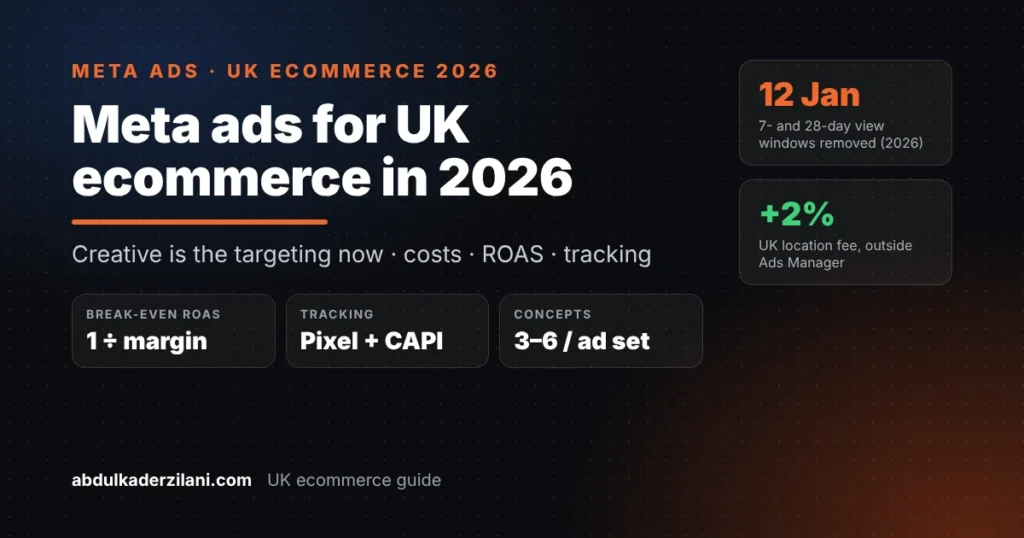
- Creative is the targeting now. Meta’s Andromeda system reads your ads to decide who sees them, so 3 to 6 genuinely different concepts per ad set beat ten versions of one ad.
- Part of the 2026 ROAS fall is measurement, not sales. Meta removed 7-day and 28-day view windows from its reporting API on 12 January 2026, and changed click attribution in March.
- Know your break-even ROAS before you spend. It is 1 divided by your margin. At 40% margin you need 2.5x just to break even on first orders.
- Run Pixel and Conversions API together, deduplicated, and check Event Match Quality weekly.
- Budget for the 2% UK location fee and VAT, which sit outside Ads Manager reporting.
What changed for Meta ads in 2026?
In short: Meta’s AI now does the targeting, using your creative as the main signal, while reporting changes made results look worse than they were. Three changes matter most for UK ecommerce brands:
- Andromeda and GEM. Meta’s ad retrieval and ranking systems now score every eligible ad and read the creative itself to decide who sees it.
- Advantage+ Sales is the default. Broad, automated campaigns replaced most manual interest targeting.
- Attribution changed. Fewer conversions are credited to ads in the reports, so ROAS looks lower even if sales did not fall by the same amount.
For the background, read our full guide to the Meta Andromeda update.
Andromeda, GEM and GenRecs in plain English
Andromeda is Meta’s ad retrieval engine, launched in December 2024. It picks which of millions of eligible ads are worth considering for each person. On 28 October 2026, Meta said the new version scores every eligible ad at more than one billion ads per second, and that Andromeda has delivered a 2.4% increase in conversions on Facebook since 2025 (PPC Land). Meta gave no baseline or method for that figure.
GEM, Meta’s Generative Ads Recommendation Model, is one central model that replaced separate models for Facebook, Instagram and Reels. GenRecs feeds it richer signals about what people engage with. Meta reports conversion gains from both, but these are Meta’s own numbers.
What it means for you: Meta groups ads that look alike and treats them as one creative. Ten near-identical ads buy you roughly one chance. Different hooks, people, formats and messages give the system more to match with different buyers.
Why did your ROAS fall, and how much was measurement?
Some of the fall is real cost inflation and some is reporting. Several independent datasets point the same way:
| Source | What it found | Caveat |
|---|---|---|
| Meta Q3 2026 results (21 Oct 2026) | Average price per ad up 14% year on year; impressions up 10% | Global; Meta does not report the UK separately |
| Confect study (3,014 advertisers, 2025) | Ecommerce ROAS down 7% after Andromeda; top performers down 31% | Reported via secondary summaries |
| Metricool (628,969 campaigns, H1 2025 vs H1 2026) | Reported ROAS for Meta sales campaigns fell from 5.48x to 4.57x | Attributed revenue, not profit |
Two reporting changes explain part of it. On 12 January 2026, Meta removed the 7-day view and 28-day view attribution windows from its Ads Insights API (Supermetrics). From March 2026, click-through attribution counts link clicks only; likes, comments and other interactions moved into a separate one-day “engage-through” window. The default for website purchase campaigns is now 7-day click, 1-day engage-through and 1-day view.
What to do: mark 12 January and early March 2026 in your reports, reset your baselines from March, and judge Meta on blended numbers (total revenue divided by total ad spend, and new-customer cost), not on platform ROAS alone.
How much do Meta ads cost in the UK?
There is no single UK figure, and anyone who gives you one is guessing. Meta does not publish UK-only prices. Published datasets disagree, so here are the medians from the largest UK dataset we could find, with its source. For the full breakdown, including cost per lead by industry, Q4 price jumps and monthly budgets, see how much Facebook ads cost in the UK.
| Metric | UK range | Source |
|---|---|---|
| CPM (cost per 1,000 impressions) | About £13 (US$17.38) median, roughly doubling from October to December | Superads, UK accounts, last 12 months |
| CPC (cost per click) | About £1.18 median | Superads, UK accounts |
| Click-through rate | About 1.59% median | Superads, UK accounts |
| Cost per purchase | About £53 median; about £36.50 in April 2026 and £85.50 in December 2025 | Superads, UK accounts |
Black Friday is expensive. In 2025, the median large Meta advertiser paid 59% more per 1,000 impressions in Black Friday week than in September, and 84% more on Black Friday itself (Lebesgue data via Selecdoo).
The UK costs most brands forget
- The 2% UK location fee. Since 1 July 2026, ads delivered to people in the UK carry a 2% fee on top of your budget. It does not show in Ads Manager reporting.
- VAT. If you are not VAT-registered, Meta adds 20% VAT you cannot reclaim. Our guide to VAT on Facebook ads explains the reverse charge and what changes in April 2027.
What ROAS should a UK ecommerce brand aim for?
Aim for a ROAS above your break-even ROAS, which is 1 divided by your margin after product, shipping, payment fees and returns. At a 40% margin, break-even is 2.5x. A campaign reporting 2.0x is losing money on first orders unless repeat purchases make up the gap.
For context, published ROAS benchmarks vary widely and are often based on US spend. Your own margin matters more than anyone’s average. Work it out with our break-even ROAS guide or free calculator.
Advantage+ Sales or manual campaigns?
Advantage+ shopping campaigns have become Advantage+ Sales campaigns. A sales campaign counts as Advantage+ when Advantage+ campaign budget, Advantage+ audience and Advantage+ placements are all switched on.
| Use Advantage+ Sales when… | Consider a manual campaign when… |
|---|---|
| You get roughly 30 to 50 purchases a week across the account | You get fewer than about 10 purchases a week |
| You have 8 or more proven creatives | You need tight control over who sees a specific offer |
| Pixel and Conversions API are both firing correctly | You are testing a new product or market on a small budget |
Meta’s own claims vary: its Help Centre mentions a 9% average improvement in cost per conversion, while its marketing pages mention 20% lower cost per result. Haus, a measurement company, analysed 640 incrementality experiments and found 58% of brands saw better incremental results on manual campaigns, while Advantage+ reached more new customers. Test both rather than trusting either claim.
One more change: Meta removed the existing-customer budget cap for Advantage+ Sales. If you want spend focused on new customers, exclude a customer list or use a second ad set with a spending limit.
Creative is the targeting now
- Build 3 to 6 genuinely different concepts per ad set, such as a UGC demo, a founder story, customer proof, a price-led static and a carousel.
- Change the hook, the person, the format and the message, not just the colour or headline.
- Refresh every few weeks. Practitioner data suggests creative now wears out faster, often within 2 to 6 weeks.
- Test statics as well as video. Do not assume video always wins: give simple product statics a fair share of the test and let results decide where the budget goes.
- Watch the Creative diversity column. A Low rating means your ads look alike to Meta, however many you have.
Vendor reports claim creative drives 70% to 80% of performance and that UGC-style ads cut CPA by around a fifth. These are vendor figures without published samples, but the direction matches what we see in accounts.
Tracking that works in 2026: Pixel plus Conversions API
Run the Meta Pixel and the Conversions API (CAPI) together, deduplicated with a shared event ID. Meta recommends using the Conversions API alongside the Pixel so it receives more complete conversion data, with a shared event ID so the same purchase is not counted twice (Meta for Developers).
- On Shopify, choose Enhanced or Maximum data sharing in the Facebook & Instagram app.
- On WooCommerce, use a server-side setup or Meta’s one-click CAPI option, launched in April 2026.
- Check Event Match Quality (0 to 10) in Events Manager weekly.
- Meta’s new on-device conversion measurement (from 12 November 2026) is not active for people in the UK, so do not expect it to change your results.
If your purchases are not showing up correctly, fix that before anything else. Every optimisation decision depends on it. Our Meta ads service includes a tracking audit as standard.
Budget and scaling: how much to spend to get out of learning
Meta says an ad set usually exits the learning phase after about 50 results in the week after its last significant edit. At a £30 cost per purchase, that is about £1,500 a week, or roughly £215 a day, for one ad set. Most small brands cannot fund that for many ad sets, which is why consolidation matters:
- One main Advantage+ Sales campaign for prospecting.
- One small testing campaign for new creative.
- One catalogue campaign if you have many products.
- Scale by 15% to 20% every few days, not by doubling overnight, and avoid editing a winning ad set daily.
The UK shopper in 2026
- 28.8% of UK retail sales were online in August 2026, seasonally adjusted (ONS).
- 80% of UK adults, about 45.9 million people, bought online in 2025 (UK Finance Payment Markets Report 2026).
- Smartphones account for 77% of UK adults’ time online (Ofcom Online Nation 2025).
- Unexpected shipping costs are the most common reason shoppers abandon late in the journey, ahead of stock issues and checkout complexity (Wunderkind UK 2026, vendor research).
Practical consequence: show delivery costs early, make the mobile checkout fast, and make sure your product page answers the questions your ad raises. Meta’s on-platform checkout for Shops was phased out in 2025, so every sale finishes on your website.
Black Friday and Christmas 2026: plan, don’t panic
- Have Black Friday ad sets live and out of learning by mid-November.
- Expect CPMs to rise sharply from mid-November; budget for it.
- Put extra budget into Cyber Week (26 to 30 November 2026), not into brand-new ad sets that start learning on the day.
- Do not compare Black Friday 2026 ROAS directly with 2025: attribution windows changed and the 2% UK fee now applies.
- Stay legal: under the DMCCA 2024, falsely claiming an offer is only available for a limited time is a banned practice.
10 mistakes UK ecommerce brands keep making on Meta
- Judging the account on platform ROAS instead of break-even ROAS and blended revenue.
- Running ten versions of one ad and calling it creative testing.
- Pixel only, with no Conversions API.
- Too many small ad sets that never leave learning.
- Editing winning ad sets every day.
- Ignoring the 2% UK location fee and VAT in the budget.
- Comparing 2026 results with 2025 without allowing for attribution changes.
- Sending ad traffic to a slow mobile page with hidden delivery costs.
- Launching Black Friday creative on Black Friday.
- Using fake urgency or incentivised reviews, now banned under UK law.
DIY or hire help?
Our honest view, as a team that sells this service: a store with steady purchase volume, Advantage+ Sales, working CAPI and a weekly creative routine can run Meta ads well in-house. Where outside help earns its fee is in tracking, account structure and disciplined creative testing, especially below about 30 to 50 purchases a week, or when there is no one producing new creative. Secret targeting tricks are not worth paying for, because they no longer exist.
A 30-day starter plan for a UK store
| Week | Focus | Actions |
|---|---|---|
| 1 | Foundations | Work out break-even ROAS; check Pixel + CAPI and Event Match Quality; fix delivery-cost and mobile checkout issues |
| 2 | Structure | One Advantage+ Sales campaign, one testing campaign; budget set from target cost per purchase |
| 3 | Creative | Launch 3 to 6 distinct concepts; check the Creative diversity column |
| 4 | Review | Judge on 7-day results, blended revenue and new-customer cost; cut losers, scale winners by 15% to 20% |
If you would like a second pair of eyes, see how we work with ecommerce and DTC brands, look at our 11x ROAS case study, or book a free 30-minute call.
Frequently asked questions
How much do Meta ads cost in the UK?
Across UK accounts in the last year, the median Facebook click cost about £1.18 and the median online purchase about £53, with December far more expensive than spring (Superads). See our full guide to how much Facebook ads cost in the UK. Add the 2% UK location fee, and VAT if you are not VAT-registered.
Are Facebook ads worth it for UK ecommerce in 2026?
They can be, if your ROAS clears your break-even ROAS once VAT, the location fee and returns are counted. Brands that fix tracking, test genuinely different creative and judge results on blended revenue tend to do well; brands relying on old targeting tricks tend to struggle.
What is a good ROAS for Meta ads in the UK?
A good ROAS is one above your break-even ROAS, which is 1 divided by your margin. At 40% margin that is 2.5x. Published benchmarks range from about 1.5x to 4x, so use your own margin rather than an industry average.
Should I use Advantage+ Sales or manual campaigns?
Advantage+ Sales usually works best with 30 to 50 purchases a week, several proven creatives and working CAPI. With fewer than about 10 purchases a week, a tighter manual campaign can concentrate spend better. Testing both is the safest approach.
Do I still need the Meta Pixel if I use the Conversions API?
Yes. Meta recommends running both together, deduplicated with a shared event ID. The Pixel captures browser events and CAPI sends server events that browsers can miss.
How many ads should I run in each ad set?
Aim for 3 to 6 genuinely different concepts per ad set, rather than many small variations. Meta groups similar ads together, so variety matters more than volume.
Can customers still buy inside Facebook and Instagram?
No. Meta phased out on-platform checkout for Shops in 2025, so purchases finish on your website. Your product pages and checkout need to convert.
Sources
- PPC Land: Meta says Andromeda lifted Facebook conversions 2.4% (28 Oct 2026)
- Segwise: Andromeda summary
- Supermetrics: Meta attribution window removals (12 Jan 2026)
- Selecdoo: Black Friday and Cyber Monday data
- ONS: Retail sales, Great Britain, August 2026
- Superads: Facebook ads cost per purchase, United Kingdom
- Meta for Developers: Deduplicate Pixel and server events
- Meta Q3 2026 earnings (21 October 2026); Confect and Metricool studies as cited; Haus: The Meta Report (640 incrementality experiments).