Digital Marketing Agency for Small Business in the UK: Affordable Packages and What to Expect
 By Abdul Kader Zilani
·
· 9 min read
Most small business owners who look for a digital marketing agency have the same two questions: what will it cost, and what will I actually get for that money? Agency websites rarely answer either clearly. Packages are named “Starter”, “Growth” and “Pro”, and it is hard to tell what sits behind them.
This guide answers both questions in plain English. Instead of quoting other agencies’ prices, it shows how to turn any monthly fee into hours and tasks, how far a realistic ad budget goes using Google’s own click price data, and which contract terms to push back on before you sign.
A digital marketing agency for small business should do a few things well rather than everything thinly. Treat the monthly fee as hours of work, keep ad spend as a separate budget, own all your accounts, and avoid long lock-in contracts. For most small firms, one well-run channel beats four half-managed ones.
What a digital marketing agency for small business should actually do
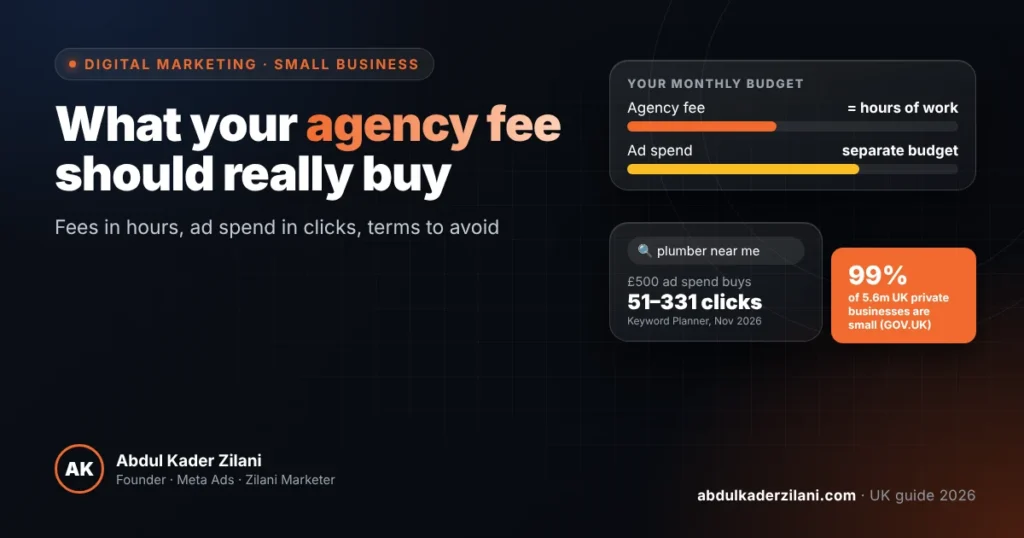
Small businesses are the norm in the UK, not the exception. The government’s Business Population Estimates 2026 put the number of private sector businesses at the start of 2026 at 5.6 million, with 99.15% of them small (0 to 49 employees) and 74% not employing anyone aside from the owners. Most of these firms do not need a big agency team. They need someone who understands a tight budget.
Digital tools are already part of how these firms work. The government’s Longitudinal Small Business Survey 2025 found 74% of SME employers used technologies or web-based software to sell to customers or manage the business, up from 69% in 2024 and 61% in 2023. The gap is usually not access to tools; it is time and know-how to use them well.
A good small business agency should:
- Start by asking about your margins, average customer value, capacity and the area you serve.
- Recommend a priority order, usually starting with the channel closest to people ready to buy.
- Fix the basics first: website enquiry paths, tracking, Google Business Profile.
- Report on enquiries, sales and cost per customer, not just impressions and followers.
- Tell you when something is not worth doing yet.
If you want the wider version of this decision, our guide on how to choose a digital marketing agency covers agency, freelancer and in-house options in more depth.
What £500, £1,000 and £2,000 a month can realistically buy
Every agency fee is really a number of hours. The simplest question you can ask is: “What is your hourly or day rate, and how many hours does this package include each month?” Divide the fee by the rate and you know what you are buying. If an agency will not answer, that tells you something too.
The table below is our view of what each fee level can realistically cover for a small business, as a scope guide, not a price list. Ad spend is separate in every case.
| Monthly agency fee | Realistic scope | What it usually cannot cover |
|---|---|---|
| Around £500 | One channel kept healthy: for example Google Business Profile and review requests, or light management of a small Google Ads or Meta account, plus a short monthly report | New content every week, regular new ad creative, website changes |
| Around £1,000 | One channel managed properly with weekly optimisation, or two channels at a lighter level; some content or creative each month | Full SEO plus paid ads plus social at once |
| Around £2,000 | Two channels with regular optimisation, ongoing content or creative, and small landing page or conversion improvements | A multi-channel national campaign or heavy video production |
The most common mistake at the lower levels is paying for a “full service” package. If £500 is spread across SEO, Google Ads, Meta ads and social posting, each one gets a sliver of time. Our guide to getting more customers explains how to pick the first channel.
Agency fee vs ad spend: the two budgets small businesses mix up
Your agency fee pays for the work. Your ad spend goes to Google, Meta or another platform. Some packages blur the two, so always ask for them separately in writing.
To show how far ad spend goes, here is what £500 and £1,000 a month buy in clicks at Google’s top-of-page bid ranges. Figures come from Google Keyword Planner, United Kingdom, last 12 months, checked 15 November 2026. The click counts are simple arithmetic, not forecasts.
| Search term | Top-of-page bid range | Clicks for £500 | Clicks for £1,000 |
|---|---|---|---|
| plumber near me | £1.51 to £9.73 | about 51 to 331 | about 102 to 662 |
| electrician near me | £1.32 to £7.41 | about 67 to 378 | about 134 to 757 |
| dentist near me | £1.46 to £5.76 | about 86 to 342 | about 173 to 684 |
| estate agents near me | £1.75 to £10.19 | about 49 to 285 | about 98 to 571 |
| accountant near me | £3.91 to £13.94 | about 35 to 127 | about 71 to 255 |
| conveyancing solicitor | £8.29 to £16.87 | about 29 to 60 | about 59 to 120 |
Two extra costs to remember: Google adds a 2% UK surcharge to ads served in the UK, and businesses not registered for VAT pay 20% VAT on Google and Meta ads (VAT-registered businesses use the reverse charge). Our Google Ads cost guide explains these in detail.
The practical lesson: if your clicks are expensive, a small ad budget only produces a handful of enquiries a month. In that case, SEO and local SEO may be a better place for some of the money. Our SEO vs PPC comparison helps with that choice.
Small business digital marketing packages: what to look for
A good package is specific. Compare what is written down, not the package name.
| Question to ask | Good answer | Warning sign |
|---|---|---|
| How many hours are included? | A clear number, with a breakdown by task | “As many as needed” or no answer |
| Who does the work? | Named people and their roles | Vague “team”, or work passed to unnamed subcontractors |
| What is reported? | Enquiries, sales, cost per lead or customer | Only impressions, reach and rankings |
| Who owns the accounts? | You own every account; the agency has access | The agency creates accounts in its own name |
| What happens in month one? | A tracking check, audit and written plan | Straight into posting or ad spend |
| How do I leave? | Short notice, with all access and data handed back | Long notice, exit fees, or “our” website templates you lose |
You can see how we set out scope, ownership and notice periods in our terms of engagement.
Contract lengths and terms to avoid with a small business agency
Long contracts are the biggest risk for a small business, because you cannot judge an agency until it has worked for you for a few months.
Terms worth pushing back on:
- 12-month minimum terms with no break clause. A short initial period followed by a rolling monthly arrangement is fairer to both sides.
- Long notice periods. Ask for 30 days.
- Website or domain held by the agency. Your domain should be registered to your business, and you should get full admin access to the website.
- Ad accounts in the agency’s name. If you leave, you could lose years of data.
- Guaranteed rankings or results. No one controls Google’s rankings or ad auctions.
- Review-generation schemes. Fake reviews and undisclosed incentivised reviews have been unlawful in the UK since 6 April 2025 under the Digital Markets, Competition and Consumers Act 2024. An agency offering to “boost your reviews” with fake or paid reviews is putting your business at risk.
Red flags when choosing a digital marketing agency for small business
- They have not asked what a customer is worth to you.
- The proposal is the same for every business, with your name dropped in.
- They promise first-page rankings in weeks.
- Reports focus on vanity numbers like reach and follower counts.
- They push you onto every channel at once.
- Case studies have no detail you can check.
- They will not say who does the work or how many hours you get.
When a small business does not need an agency yet
Sometimes the honest answer is “not yet”. You may be better off doing it yourself, or paying for a one-off audit or strategy session, if:
- Your website does not make it easy to call, book or buy. Fix that first.
- You can only handle a few more jobs a month. A complete Google Business Profile and steady reviews may be enough; our small business SEO guide shows the priority order.
- Your total budget, fee plus ad spend, is too small to test one channel properly.
- You have not yet confirmed what makes customers choose you over competitors.
A short consultancy engagement can also make sense if you have someone in-house who can do the work but needs a plan. Our digital marketing consultant guide explains how that differs from an agency retainer.
A quick checklist before you sign
- Write down your average customer value and how many new customers you can handle a month.
- Ask for the fee in hours and tasks.
- Get ad spend quoted separately, including the Google surcharge and VAT position.
- Confirm you own your domain, website, ad accounts, analytics and Google Business Profile.
- Agree what success looks like at 30, 60 and 90 days.
- Check the minimum term, notice period and any exit fees.
- Ask for one or two clients you can speak to, or case studies with checkable detail.
Frequently asked questions
How much does a digital marketing agency cost for a small business in the UK?
It depends on hours and scope. Ask any agency for its hourly or day rate and the hours included, then divide. Keep ad spend separate. As a guide, a few hundred pounds a month usually covers one channel at a light level, not full-service marketing.
Is £500 a month enough for digital marketing?
It can be enough to keep one channel healthy, for example your Google Business Profile and reviews, or light management of a small ad account. It is not enough for SEO, paid ads and social media at the same time.
Should ad spend be included in the agency fee?
No. Keep the agency fee and the ad spend separate in writing, so you can see exactly what goes to the platforms and what pays for the work.
What contract length is reasonable?
A short initial period followed by rolling monthly terms with around 30 days’ notice is a sensible starting point for a small business. Be cautious with 12-month terms that have no break clause.
Should a small business use an agency or a freelancer?
A freelancer often suits one channel and a small budget. An agency suits work needing several skills, such as ads plus creative plus website changes. The right choice depends on scope, not the label.
What should a small business agency report each month?
Enquiries or sales, cost per lead or customer, what changed and what is planned next. Impressions and reach are useful context, not the main result.
The bottom line
A digital marketing agency for small business is worth paying for when it focuses your budget on the one or two channels most likely to bring customers, explains the fee in hours, keeps ad spend separate and leaves you owning everything. Be wary of all-in-one packages that spread a small fee too thin.
If local customers matter most to you, see our local SEO service or our Google Ads management service. Or book a strategy call and we will help you decide which channel to start with, or whether you need an agency at all yet.
Sources
- GOV.UK: Business population estimates for the UK and regions 2026
- GOV.UK: Longitudinal Small Business Survey 2025, SME employers
- Google Keyword Planner, United Kingdom, last 12 months, checked 15 November 2026
- Digital Markets, Competition and Consumers Act 2024 (legislation.gov.uk)