Digital Marketing Consultant in the UK: Costs in 2026, Retainers and What You Get
 By Abdul Kader Zilani
·
· 9 min read
Most small business owners who look up a digital marketing consultant want one number: what will this cost me each month? The honest answer is that the number depends far less on the consultant’s title than on how many hours of real work you are buying, and whether those hours go on thinking or on doing.
This guide breaks a consultant’s cost into those hours, shows what each type of engagement should produce, and covers the UK-specific bits that catch people out, such as VAT, IR35 and the platform fees that sit on top of your ad spend.
A digital marketing consultant in the UK is paid for time: a one-off audit, a set number of days, or a monthly retainer that buys a fixed block of hours. Work out the hours first, then the rate. A sensible first step for most small businesses is a paid audit and 90-day plan, then a monthly retainer only if the plan needs ongoing hands-on work. Ad spend, software and VAT are separate costs.
What a digital marketing consultant in the UK actually does
A consultant is usually one experienced person (sometimes with a small team behind them) who looks at your whole marketing picture and tells you what to do first. The good ones also tell you what to stop doing. That is different from an agency, which is normally hired to deliver a defined channel, such as running your Google Ads or writing content every month.
In practice the work falls into three buckets:
- Diagnosis: checking your tracking, website, offer, Google Business Profile, ad accounts and search visibility, then finding where money or leads are leaking.
- Strategy: choosing the two or three channels that fit your budget and customers, setting targets, and writing a plan with owners and dates.
- Delivery or oversight: either doing the work (building campaigns, fixing tracking, writing landing pages) or reviewing the work of your team or other suppliers.
If you are still deciding between a consultant and an agency, our guide to choosing a digital marketing agency and the broader marketing consultant guide cover that choice in more depth.
Digital marketing consultant costs in the UK: how pricing is built
Every pricing model is a different way of packaging hours. Once you know roughly how many hours a job takes, you can compare quotes fairly, whatever the consultant calls their package.
| Pricing model | What you are buying | Best for | Watch out for |
|---|---|---|---|
| Hourly | Ad hoc time, billed in small blocks | One-off questions, quick fixes | Open-ended bills if scope is vague |
| Day rate | Full days of focused work | Audits, workshops, strategy sprints | Ask what “a day” includes (usually 7 to 8 hours) |
| Fixed project fee | A defined deliverable, such as an audit or tracking setup | Clear, one-off jobs | Make sure revisions and handover are included |
| Monthly retainer | A set number of hours or days each month | Ongoing management or advice | Rolling hours, minimum terms, and who owns the accounts |
| Performance or revenue share | A share of results | Rare for small businesses | Hard to measure fairly; attribution arguments |
The table is deliberately rate-free. Rates vary with experience, location and whether you are hiring a sole trader or a limited company, and quoting a “typical” day rate would not tell you whether your quote is fair. Hours will.
How many hours common consultant jobs take
These are working examples based on the scope we would expect for a single-location small business with one or two ad channels. Your consultant should give you their own estimate in writing.
| Job | Example hours | What you should receive |
|---|---|---|
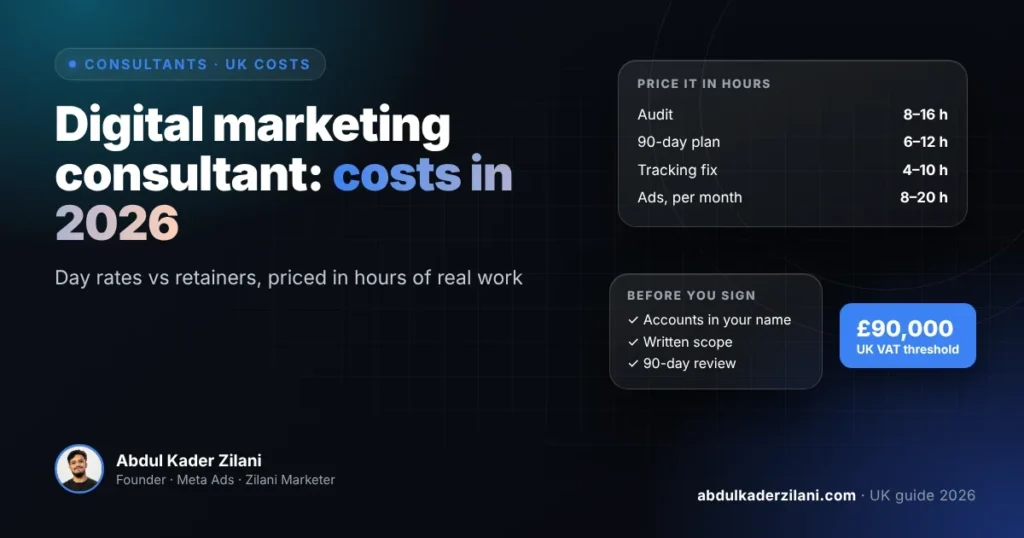
| Marketing audit (tracking, ads, website, Google Business Profile) | 8 to 16 hours | Written findings ranked by impact, with screenshots |
| 90-day strategy and plan | 6 to 12 hours | Channel choice, budget split, targets, owner for each task |
| Conversion tracking fix (GA4, Google Ads, Meta) | 4 to 10 hours | Working conversions, tested, with a short handover note |
| Monthly ad management, one channel | 8 to 20 hours a month | Changes log, monthly report, next month’s tests |
| Monthly advisory call plus review of your team’s work | 3 to 6 hours a month | Call notes and a prioritised action list |
Multiply those hours by the rate you are quoted and you have a sanity check. If a monthly fee works out at two hours of real work for “full management”, ask what is actually being done. If a quote assumes 40 hours of strategy before anything changes, ask why.
For our own fees and how we scope work, see the terms of engagement.
Day rate vs retainer: which digital marketing consultant model fits
The right model depends on whether you need thinking or doing.
| Your situation | Better fit | Why |
|---|---|---|
| You have a team or freelancer doing the work but no clear plan | Day rate or fixed-fee audit and strategy | You need direction, not more hands |
| You have no one running ads or tracking | Retainer with hands-on delivery | Someone has to do the weekly work |
| You have a specific broken thing (tracking, a failing campaign) | Fixed project fee | Clear scope, clear finish line |
| You are growing fast and spending across several channels | Retainer with monthly reviews | Decisions need to be made every week |
| You only want a second opinion before hiring an agency | One or two days | An independent check is cheap compared with a bad contract |
A common, sensible route is: audit first, then a short retainer with a review point at 90 days. That gives you an exit if the plan is not working and stops you locking into a 12-month contract on day one.
What a good digital marketing consultant should deliver in the first 90 days
Whatever you pay, the first three months should produce visible outputs, not just meetings.
- Weeks 1 to 2: access to your accounts (in your name), a tracking check, and a written audit with the three biggest problems.
- Weeks 3 to 4: a plan that says which channels, what budget, what target cost per lead or return on ad spend, and who does each task.
- Month 2: the first fixes are live. Tracking is reliable, the worst-performing spend is cut, and at least one new test is running.
- Month 3: a review against the targets in the plan, with a clear recommendation to continue, change or stop.
Tracking deserves special attention because almost every decision depends on it. If purchases or leads are not recorded properly, the consultant is guessing. Our guides to Meta Pixel purchase tracking problems and the Facebook Conversions API show what a working setup looks like.
The costs that sit on top of a consultant’s fee
A consultant’s fee is rarely your biggest marketing cost. Budget for these too.
| Cost | What it is | UK detail |
|---|---|---|
| Ad spend | Money paid to Google, Meta, TikTok and others | Paid directly to the platform, ideally on your own card |
| Google UK surcharge | Extra charge on ads served in the UK | Google adds 2% to ads served in the UK, in place since 1 November 2020 |
| Meta UK location fee | Extra charge on ads delivered in the UK | Meta has added a 2% UK location fee since 1 July 2026 |
| VAT on ad spend | Tax on platform invoices | VAT-registered businesses use the reverse charge; non-registered pay 20% VAT |
| VAT on the consultant’s fee | Added if the consultant is VAT registered | The UK VAT registration threshold is £90,000 of taxable turnover |
| Software | Email tools, landing page builders, call tracking | Usually monthly subscriptions in your name |
Our posts on Google Ads costs in the UK and VAT on Facebook ads explain the platform side in detail.
IR35 and contracts: the UK paperwork small businesses ask about
If your consultant works through their own limited company, the off-payroll working rules (often called IR35) may apply. GOV.UK guidance says that medium and large clients must decide the employment status of contractors who work through their own company. If your business counts as small under the rules, that decision stays with the consultant’s own company.
The size test uses Companies Act thresholds (turnover, balance sheet total and number of employees), and those thresholds have changed recently, so check the current figures on GOV.UK or with your accountant. For most small businesses hiring a consultant for a defined project, the practical points are simpler:
- Buy outcomes and deliverables, not a person’s time under your direction.
- Let the consultant use their own tools, working hours and methods.
- Put the scope, notice period and ownership of work in writing.
This is general information, not tax or legal advice.
Red flags when hiring a digital marketing consultant
- Guaranteed rankings or guaranteed returns. No one controls Google’s results or an ad auction.
- Accounts set up in the consultant’s name. Your Google Ads, Meta Business Manager, GA4 and Google Business Profile should belong to your business, with the consultant added as a user.
- No written scope. “We’ll handle your marketing” is not a scope.
- Reports full of impressions and reach but no leads, sales or cost per result.
- Long minimum terms before any results review. A 90-day review point is reasonable; 12 months with no exit is not.
- Fake proof. Since 6 April 2025, fake reviews and undisclosed incentivised reviews are unlawful in the UK under the DMCC Act 2024. A consultant who offers to “boost” your reviews is putting your business at risk.
A simple checklist before you sign
- Ask for an hours estimate for each part of the work.
- Confirm all accounts and data stay in your business’s name.
- Agree two or three targets that link to revenue (leads, sales, cost per lead).
- Agree how and when you will get reports, and what they will include.
- Check notice period and what happens to work in progress if you leave.
- Ask who actually does the work: the consultant, a junior, or a subcontractor.
- Ask for a recent example of an audit, with client details removed.
Frequently asked questions
How much does a digital marketing consultant cost in the UK?
It depends on the hours involved and the rate. As a working example, an audit for a small business typically takes 8 to 16 hours and a monthly retainer for one ad channel 8 to 20 hours. Multiply the hours by the quoted rate, then add ad spend, software and VAT.
Is a day rate or a monthly retainer better?
A day rate or fixed fee suits audits, strategy and one-off fixes. A retainer suits ongoing hands-on work, such as running ads every week. Many small businesses start with an audit, then move to a short retainer with a 90-day review.
What should a consultant deliver in the first month?
Access to accounts in your name, a tracking check, a written audit ranked by impact and a plan with targets, owners and dates. If after a month you only have meeting notes, ask why.
Do I pay VAT on a consultant’s fees?
Only if the consultant is VAT registered. Businesses must register once taxable turnover passes £90,000. If you are VAT registered yourself you can normally reclaim it.
Does IR35 apply when I hire a marketing consultant?
It can if they work through their own limited company. Medium and large clients must decide employment status; for small clients the consultant’s company decides. Check the current GOV.UK guidance or ask your accountant.
Is a consultant cheaper than an agency?
Not always per hour, but you often buy fewer hours because a consultant focuses on the few changes that matter. An agency can be better value when you need a lot of ongoing production, such as content or creative.
The bottom line
A digital marketing consultant is worth the money when you can see what each hour bought: a clear audit, a plan with targets, working tracking and a regular review against results. Price the hours, keep your accounts in your own name, and build in a 90-day review.
If you want an outside view of your current marketing, see how our Meta ads management and Google Ads management work, or book a strategy call and we will tell you honestly whether you need a consultant at all.