VAT on Facebook Ads: Do UK Businesses Pay It? (2026 Guide)
 By Abdul Kader Zilani
·
· Updated 23 Nov 2026 · 13 min read
You set a £300 budget in Ads Manager, and £360 leaves your bank account. Or you are VAT-registered and your accountant asks why there is no VAT on your Meta invoice. Both situations come from the same rule, and once you know it, Facebook ad billing stops being confusing.
This guide explains, in plain English, whether UK businesses pay VAT on Facebook and Instagram ads, how the reverse charge works on your VAT return, what the new 2% UK location fee is, and what changes from April 2027. It is written for UK small business owners, not tax specialists.
This is a general guide based on HMRC guidance and Meta billing information as of November 2026. VAT depends on your own circumstances, especially if you are partly exempt or use a special scheme such as the Flat Rate Scheme. Check your position with your accountant.
- It depends on one thing: whether you are VAT-registered. If you are, and Meta has your VAT number, Meta adds no VAT and you account for it yourself under the reverse charge.
- For most VAT-registered businesses the reverse charge costs nothing. You declare 20% and reclaim the same 20% on the same return.
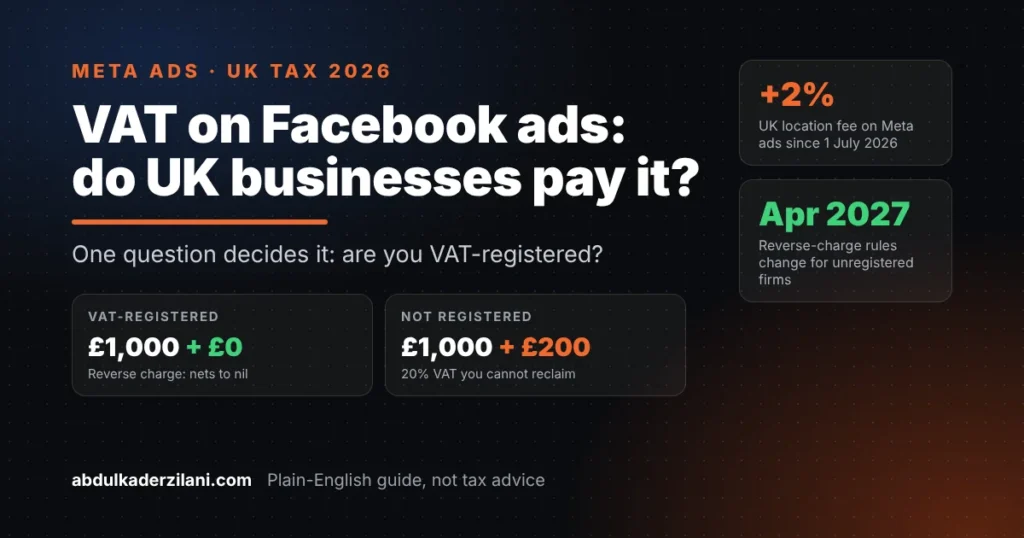
- If you are not VAT-registered, Meta adds 20% VAT you cannot reclaim. A £1,000 spend costs £1,200.
- There is also a separate 2% UK location fee on ads shown to people in the UK since 1 July 2026. It is not VAT and it does not show in Ads Manager reporting.
- The rules change on 1 April 2027. The reverse charge will only apply to VAT-registered businesses. This was announced in the Autumn Budget 2026.
Do UK businesses pay VAT on Facebook ads?
Yes, but how you pay it depends on whether you are VAT-registered. If you are VAT-registered and Meta has your VAT number, Meta charges no VAT and you account for 20% yourself through the reverse charge, which usually nets to zero. If you are not VAT-registered, Meta adds 20% UK VAT to your bill, and you cannot reclaim it.
| Your situation | What Meta charges on £1,000 of ads | Net VAT cost to you |
|---|---|---|
| VAT-registered, VAT number added, fully taxable business | £1,000, no VAT added | £0 (you declare and reclaim £200 on the same return) |
| VAT-registered, but VAT number missing | £1,200, VAT added | Ask your accountant; fix the account so future receipts are right |
| Not VAT-registered | £1,200, VAT added | £200, which you cannot reclaim |
| Partly exempt (e.g. insurance, finance, health, education) | £1,000, no VAT added | Possibly a real cost; depends on how the ads relate to your taxable sales |
On top of any of these, ads delivered to people in the UK carry a 2% location fee, which is covered further down.
Why are Facebook ads treated as bought from abroad?
For most UK advertisers, the seller on the invoice is Meta Platforms Ireland Ltd, not a UK company. Under HMRC’s place-of-supply rules, advertising sold business-to-business is taxed where the customer belongs. So when a UK business buys ads from an overseas supplier, the supply is treated as made in the UK, and the UK business accounts for the VAT. This is explained in HMRC VAT Notice 741A.
Check your own receipt first. In Meta Business Suite or Ads Manager, open Billing and payments, then Payment activity, and open one receipt. Look at the “Sold by” line. If it says Meta Platforms Ireland and you are buying for business, there should be no VAT once your VAT number is on file. If the seller is a local Meta company, VAT may be added and a VAT-registered business can usually reclaim it in the normal way.
How does the reverse charge work if you are VAT-registered?
Under the reverse charge you act as both seller and buyer for VAT purposes: you add VAT on the ad spend as if you had charged it, then reclaim the same amount as input tax. For a business that makes only taxable sales, the two cancel out, so there is no cash cost.
What goes on your VAT return: a £1,000 example
Say you spent £1,000 on Meta ads in the quarter, with your VAT number on the account. Following HMRC VAT Notice 700/12:
| Box | What you enter | Amount |
|---|---|---|
| Box 1 | VAT due on the ad spend (output tax) | £200 |
| Box 4 | VAT you reclaim on the same spend (input tax) | £200 |
| Box 6 | Total value of sales, including the reverse-charge supply | +£1,000 |
| Box 7 | Total value of purchases, including the reverse-charge supply | +£1,000 |
Net effect: £0. Most bookkeeping software (Xero, QuickBooks, FreeAgent) has a “reverse charge” tax code that fills these boxes for you when you record the Meta receipt.
What if you are not VAT-registered?
If you are not VAT-registered, Meta treats your purchase as non-business and adds 20% UK VAT. You pay it, and you cannot reclaim it, so it is simply part of the cost of advertising. A £300 monthly budget becomes £360 leaving your bank, before the location fee.
Two practical points. First, your daily budget in Ads Manager does not include VAT, so the amount charged will always be higher than the budget you set. Second, plan your budget on the gross figure, not the Ads Manager figure, or the first invoice will be a surprise.
The £90,000 threshold trap: can ad spend push you into VAT registration?
The VAT registration threshold is £90,000 of taxable turnover in any rolling 12-month period, and has been since 1 April 2024. Some older guides still quote £85,000, which is out of date.
Here is the part many guides get wrong. HMRC Notice 741A says that if you are not registered and receive business services from overseas that fall under the reverse charge, their value must be added to your taxable supplies when you check whether you need to register. In HMRC’s words, you “may still be required to register” even if you make no taxable supplies yourself. If you are close to the threshold and spend heavily on Meta, Google or other overseas services, ask your accountant how this applies to you. This trap is due to disappear for unregistered businesses from April 2027.
What should your Meta invoice show?
Meta issues receipts and, where applicable, invoices in Billing and payments (on desktop). For a business account using the reverse charge, check that the document shows:
- Your business name and address
- Meta’s VAT number and the seller entity (for most UK accounts, Meta Platforms Ireland Ltd)
- The amount excluding VAT
- A note that the reverse charge applies
- Your VAT number, once it has been added
One quirk reported by advertisers: some receipts show a VAT total line even when no VAT was charged. Look at what was actually taken, and give your accountant the receipt rather than a screenshot of Ads Manager.
How to add your VAT number in Ads Manager
- Open Ads Manager, then the ad account settings.
- Find the business information or tax section and the VAT number field.
- Select the country, enter your VAT number exactly as it appears on your HMRC certificate, and save.
- Wait for the next charge, then open that receipt and confirm your VAT number appears and no VAT was added.
Two warnings. New tax details only apply to future receipts, not past ones. And advertisers have reported that the field is labelled for EU VAT numbers, with little guidance for UK numbers after Brexit. Do not assume it worked from the settings page alone; check the next receipt, and contact Meta support if your number is missing.
What is the 2% UK location fee on Meta ads?
Since 1 July 2026, Meta adds a “location fee” to ads delivered to people in certain countries, to pass on digital services taxes it previously absorbed. The UK rate is 2%. It is not VAT, it is based on where your audience is rather than where your business is, and it is charged on top of your budget.
- Rates: UK 2%, France, Italy and Spain 3%, Austria and Türkiye 5% (Search Engine Land; Digiday).
- Where it shows: as a separate line in Billing and payments, not in Ads Manager reporting.
- VAT: VAT is applied on top of the ad cost plus the fee.
- Example: on £1,000 of ads shown in the UK, the fee is £20. If you are not VAT-registered, you would pay roughly £1,000 + £20 + 20% VAT = £1,224.
The fee reflects the UK Digital Services Tax, a 2% tax on large digital companies’ UK revenues that has applied since April 2020 (HMRC Digital Services Tax review). How the fee is treated inside a reverse-charge calculation is worth confirming with your accountant.
If you sell exempt services, is the reverse charge a real cost?
It can be. HMRC’s guidance is that if you cannot reclaim all your input tax, because some of your sales are VAT-exempt, the reverse charge effectively makes you pay VAT on the ads. This affects businesses in areas such as insurance, finance, some healthcare, education and property.
A useful example is the tribunal case of Sofology and DFS v HMRC [2022] UKFTT 153 (TC). Both retailers sold sofas (taxable) and also earned commission on credit insurance (exempt). HMRC argued that VAT on their online advertising should be split between the two. The tribunal disagreed: the advertising had a direct and immediate link to the sofa sales, so the VAT was fully recoverable. The lesson for a partly exempt business is that the answer depends on what your ads actually promote, so it is worth getting advice.
What changes on 1 April 2027?
At the Autumn Budget on 28 October 2026, the government announced that from 1 April 2027 the reverse charge on services from overseas will only apply when the UK customer is VAT-registered. If the UK business is not registered, the overseas supplier will have to charge UK VAT itself (HMRC policy paper, 28 October 2026).
| If you are… | Today | From 1 April 2027 (as announced) |
|---|---|---|
| VAT-registered | Reverse charge; usually £0 net | No change |
| Not VAT-registered | Meta adds 20% VAT in practice; reverse-charge services can count towards the £90,000 threshold | Supplier must charge 20% UK VAT; the threshold trap falls away |
For Meta ads, the visible change for unregistered businesses may be small, because Meta already adds VAT when no VAT number is on file. The bigger change is the end of the threshold trap. The measure still depends on legislation, so treat the detail as subject to change.
Does VAT change your ROAS?
Ads Manager’s “Amount spent” excludes VAT and excludes the location fee. If you are VAT-registered and fully taxable, that is fine: your real cost is close to the Ads Manager figure plus the 2% fee. If you are not VAT-registered, your real cost is about 22% higher than Ads Manager shows for UK-delivered ads, so your true return on ad spend is lower than the dashboard says.
For example, if Ads Manager shows £1,000 spent and £3,000 in sales (3.0x ROAS), an unregistered business actually paid about £1,224, so the real return is about 2.45x. Work out your break-even ROAS on the gross figure, or use our free ROAS calculator.
VAT on Google Ads: how it differs from Meta
Google Ads handles VAT differently from Meta, and the difference matters most if you are not VAT-registered. Google serves UK advertisers from Google Ireland Ltd. Its tax help page says Google “can’t charge VAT” when your billing address is outside the European Union, and the UK has been outside the EU since 2021. In practice, a Google Ads invoice to a UK address carries no VAT.
| Meta (Facebook and Instagram) | Google Ads | |
|---|---|---|
| VAT-registered, VAT number added | No VAT on the invoice. You account for it with the reverse charge | No VAT on the invoice. You account for it with the reverse charge |
| Not VAT-registered | Meta adds 20% UK VAT | No VAT added |
| Extra UK fee on top | 2% location fee (since 1 July 2026) | 2% UK surcharge (since 1 November 2020) |
| Is the extra fee VAT? | No | No |
If you are VAT-registered, the reverse charge works exactly as it does for Meta. You record 20% output VAT and 20% input VAT on the same return, so the net is zero for a fully taxable business. Google’s own help puts it plainly: non-Irish advertisers are “responsible for determining taxes due at your country’s local rate” (Google Ads Help).
If you are not VAT-registered, you pay no VAT on Google Ads, while the same spend on Meta carries 20%. The spend can still count towards the £90,000 registration threshold, as explained in the threshold section above.
On a £500 monthly budget, a non-registered business pays about £600 a month on Meta (budget plus VAT) but about £500 on Google Ads, before the 2% UK fees on each. Compare the platforms on the gross cost that leaves your bank, not on the figure in each ads account.
Common mistakes UK advertisers make
- Adding a VAT number and never checking the next receipt.
- Budgeting from the Ads Manager figure when not VAT-registered.
- Treating the 2% location fee as VAT, or not noticing it at all.
- Recording Meta receipts without the reverse-charge tax code, so Boxes 6 and 7 are wrong.
- Assuming the reverse charge is always free when you also make exempt sales.
- Relying on old guides that quote an £85,000 threshold.
Frequently asked questions
Do I pay VAT on Facebook ads if I am not VAT-registered?
Yes. If you are not VAT-registered, Meta treats you as a non-business customer and adds 20% UK VAT to your bill. You cannot reclaim it, so a £1,000 spend costs £1,200, plus the 2% UK location fee on ads shown in the UK.
Can I claim the VAT back on Facebook ads?
If you are VAT-registered and make taxable sales, yes in effect: under the reverse charge you declare and reclaim the same 20% on one VAT return, so the net cost is nil. If you are not registered, you cannot reclaim it. If you make exempt sales, you may only recover part of it.
Why is Meta charging me VAT when I am VAT-registered?
Usually because your VAT number is missing from the ad account, was entered incorrectly, or was added after the charge. New details only apply to future receipts. Add or correct the number, check the next receipt, and talk to your accountant about the past charges.
Is the 2% Meta location fee VAT?
No. It is a separate fee Meta has added since 1 July 2026 for ads delivered to people in the UK, to pass on digital services tax costs. It is charged on top of your budget, shown in Billing and payments, and VAT is applied on top of it.
Does Facebook ad spend count towards the VAT threshold?
For an unregistered business, HMRC guidance says the value of reverse-charge services received from overseas must be added to taxable supplies when checking the £90,000 threshold. This is due to change from 1 April 2027. Check your own position with your accountant.
Which boxes do I use on my VAT return for Meta ads?
Under the reverse charge, enter the VAT in Box 1 and reclaim it in Box 4, and include the net value of the ads in both Box 6 and Box 7.
Is a Meta receipt enough for HMRC?
Keep the receipt or invoice from Billing and payments, which shows the seller, the amount and tax details. Make sure your VAT number appears on it once added. Your accountant can confirm what your records need to show.
Are Facebook ads vatable in the UK?
Yes. Facebook and Instagram advertising is a standard-rated service in the UK, so 20% VAT applies. If you are VAT-registered and your VAT number is in Ads Manager, Meta charges no VAT and you account for it with the reverse charge. If you are not registered, Meta adds 20% to your bill.
Is there VAT on Google Ads in the UK?
Google Ireland does not add VAT to Google Ads invoices sent to a UK address. If you are VAT-registered, you account for it yourself with the reverse charge, which nets to zero for most businesses. If you are not registered, you pay no VAT on Google Ads, but the spend can still count towards the VAT threshold.
Is the 2% Google UK surcharge VAT?
No. It is a separate fee Google has added to ads served in the UK since 1 November 2020, so you cannot reclaim it as VAT.
The bottom line
If you are VAT-registered, add your VAT number, check the next receipt, record Meta under the reverse charge and budget for the 2% location fee. If you are not registered, budget about 22% above your Ads Manager spend for UK audiences and judge results on the real cost. Either way, put a note in your diary for March 2027 and ask your accountant how the new rules affect you.
If you want help making Meta ads pay back once every cost is counted, see our Facebook ads management service, read our 2026 Meta ads playbook for UK ecommerce, see what Facebook ads really cost in the UK, or book a free 30-minute call.
Sources
- HMRC VAT Notice 741A: place of supply of services
- HMRC VAT Notice 700/12: filling in your VAT return
- HMRC: reform of the B2B reverse charge (28 October 2026)
- HMRC: Digital Services Tax review
- Sofology Ltd and DFS Furniture Company Ltd v HMRC [2022] UKFTT 153 (TC)
- Search Engine Land: Meta location fees
- Digiday: advertisers and Meta location fees
- Meta Business Help Center pages on VAT, receipts and location fees (via Mockingbird and TofuAds summaries, October 2026).