Landing Page Design That Converts in the UK: Layout, Copy and Cost Guide
 By Priotum Dhar
·
· 8 min read
Most paid traffic in the UK is wasted after the click, not before it. A business can choose the right keywords, write a good ad and pay a fair price per click, then send that visitor to a homepage with six menu items, a slider and a contact form hidden at the bottom.
A landing page fixes that by doing one job for one type of visitor. This guide covers the layout, copy, speed and legal basics of landing page design that converts, and how to think about cost without relying on anyone’s price list.
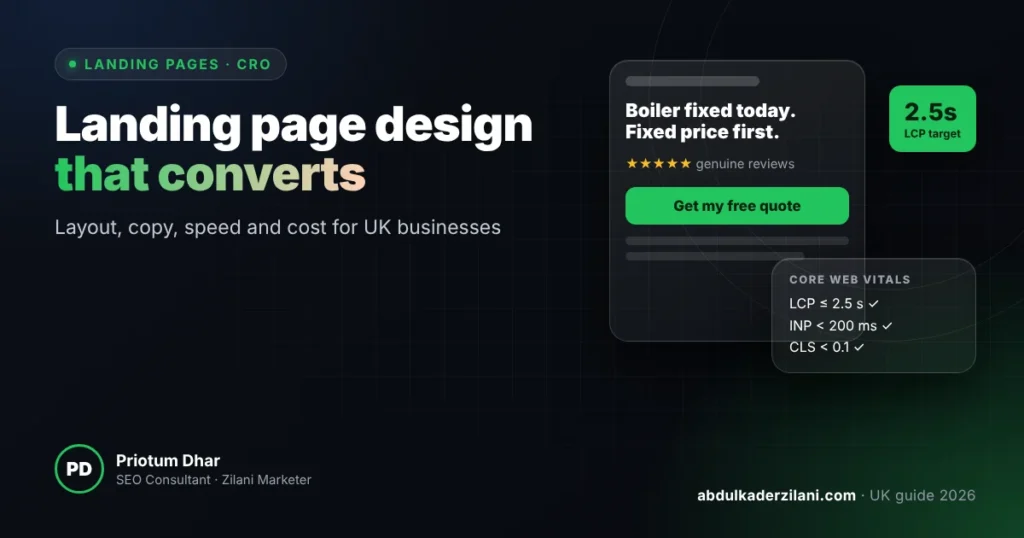
Landing page design that converts matches the search or ad that brought the visitor, says what you offer and who it is for in the first screen, shows proof, makes one clear action easy and loads fast on a phone. Google’s own guidance is to aim for Largest Contentful Paint within 2.5 seconds. For UK businesses, prices must include mandatory fees up front. Cost depends mainly on how much copy, design and tracking work is needed, not the number of pages.
Why landing page design that converts matters for paid traffic
When you pay for a click, the landing page decides whether that money turns into an enquiry. It also feeds back into the ad platforms.
Google Ads uses landing page experience as one of the three components of Quality Score, alongside expected click-through rate and ad relevance. Google describes it as how relevant and useful your landing page is to people who click your ad, and says better-rated pages are usually well organised with text that relates to the search. A “below average” status is Google telling you, in plain terms, that the page is letting the ad down.
Meta works differently, but the logic is the same: if people click and leave, you pay for clicks that never become results. Our guides to Facebook ads costs in the UK and Google Ads costs in the UK show how quickly that adds up.
Landing page design that converts: the layout, top to bottom
Every good landing page follows roughly the same order, because it follows the questions a visitor asks in their head.
| Section | Visitor’s question | What to put there |
|---|---|---|
| First screen (above the fold) | Am I in the right place? | Headline that echoes the search, one-line offer, main button, a trust signal |
| Problem and offer | Do you understand my situation? | Two or three short paragraphs, plain English |
| Proof | Can I trust you? | Genuine reviews, accreditations, photos of real work, guarantees you can honour |
| How it works | What happens next? | Three or four numbered steps |
| Price or price guide | What will it cost me? | Full price including mandatory fees, or a clear “from” price with what it includes |
| Objections and FAQs | What could go wrong? | Answers to the five questions you hear most on the phone |
| Final call to action | How do I start? | Repeat the main button and form |
The first screen does most of the work
On a phone, the first screen is roughly a headline, two lines of text and a button. That is where most visitors decide to stay or leave. Three rules help:
- Match the message. If the ad says “Emergency boiler repair in Leeds”, the headline should say the same, not “Welcome to Smith Heating”.
- One main action. Call, book or get a quote. Pick one as the main button and make the others secondary.
- Remove the exits. Most landing pages work better without the full site menu. Keep the logo, phone number and one button.
Forms: shorter is usually better, but not always
Ask only for what you need to respond well. For a plumber, that might be name, phone, postcode and a short description. For a solicitor or a high-value service, a few qualifying questions can be worth the drop in volume because they filter out poor leads. Test it rather than guessing, and track form submissions as a conversion so you can see the effect.
Copy that converts: what to say and how to say it
Design gets attention; copy gets the enquiry. Write the way you would explain your service to a customer on the phone.
- Lead with the outcome. “Boiler fixed today, fixed price before we start” beats “Professional heating solutions”.
- Be specific. Areas covered, response times you can actually meet, what is included and what is not.
- Use real proof only. Since 6 April 2025, fake reviews and undisclosed incentivised reviews are unlawful in the UK under the Digital Markets, Competition and Consumers Act 2024. Show genuine reviews and say where they come from.
- Answer objections directly. Price, timing, mess, guarantees, parking, cancellations. If customers ask it on the phone, answer it on the page.
- Make the button say what happens. “Get my free quote” or “Book a call back” works better than “Submit”.
Pricing on the page must follow UK rules
The Competition and Markets Authority’s price transparency guidance (CMA209) explains how businesses must show prices, including mandatory fees, taxes and charges, and warns against “drip pricing”, where extra charges appear as the customer moves through a transaction. If you show a price, it should be the total a customer will have to pay for that offer, not a headline figure with a booking fee added at the end.
Speed and mobile: the technical side of landing page design
A beautiful page that loads slowly on 4G is a slow page. Google’s Search Central documentation sets out three Core Web Vitals targets for a good experience.
| Metric | What it measures | Google’s “good” target |
|---|---|---|
| Largest Contentful Paint (LCP) | How fast the main content appears | Within 2.5 seconds |
| Interaction to Next Paint (INP) | How quickly the page responds to taps and clicks | Under 200 milliseconds |
| Cumulative Layout Shift (CLS) | How much the layout jumps while loading | Under 0.1 |
The usual culprits on small-business pages are oversized hero images, sliders, chat widgets, several tracking scripts loading at once and heavy page-builder themes. Compress images, drop the slider, load chat only after a few seconds and check the page in Search Console’s Core Web Vitals report once it has traffic.
Tracking and consent belong in the design brief
A landing page you cannot measure is a guess. Before launch, make sure form submissions, calls and purchases are tracked in Google Ads and Meta, and that your cookie banner is connected properly. Google’s EU user consent policy applies to visitors in the UK and requires valid consent for ad cookies and personalisation. If your Meta tracking is patchy, our guide to the Facebook Conversions API explains how server-side tracking fills the gaps.
Landing page design cost in the UK: what drives the price
We will not quote other firms’ rates, because they vary widely and say little about what you get. A more useful way to think about landing page design cost is in hours of work and what each piece involves.
| Piece of work | What it involves | What makes it bigger |
|---|---|---|
| Research and brief | Understanding the offer, audience, ads and objections | Several services or audiences |
| Copywriting | Headline, offer, proof, FAQs, button text | Technical or regulated services |
| Design | Layout for mobile and desktop, brand styling | Custom illustrations or video |
| Build | Building in WordPress, Shopify or a page builder | Custom functionality, booking or payments |
| Tracking setup | Conversions in Google Ads, Meta and analytics, consent | Multiple platforms or server-side tracking |
| Testing and changes | Reviewing results and adjusting after launch | A formal A/B testing programme |
When you get a quote, ask for it broken down this way. If one supplier is much cheaper, find out which pieces are missing. Often it is the copy and the tracking, which are the two parts that most affect results. Our own approach to pricing and scope is on our terms of engagement page.
Template, page builder or custom build?
| Option | Best for | Trade-off |
|---|---|---|
| Template on your existing site | One service, small budget, quick launch | Can inherit a slow theme and full navigation |
| Landing page builder tool | Frequent testing of several versions | Monthly subscription, pages live outside your main site |
| Custom-built page | High-value services, heavy paid traffic | Higher upfront cost, needs a developer for changes |
A pre-launch checklist for a landing page that converts
- Headline matches the main keyword or ad message
- One primary button, visible on the first screen on a phone
- Phone number tappable on mobile
- Genuine reviews or proof, with their source
- Full price including mandatory fees, or a clear price guide
- Form asks only for what you need
- LCP within 2.5 seconds on a mid-range phone
- Conversion tracking tested with a real submission
- Cookie banner and consent working
- Thank-you page or message that says what happens next
If you are running ads for a local service, our guide on how to get more customers shows how the landing page fits with Google Business Profile, reviews and search.
Frequently asked questions
What is the difference between a landing page and a homepage?
A homepage introduces your whole business to many types of visitor. A landing page is built for one offer and one audience, usually from one ad or search, with one main action.
How long should a landing page be?
Long enough to answer the questions a buyer has before taking action. A simple emergency service can be short; a high-value or considered purchase usually needs more proof and FAQs.
Do I need a separate landing page for every ad?
Not for every ad, but usually one per main service or offer. If you advertise boiler repair and boiler installation, they deserve separate pages.
Will a better landing page lower my Google Ads costs?
It can help. Landing page experience is one of the components Google uses in Quality Score, and a page that converts better lowers your cost per lead even if click prices stay the same.
What affects landing page design cost the most?
The amount of copywriting, custom design, integrations such as booking or payments, and tracking setup. Ask for quotes broken down by these pieces.
Can I show prices without VAT on my landing page?
For consumers, the CMA’s guidance says the price should include mandatory taxes and charges. Business-to-business pages often show prices excluding VAT, but say so clearly.
The bottom line
Landing page design that converts is less about clever design and more about clarity: match the search, make the offer obvious, prove it, price it honestly and make the next step easy on a phone. Get that right and every pound of ad spend works harder. If you would like help, our landing page development service covers copy, design, build and tracking, or you can book a strategy call to review your current pages first.
Sources
- Landing page experience: Definition (Google Ads Help)
- About Quality Score for search campaigns (Google Ads Help)
- Understanding Core Web Vitals and Google search results (Google Search Central)
- Price transparency guidance, CMA209 (Competition and Markets Authority, GOV.UK)
- EU user consent policy (Google)