How Much Do Facebook Ads Cost in the UK? (2026 Meta Ads Prices)
 By Abdul Kader Zilani
·
· 10 min read
Search “how much do Facebook ads cost” and you will find numbers from 26p a click to £60 a lead. Most of them measure different things, in different months, for different goals, and almost none include the extra charges on your invoice.
This guide sorts that out for UK businesses. It gives the 2026 numbers for Facebook and Instagram ads (both run through Meta) from one large, published dataset, explains which number to look at for which goal, shows why prices jump before Christmas, and works out a realistic monthly budget once the 2% UK location fee and VAT are added.
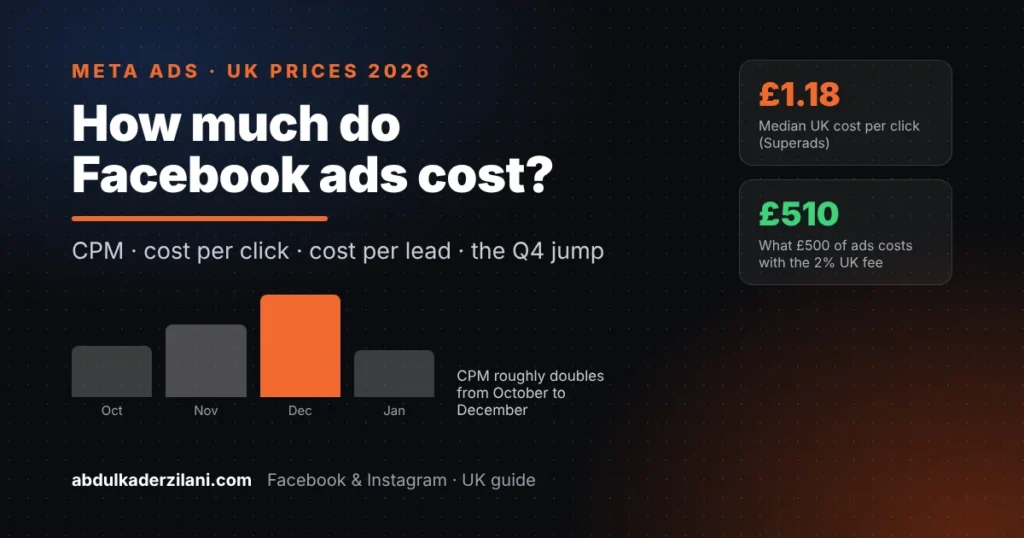
Across UK accounts over the last year, the median Facebook ad cost about £1.18 per click, £37.80 per lead and £53 per online purchase, with big swings by month: costs in December were much higher than in October. On top of that, Meta adds a 2% UK location fee, and 20% VAT if you are not VAT-registered. What you pay depends far more on your offer, creative and goal than on any average.
There is no price list
Meta ads, like Google ads, are sold by auction. You choose a budget and a goal, and Meta decides who sees your ad and what each result costs. According to Meta, the auction weighs three things: your bid, how likely your ad is to get the result you asked for, and the quality of the ad. A better ad can cost less than a worse one aimed at the same people.
That is why “how much does a Facebook ad cost?” has no single answer. The useful question is “what will a lead or a sale cost me?”, and that depends on your goal, your offer, your creative and the time of year.
What Facebook ads cost in the UK in 2026
Superads, an ad software company, publishes Facebook ads benchmarks from more than $3bn of ad spend across thousands of ad accounts. For Great Britain, averaged over roughly the last 13 months at the time of writing:
| Metric | What it means | UK median |
|---|---|---|
| Cost per click (CPC) | What each click on your ad costs | about £1.18 |
| Click-through rate (CTR) | Share of people who see the ad and click | about 1.59% |
| Cost per lead (CPL) | Cost of each form, call or message enquiry | about £37.80 |
| Cost per purchase | Cost of each online sale | about £53 |
Source: Superads UK benchmarks, checked 15 November 2026.
Behind those medians the monthly swings are large:
- Cost per click ran from about £1.02 in October 2025 to £1.49 in December 2025.
- Cost per lead ran from under £18 in summer 2026 to almost £60 in February 2026.
- Cost per purchase ran from about £36.50 in April 2026 to £85.50 in December 2025.
Those swings are the point. Any single “average cost” hides a range that moves with the season and with who else is advertising.
Judge your campaign on cost per result, not CPM or CPC. A lead campaign with expensive impressions that brings £25 leads beats a traffic campaign with cheap clicks that never enquire.
Facebook vs Instagram
Both are bought in the same Meta ads account, and you can let Meta choose placements or pick them yourself. Prices differ by placement: feed, Stories and Reels each have their own auction dynamics, and what is cheap to show is not always cheap to convert. Do not choose by CPM; let a campaign run across placements and compare cost per lead or sale in the breakdown in Ads Manager.
What should a lead cost you?
Averages by industry are everywhere online, but many are US data converted to pounds and none of them know your margins. The better question is what you can afford:
| Step | Example | Formula |
|---|---|---|
| Profit on a typical sale or job | £400 | Your figure |
| Share of leads that buy | 25% (1 in 4) | Your close rate |
| Most you can afford per lead | £100 | £400 × 25% |
| Target cost per lead, leaving profit | £50 to £70 | About half to two-thirds of the maximum |
If your affordable cost per lead is well above the UK median of about £38, Meta ads have room to work for you. If it is well below, fix the offer, the price or the close rate before spending more.
Costs also vary hugely by country. In one South Asian ecommerce account we ran, purchases cost $1.12 each across 1,056 sales in 30 days. UK auctions are far more expensive than that market, which is why it is worth being sceptical of any case study that does not say where the ads ran.
Why costs jump in Q4
Seasonality is one of the biggest cost drivers. From October to December, retailers flood the auction for Black Friday and Christmas, and everyone pays more to reach the same people. In Superads’ Great Britain data, the median cost per purchase in December 2025 was more than double the April 2026 figure, and CPM roughly doubled between October and December 2025.
What this means in practice:
- Plan Q4 budgets on a noticeably higher cost per result than the rest of the year.
- Do not judge a test run in November against January prices, or the other way round.
- If you are not a retailer, consider spending less in late November and December and more in January.
The hidden costs: the 2% location fee and VAT
The amount you see in Ads Manager is not what leaves your bank.
- The 2% UK location fee. Since 1 July 2026 Meta has added a 2% fee to ads delivered to people in the UK. It is charged on top of your spend and shown on your invoice.
- VAT. If you are VAT-registered and your VAT number is in your Meta account, Meta charges no VAT and you use the reverse charge, which nets to nil for a fully taxable business. If you are not VAT-registered, Meta adds 20% VAT you cannot reclaim.
| On a £500 monthly budget | VAT-registered (number added) | Not VAT-registered |
|---|---|---|
| Ad spend | £500 | £500 |
| 2% UK location fee | £10 | £10 |
| VAT | £0 (reverse charge) | £102 |
| Paid to Meta | £510 | £612 |
So a £15 lead is really £15.30 after the fee, and about £18.36 for a business that cannot reclaim VAT. We explain every part of this, including the April 2027 change to the reverse charge, in VAT on Facebook ads in the UK. This is general information, not tax advice.
How much to spend a month
Meta’s delivery system needs data to learn. Meta’s guidance is that an ad set needs around 50 optimisation events a week (for example 50 leads or 50 purchases) to leave the “learning phase” and settle. That turns into a simple budget check:
| Your expected cost per result | Weekly spend for 50 results in one ad set | Roughly per month |
|---|---|---|
| £5 | £250 | £1,080 |
| £15 | £750 | £3,250 |
| £38 (UK median lead) | £1,900 | £8,230 |
Most small businesses cannot fund that on every ad set, and that is fine. It is a reason to run fewer ad sets with broader audiences, rather than splitting a small budget ten ways so none of them ever learns, and to consider optimising for an event that happens more often while you build data. It is also a reason not to judge a new campaign in its first week: costs are usually highest while it is still learning.
A practical way to set a first budget: decide how many leads or sales you need to judge the test (20 to 30 is a reasonable minimum), multiply by your expected cost per result, and run for at least two to four weeks. At a £38 lead, 25 leads is about £950 of spend.
Spending £1 a day technically runs an ad, but it buys a few hundred impressions and gives Meta almost nothing to learn from.
What moves your price
- Your goal. Lead and sales campaigns pay more per impression and usually less per result.
- Your offer. A free quote, a discount and a paid consultation convert at very different rates from the same audience. The offer often moves cost per lead more than any setting.
- Your creative. Meta’s auction rewards ads people engage with. Fresh, clear creative every few weeks usually does more than any bidding change. Since Meta’s Andromeda update, the ad itself does much of the targeting; see our Andromeda guide.
- Your audience. Very small audiences cost more; retargeting warm visitors costs more per thousand views but often less per result.
- The season. See Q4 above.
- Your tracking. Without the Meta Pixel and Conversions API sending reliable data, Meta optimises on incomplete signals and you pay more per real result than the dashboard shows.
Facebook ads vs Google Ads: which costs less?
Facebook clicks are usually cheaper than Google Search clicks: the UK median Facebook click is about £1.18, while Google Keyword Planner puts top-of-page bids for many local service searches between about £1.50 and £10, and far higher for legal or emergency work. But the comparison that matters is cost per customer. Google captures people who are already searching for what you sell; Meta reaches people who were not looking yet. Urgent services usually win on Google; visual, planned or impulse purchases often win on Meta. Most growing businesses use both. See how much Google Ads cost in the UK for the other side.
How management is usually charged
Whoever runs your ads will usually charge a flat monthly fee or a percentage of ad spend, sometimes with a setup fee. Whatever you pay, you should own the ad account, see cost per lead or sale every month, and know what was tested and changed. Our own terms are on our terms of engagement page.
Frequently asked questions
How much do Facebook ads cost per month in the UK?
There is no minimum. A useful first test buys enough results to judge, usually 20 to 30 leads or sales over two to four weeks. At the UK median cost per lead of about £38 that is roughly £750 to £1,150 of spend. Add the 2% UK location fee, and 20% VAT if you are not VAT-registered.
What is the average cost per click for Facebook ads in the UK?
One large dataset of UK accounts puts the median at about £1.18 over the last year, ranging from about £1.02 in October 2025 to £1.49 in December 2025. Traffic campaigns can show cheaper clicks, but those clicks convert less often.
What is a good cost per lead on Facebook in the UK?
One that leaves a profit once your close rate is counted. Work it out as profit per sale × close rate, then aim below that. For comparison, the UK median across a large dataset was about £37.80 per lead over the last year.
Why are my Facebook ads more expensive in November and December?
Retailers crowd the auction for Black Friday and Christmas. In one large UK dataset, CPM roughly doubled between October and December 2025, and cost per purchase in December was more than double the spring low. Costs usually drop back in January.
Is £5 a day enough for Facebook ads?
It will run, but it is rarely enough to produce meaningful results for a lead or sales campaign, because Meta needs around 50 results a week per ad set to leave the learning phase. Use it for a simple test or local awareness, and judge results over several weeks.
Do I pay VAT on Facebook ads in the UK?
If you are VAT-registered and your VAT number is in your Meta account, Meta charges no VAT and you use the reverse charge. If you are not VAT-registered, Meta adds 20% VAT. Meta also adds a 2% UK location fee from July 2026.
Are Facebook ads cheaper than Google Ads?
Per click, usually yes. Per customer, it depends: Google is often better for urgent services people search for, and Meta for visual or planned purchases people discover. Compare cost per lead or sale, not cost per click.
The bottom line
Facebook ads do not have a price; they have a cost per result that you can push down. Pick the right goal, budget for learning, plan around Q4, add the 2% fee and VAT before you compare numbers, and measure what each lead or sale really costs.
If you want help making Meta ads pay back, see our Facebook ads management service, read our Meta ads playbook for UK ecommerce, or book a free 30-minute call.
Sources
- Superads: Facebook ads cost per click, United Kingdom
- Superads: Facebook ads cost per lead, United Kingdom
- Superads: Facebook ads cost per purchase, United Kingdom
- Superads: Facebook ads CPM, United Kingdom
- Superads: Facebook ads click-through rate, United Kingdom
- Meta Business Help: About the learning phase
- Google Keyword Planner, United Kingdom, checked 15 November 2026 (Google comparison)