How to Choose a Digital Marketing Agency in the UK (And When You Don’t Need One)
 By Abdul Kader Zilani
·
· 11 min read
Most small business owners do not choose a digital marketing agency badly because they are careless. They choose badly because every agency website says the same things: data-driven, results-focused, transparent. The words stop meaning anything, so the decision comes down to who was most likeable on the call.
This guide gives you a better filter. It covers what to check before you sign, who should own what, how to read a proposal, the red flags that matter, and the honest cases where you do not need an agency at all. A quick disclosure: Zilani Marketer is a consultant-led service with a small specialist team, so we sit somewhere between a freelancer and an agency. We have tried to write this so it is useful whoever you end up hiring.
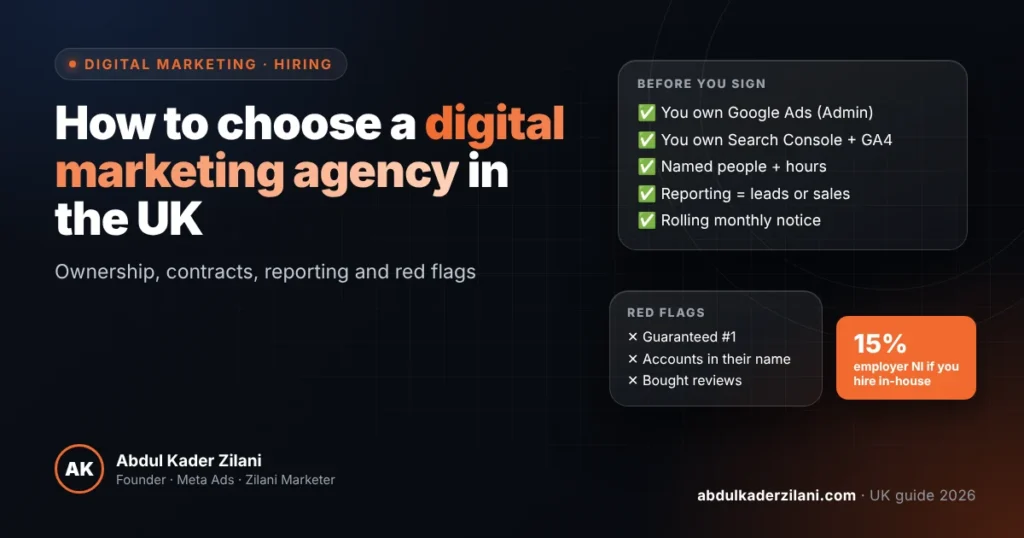
Choose an agency on four things: you own every ad account, analytics property and website login; the proposal names who does the work and how many hours it covers; reporting ties back to enquiries or sales, not just clicks; and you can leave on short notice. If an agency cannot agree to all four, keep looking. If your budget only covers a few hours a month, a specialist or a good DIY setup may beat an agency.
Start with the problem, not the agency
Before you speak to anyone, write down the one commercial problem you want fixed. “We need more marketing” is not a problem. “Our phone rings less in winter” or “our online shop gets traffic but few orders” is. The problem decides which kind of help you need, and it stops an agency selling you a bundle of services you did not ask for.
| Your main problem | What usually helps first | The specialist you need |
|---|---|---|
| Nobody finds you on Google Maps | Google Business Profile, reviews, local pages | Local SEO |
| You need enquiries this month | Search ads on high-intent terms | Google Ads |
| You sell products and need volume | Meta ads plus Shopping ads, with clean tracking | Paid social and ecommerce |
| Traffic but few sales or leads | Landing pages, offer, checkout, speed | Conversion and web |
| You cannot tell what is working | Conversion tracking across GA4, Google Ads and Meta | Tracking |
If your problem sits clearly in one row, you may only need one specialist. If it spans three or four rows, an agency or a consultant who co-ordinates several people starts to make sense. Our guide to how to get more customers walks through this diagnosis in more detail.
Agency vs freelancer vs in-house
There is no single right answer here. Each option trades cost, capacity and control differently.
| Agency | Freelancer or consultant | In-house hire | |
|---|---|---|---|
| Range of skills | Wide, if the team is real | Usually deep in one or two areas | Depends on one person |
| Who does the work | Often a junior account manager | The person you hired | Your employee |
| Cover for holidays and sickness | Usually yes | Often limited | No, unless you hire two |
| Cost structure | Monthly fee, often with a minimum term | Monthly fee or project price | Salary plus employer costs |
| Hidden costs | Setup fees, reporting fees, tool fees | Capacity limits | Employer NI, pension, tools, training, management time |
| Best for | Several channels at once | One channel done well | Steady, high-volume work |
The in-house option is often under-costed. For 2026 to 2027, employers pay Class 1 National Insurance at 15% on earnings above £5,000 a year, and the National Living Wage for workers aged 21 and over is £12.71 an hour from April 2026 (GOV.UK). As a worked example, on a £30,000 salary (an example figure, not a market rate) employer NI alone adds £3,750 a year before pension contributions, software, training and the time you spend managing that person. Eligible businesses can claim the £10,500 Employment Allowance to reduce their NI bill, so check with your accountant.
The ownership checklist (do this before anything else)
The single biggest risk with any marketing provider is losing access to your own data when you part ways. If an agency builds your Google Ads account inside its own setup, or sets itself as the only owner of your Search Console property, you can end up starting from zero when you leave.
Insist on these points in writing:
- Google Ads: the account is created in your business name with your payment method, and you hold Admin access. In Google Ads, Admin users “can give account access, change access levels”, which is what you need to stay in control (Google Ads Help).
- Search Console: you are a verified owner. Google says only owners can add or remove users, and an SEO doing an audit only needs read access at first (Search Console Help, Google Search Central).
- Google Analytics 4: the account and property sit under your business, with the agency added as a user (Analytics Help).
- Meta: your Business Portfolio owns the ad account, Page, pixel and datasets, and the agency is added as a partner. Ad spend is charged to your card.
- Website, domain and hosting: registered to you, with your own admin login.
- Creative and copy: the contract says you own the ads, images and pages you paid for.
We separate fees from ad spend on every account. You pay Google and Meta directly, on your own card, and we never mark up spend. You can see how that works on our terms of engagement page. Whoever you hire, ask them to put the same in writing.
How to read a proposal
A good proposal answers five questions. If any answer is missing or vague, ask before you sign.
- Who will do the work? Names and roles, not “our team”. Ask whether any of it is outsourced.
- How many hours a month does the fee cover? Divide the monthly fee by the hours to see what you are really paying per hour, and compare like with like.
- What is delivered each month? For example: new ad tests, search term reviews, landing page changes, a number of articles, a report and a call.
- What is the notice period? Rolling monthly with 30 days’ notice is common for ongoing work. Be careful with 12-month terms on a service you have not tested.
- What costs sit outside the fee? Setup, tools, stock images, video production, extra reporting. Ad spend should always be separate.
Two platform costs surprise UK advertisers and are not the agency’s fault. Google adds a 2% surcharge to ads served in the UK, and Meta adds a 2% UK location fee from 1 July 2026. VAT-registered businesses account for VAT on Google and Meta ads under the reverse charge; businesses that are not registered pay 20% VAT on top. Our guides to VAT on Facebook ads and Google Ads costs in the UK explain both. A good agency will build these into your budget plan rather than let them appear as a surprise.
What good reporting looks like
Reporting should answer “what did we get for the money?” in under a minute. Clicks, impressions and reach are useful for the person running the account, but they are not results.
| Weak report | Useful report |
|---|---|
| Impressions, reach, clicks | Enquiries, calls, bookings or sales |
| Platform ROAS only | Cost per lead or sale, checked against your own records |
| No context | What changed this month and why |
| Same template every month | Clear next tests and decisions |
| PDF you cannot question | Live access to the accounts behind the numbers |
This only works if tracking is right. If Meta or Google cannot see your purchases or form submissions, every number in the report is a guess. Ask any agency how it will check tracking in the first week. Our posts on the Facebook Conversions API and why the Meta pixel misses purchases cover the common faults. For ecommerce, ask whether they work to a break-even ROAS based on your margins rather than a platform target.
Red flags that should end the conversation
- Guaranteed rankings or results. Google is blunt about this: “No one can guarantee a #1 ranking on Google” (Google Search Central). The same logic applies to guaranteed ROAS or a fixed number of leads.
- They will not explain what they do. Google also warns against providers who are secretive or will not explain their plans.
- Accounts in their name only. See the ownership checklist above.
- Fake or bought reviews. Since 6 April 2025, fake reviews and undisclosed incentivised reviews are unlawful in the UK under the Digital Markets, Competition and Consumers Act 2024. An agency that offers to “boost your reviews” this way is putting your business at legal risk.
- Influencer or social posts without clear ad labels. The ASA and CMA prefer labels that clearly say the content is an ad, such as “Ad” (ASA).
- A badge as the main selling point. Google Partner status is real, but it is based on things like an optimisation score of at least 70%, $10,000 of managed spend over 90 days and staff certifications (Google Ads Help). It tells you an agency meets a minimum standard, not that it suits your business.
- No data processing terms. If the agency handles customer lists, CRM data or form leads, it is likely acting as a processor. The ICO sets out what a controller-processor contract must include, such as acting only on your documented instructions and deleting or returning data at the end (ICO).
Questions to ask on the first call
Use these and write the answers down. Comparing three agencies on the same questions is far more useful than comparing three sales pitches.
- Can you show me work for a business with a similar problem, and can I speak to that client?
- Who exactly will manage my account, and how many other accounts do they manage?
- What will you do in the first 30, 60 and 90 days?
- How will you check that tracking is correct before we spend?
- What results would make you recommend we stop or change direction?
- What happens to my accounts, data and creative if we part ways?
- How often will we talk, and will you share every change you make?
When you do not need an agency
You may be better off without one if:
- You are a single-location local business with a small budget. Google says a small local business “can probably do much of the work yourself”, starting with its SEO Starter Guide (Google Search Central). Start with our guide to getting your business on Google.
- Your ad budget is very small. If most of your monthly spend would go on fees rather than ads, a one-off setup and audit, then managing it yourself, is often better value.
- The real problem is the offer or the website. No agency can fix a weak offer with ads. Sort the offer, prices and landing page first.
- You only need one channel. A specialist in that channel may give you more senior attention for the same money.
A simple decision checklist
- I can describe my main marketing problem in one sentence.
- I know which channel or channels it needs.
- I have a monthly figure for fees and a separate figure for ad spend.
- I own, or will own, every account the provider uses.
- The proposal names people, hours, deliverables and notice period.
- Reporting will show enquiries or sales, checked against my own records.
- I have spoken to at least one past client of each shortlisted provider.
- I know what I would do if it does not work after 90 days.
Frequently asked questions
How much does a digital marketing agency cost in the UK?
It depends on scope, hours and channels, so ignore headline prices and ask how many hours the fee covers and who does the work. Keep ad spend separate from fees, and add the 2% Google and Meta UK fees and any VAT to your budget.
Should I choose an agency or a freelancer?
Choose an agency if you need several channels managed together and want holiday cover. Choose a freelancer or consultant if you need one channel done well and want direct access to the person doing the work.
What contract length is reasonable?
For ongoing work, a rolling monthly arrangement with around 30 days’ notice is common and gives you a way out if results do not come. Be wary of long fixed terms for a service you have not tested.
Who should own my Google Ads and Meta ad accounts?
You should. Create the accounts in your business name, pay the platforms with your own card, and give the agency user or partner access. Keep Admin access in Google Ads and owner access in Search Console.
Is a Google Partner badge a guarantee of quality?
No. It shows an agency meets Google’s minimums for optimisation score, managed spend and certifications. It does not tell you whether they understand your market or will put a senior person on your account.
How long before I should judge results?
Paid search can show early signals within weeks once tracking works. SEO takes longer; Google says some changes take effect in hours and others take several months. Agree what a good 90 days looks like before you start.
The bottom line
Choose the provider who gives you ownership, clear people and hours, honest reporting and a short notice period, not the one with the best pitch deck. If you only need one channel, hire a specialist in it, such as Google Ads management or Meta ads management. If you would like a second opinion on a proposal you have received, or want to see whether we are the right fit, book a strategy call.
Sources
- Do you need an SEO? – Google Search Central
- SEO Starter Guide – Google Search Central
- About access levels in your Google Ads account – Google Ads Help
- How to become a Google Partner or Premier Partner – Google Ads Help
- Managing owners, users and permissions – Search Console Help
- Set up Analytics for a website and/or app – Analytics Help
- Rates and thresholds for employers 2026 to 2027 – GOV.UK
- What needs to be included in the contract? – ICO
- Recognising ads: social media and influencer marketing – ASA
- Digital Markets, Competition and Consumers Act 2024 – legislation.gov.uk