How to Get More Customers: 15 Marketing Ideas for UK Small Businesses
 By Abdul Kader Zilani
·
· Updated 23 Nov 2026 · 14 min read
Most small businesses do not need more traffic. They need more of the right people to find them, trust them and get in touch. That is a different problem, and it usually starts with things that cost very little.
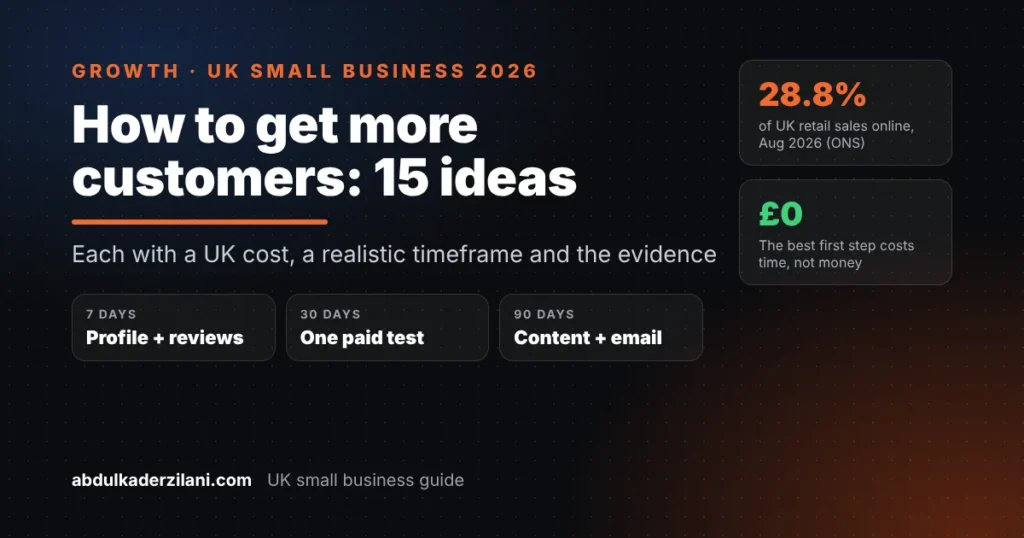
Below are 15 practical ways for UK small businesses to get more customers, grouped by what they do. Each one has a typical UK cost, a realistic timeframe and the evidence behind it, including where the evidence is weak. At the end there is a 7, 30 and 90-day plan for three budgets.
- Start with trust, not ads. A complete Google Business Profile and a steady flow of genuine reviews make every other channel work better.
- Pick three ideas, not fifteen: one fast, one paid and one slow-burn.
- Test one paid channel properly: about £500 for at least a month, one offer, one landing page and tracking.
- Measure cost per customer, not clicks, likes or followers.
- Stay legal: fake and incentivised reviews have been banned in the UK since 6 April 2025.
How to use this list
There are 5.64 million small businesses in the UK, 99.2% of all private-sector businesses (DBT, 2025), and 28.8% of UK retail sales were made online in August 2026 (ONS). Customers are online; the question is which channel suits you.
Choose one fast idea (for example your Google Business Profile or reviews), one paid idea (Google Ads or Meta Ads) and one slow-burn idea (content, email or SEO). Give them 90 days before you judge them.
Where to start: pick your situation
You don’t need all 15 ideas. Pick the row that matches your business and start with those three. The numbers refer to the ideas below.
| Your situation | Start with | Why |
|---|---|---|
| Brand-new business, no reviews yet | 1 Google Business Profile, 4 Reviews, 15 Referrals | Cheapest way to get found and trusted before you pay for traffic |
| Local service (trades, clinics, salons) | 1 Google Business Profile, 2 Service and town pages, 6 Google Ads | People search “near me” when they are ready to book. See local SEO and Google Ads management |
| Online shop selling UK-wide | 5 Website fixes, 7 Meta Ads, 8 Email | Most buyers find products while scrolling, and email brings them back. See Meta Ads management |
| B2B or trade accounts | 10 Helpful content, 8 Email, 15 Partnerships | Buyers research for weeks, so answer their questions and stay in touch |
| You need enquiries this week | 6 Google Ads, 7 Meta Ads, 9 WhatsApp | Paid search and social are the only channels that work within days |
What a click costs on Google in the UK
Paid search is the fastest route, so it helps to know the going rate before you set a budget. These are Google’s own top-of-page bid ranges for UK searches:
| Search term | UK searches a month | Top-of-page bid range |
|---|---|---|
| dentist near me | 246,000 | £1.46 – £5.76 |
| plumber near me | 90,500 | £1.51 – £9.73 |
| accountant near me | 12,100 | £3.91 – £13.94 |
| emergency plumber | 9,900 | £5.39 – £28.07 |
Source: Google Keyword Planner, United Kingdom, last 12 months, checked 15 November 2026. A click is not a customer. If 1 in 10 clicks becomes an enquiry, a £4 click means about £40 per enquiry. Our Google Ads cost guide explains how to work out your own numbers.
Get found locally
1. Complete your Google Business Profile
Claim and verify your free profile, then fill in everything: the right categories, services, hours, photos, booking link and questions and answers. Add new photos and a short post every week.
- Typical cost: £0 if you do it yourself; around £195 to £599 for a professional set-up in UK local SEO guides.
- Realistic timeframe: Days to appear correctly; 2 to 8 weeks for noticeable movement in Google Maps.
- Why it works: Google-linked research compiled by BrightLocal says customers are 2.7 times more likely to consider a business reputable when its profile is complete. Our step-by-step guide to getting your business on Google covers this in detail.
2. Build service and town pages that rank
Create one page for each main service and each area you genuinely serve, with real prices, photos and local examples, rather than one generic Services page.
- Typical cost: £0 to £150 a month in tools if you do it yourself; £300 to £1,500 a month for local SEO from a freelancer or small agency.
- Realistic timeframe: First movement in 3 to 6 months; steady enquiries in 6 to 12 months.
- Why it works: Whitespark’s 2026 survey of 47 local search experts rated Google Business Profile signals and relevant pages among the strongest factors for local rankings.
3. Claim the directories that actually rank
Claim free listings with the same name, address and phone number everywhere: Bing Places, Apple Business Connect, Facebook and the two or three directories that appear on page one for your trade and town (often Yell, Checkatrade or TrustATrader for trades).
- Typical cost: Free basic listings; paid directory plans from around £30 a month. Pay only if the directory itself sends enquiries.
- Realistic timeframe: Listings live in days; search benefit over 4 to 12 weeks.
- Why it works: In a small October 2026 check of 10 UK trade searches, Yell, Checkatrade and TrustATrader appeared on page one in most, while generic free directories appeared in none. Five good listings beat 150 random ones.
Earn trust before you buy traffic
4. Build a review routine, and stay legal
Ask every customer at the moment they are happiest, with a one-tap link, and reply to every review within 24 to 48 hours. Never buy, fake or filter reviews, and never offer a reward for one.
- Typical cost: £0 if you ask manually; £20 to £80 a month for review-request software.
- Realistic timeframe: First new reviews within days; a credible profile of 20 or more recent reviews in 1 to 3 months.
- Why it works: In BrightLocal’s 2026 survey (1,002 US adults, so treat as indicative for the UK), 97% read reviews, 68% only use businesses rated 4 stars or more, and 74% only care about reviews from the last three months. In the UK, fake and concealed incentivised reviews have been banned since 6 April 2025 under the DMCCA 2024, and the CMA can fine up to 10% of global turnover.
5. Fix your website so visitors become enquiries
Make the offer clear above the fold, use one call to action per page, put trust signals near the button, cut forms to three fields and add click-to-call or online booking.
- Typical cost: £0 to £200 for do-it-yourself fixes; £500 to £2,500 for a conversion audit or landing page rebuild.
- Realistic timeframe: Speed and form fixes can lift enquiries in 1 to 4 weeks.
- Why it works: Benchmarks put average ecommerce conversion at around 2.5% and median landing page conversion at 6.6% (Contentsquare; Unbounce). These are cross-industry averages, but they show the upside of fixing the site before buying more traffic. See our landing page design service.
Buy customers who are already looking
6. Google Ads for high-intent searches
Run Search campaigns on service and location keywords, such as “emergency plumber Leeds”, with a dedicated landing page, call tracking and negative keywords. Start narrow.
- Typical cost: It depends on the search: in Google Keyword Planner, UK top-of-page bids for “dentist near me” run about £1.50 to £5.80 and “plumber near me” about £1.50 to £9.70, while “personal injury solicitor” reaches about £51 (November 2026). Budget for at least 150 to 300 clicks a month to judge a campaign. Google adds a 2% UK Digital Services Tax fee, plus 20% VAT if you are not VAT-registered (see how much Google Ads cost in the UK).
- Realistic timeframe: Traffic the same day; meaningful learning in 2 to 4 weeks.
- Why it works: Search was 44% of UK digital ad spend in 2025, £17.9bn, according to IAB UK. See our PPC management service and Google Ads case study.
7. Meta Ads on Facebook and Instagram
Use short video and image ads to reach people who do not yet know you, then retarget website visitors, video viewers and past customers.
- Typical cost: Across UK accounts, the median cost per click is about £1.18 and cost per lead about £37.80, with big seasonal swings (Superads, last 12 months). See how much Facebook ads cost in the UK. Since July 2026 Meta adds a 2% UK location fee, plus VAT if you are not VAT-registered.
- Realistic timeframe: 1 to 2 weeks to test creative; 4 to 6 weeks to judge cost per lead properly.
- Why it works: Social took 28% of the UK’s £40.5bn digital ad market in 2025 (IAB UK). For ecommerce, read our 2026 Meta ads playbook; for costs, see VAT on Facebook ads.
Build an audience you own
8. Email marketing with three simple automations
Grow a permission-based list with a useful freebie, then set up a welcome email, an abandoned basket or enquiry reminder, and a post-purchase follow-up. Never buy a list.
- Typical cost: Free to about £20 a month to start; £20 to £100 a month for a small list.
- Realistic timeframe: Days to set up; first sales from automations in 2 to 6 weeks.
- Why it works: UK marketers consistently rank email among their highest-returning channels in the DMA’s email research. Those returns are self-reported rather than measured, but email is also one of the cheapest channels to run, because you are marketing to people who already know you.
9. WhatsApp Business and SMS
Use the free WhatsApp Business app with quick replies and a click-to-chat button on your website and Google profile. Use SMS for appointment reminders. Only message people who have opted in; UK GDPR and PECR apply.
- Typical cost: WhatsApp Business app free; marketing messages through the API cost a few pence each.
- Realistic timeframe: Set up in a day; faster replies and fewer no-shows within 1 to 2 weeks.
- Why it works: Open rates for WhatsApp and SMS are reported far above email in vendor comparisons. The figures are not audited, but speed of reply is one of the simplest ways to win more enquiries.
10. Helpful content that answers buyer questions
Write useful pages answering the questions buyers ask, such as “how much does X cost in [town]?”, and link them to your service pages. Make them clear and factual so they can also appear in Google AI Overviews and ChatGPT.
- Typical cost: Your time if you write it yourself; £300 to £900 a month from a freelancer as part of SEO.
- Realistic timeframe: Google says SEO improvements usually take four months to a year to show benefit; most UK guides say 3 to 6 months for first results.
- Why it works: BrightLocal’s 2026 survey found 45% of consumers had used AI tools for local recommendations, up from 6% a year earlier (US sample). Clear, citable content now feeds search and AI answers.
Meet customers where they scroll and watch
11. Organic social that teaches and proves
Post 3 to 5 times a week on one or two channels your customers use, mixing before-and-after, customer stories, answers to questions and behind the scenes. Reply to every comment.
- Typical cost: £0 plus your time; £200 to £2,000 a month if outsourced.
- Realistic timeframe: 2 to 3 months to build a rhythm; 6 months or more to become a reliable enquiry source.
- Why it works: The UK has 38.8 million Facebook users and 35.5 million on Instagram (DataReportal Digital 2026). Organic reach alone rarely drives fast sales, so pair it with one paid channel.
12. TikTok and TikTok Shop
Post short, native videos such as demos, how-it-works clips and customer reactions. If you sell products, consider TikTok Shop and creator partnerships.
- Typical cost: £0 with a phone; £300 to £1,500 a month for regular short-form help; Shop commission varies by category.
- Realistic timeframe: Views can come in hours, but consistent sales usually take 4 to 12 weeks of posting.
- Why it works: TikTok had about 26.8 million UK users aged 18 and over in 2026, and more than 300,000 UK small businesses were selling on TikTok Shop by July 2026 (Retail Gazette, reporting TikTok’s figures).
13. YouTube and short video
Make short how-to and explainer videos that answer buyer questions, embed them on your service pages and post them as Shorts.
- Typical cost: £0 to £200 to start with a phone; £500 to £2,000 for a basic professional shoot.
- Realistic timeframe: 3 to 6 months to build a searchable library.
- Why it works: UK adults watch YouTube for about 51 minutes a day, making it the UK’s second most-watched media service after the BBC (Ofcom Media Nations 2025).
Sell where buyers already shop
14. Marketplaces: Amazon, eBay, Etsy and OnBuy
List your best sellers where buyers already search, with marketplace-friendly titles, photos and prices that allow for fees. Keep your own website as home base.
- Typical cost: Amazon Professional is £25 a month plus referral fees of mostly 8% to 15%; Etsy charges listing, transaction and payment fees. Fees change often, so check before you price.
- Realistic timeframe: Listings live in days; first sales in 1 to 4 weeks if well priced.
- Why it works: 80% of UK adults, about 45.9 million people, bought online in 2025 (UK Finance Payment Markets Report 2026).
Turn one customer into the next
15. Referrals, loyalty and local partnerships
Ask happy customers to recommend you with a simple, trackable offer (for example £10 off for both), reward the second purchase with a loyalty scheme, and team up with non-competing local businesses for joint offers.
- Typical cost: £0 to £50 a month for referral software, plus rewards only when they convert; loyalty apps from about £20 a month.
- Realistic timeframe: First referrals in 2 to 4 weeks once the ask is built into your follow-up.
- Why it works: Nielsen research has repeatedly found around 9 in 10 people trust recommendations from people they know above all forms of advertising, and 88% of UK adults belong to at least one loyalty scheme (KPMG). There is no reliable UK benchmark for partnership returns, so start small and track it.
28 practical checks to get your business found on Google, Google Maps and in AI answers. Get the free checklist →
What to do in the next 7, 30 and 90 days
| Budget | Next 7 days | Next 30 days | Next 90 days |
|---|---|---|---|
| £0 a month | Complete your Google Business Profile; ask your last 10 customers for a review | Fix your website’s call to action, phone number and forms; claim 5 key listings | Publish 4 helpful pages answering buyer questions; start an email list |
| £500 a month | Everything in the £0 plan | Run one paid test: Google Ads for urgent local searches, or Meta Ads for products, with tracking | Keep the channel with the lowest cost per customer; add email automations |
| £1,500 a month | Everything in the £0 plan | Google Ads plus Meta retargeting, with a dedicated landing page | Add content and local SEO; test video; review cost per customer monthly |
How to know if it is working
- Cost per enquiry: what you spent divided by the number of calls, forms and messages.
- Cost per customer: what you spent divided by the number of enquiries that actually bought.
- Where they came from: ask every new customer “how did you hear about us?” and log it.
- Quarterly review: move budget towards the channel with the lowest cost per customer, not the one you enjoy most.
As a rule of thumb, established businesses often spend around 5% to 10% of revenue on marketing and growing businesses 10% to 20%. For a business turning over £120,000, that is roughly £500 to £1,000 a month to maintain, or £1,000 to £2,000 a month to grow.
Frequently asked questions
How can I get more customers for my small business for free?
Start with a complete Google Business Profile, ask every happy customer for a review, claim a handful of free listings such as Bing Places and Apple Business Connect, and make sure your website has a clear phone number and call to action. These cost time rather than money and make every other channel work better.
Should a UK small business start with Google Ads or Meta Ads?
Use Google Ads when people already search for what you offer, such as urgent local services. Use Meta Ads to create demand for products or services people do not search for yet, and to retarget visitors. Test one properly, with about £500 for at least a month, before adding the other.
How much should a UK small business spend on marketing?
A common rule of thumb is 5% to 10% of revenue to maintain your position and 10% to 20% to grow. Many single-location small businesses spend £500 to £2,000 a month. Review it quarterly against cost per customer.
How long does it take to get more customers from SEO?
Google says SEO improvements usually take between four months and a year to show benefit. Local improvements such as your Google Business Profile and reviews can show results within weeks.
Are fake or incentivised reviews illegal in the UK?
Yes. Since 6 April 2025, fake reviews and reviews that hide an incentive are banned practices under the Digital Markets, Competition and Consumers Act 2024, and the CMA can fine businesses up to 10% of global turnover.
What are the best marketing ideas for a small business with no time?
Choose two: a complete Google Business Profile with a weekly photo and post, and a simple review request sent after every job. Together they take about 15 minutes a week.
How do I get customers for a new business?
Start with what costs nothing but time: a complete Google Business Profile, a routine for asking every customer for a review, and referrals from people who already know you. Add paid ads once you know which service sells best and what a customer is worth.
How can I get more customers online in the UK?
Be findable on Google (Business Profile plus service and town pages), make your website turn visitors into enquiries, then use Google Ads for people already searching and Meta Ads for people who don’t know you yet.
What is the cheapest way to find new customers?
Referrals and reviews from existing customers, because they cost almost nothing and convert well. A Google Business Profile is free and shows you to local people searching right now.
Want help choosing the right three?
We help UK small businesses pick the channels that will pay back first and measure them on customers, not clicks. See our services, read our growth results, or book a free 30-minute call.
Sources
- DBT: Business population estimates 2025
- ONS: Retail sales, Great Britain, August 2026
- BrightLocal: Local Consumer Review Survey 2026
- IAB UK: Digital adspend
- Superads: Facebook ads cost per lead, United Kingdom
- Retail Gazette: TikTok Shop UK sellers (July 2026)
- DMA: email research
- Google Keyword Planner, United Kingdom, checked 15 November 2026
- Whitespark Local Search Ranking Factors 2026; DataReportal Digital 2026 UK; Ofcom Media Nations 2025; Contentsquare and Unbounce benchmarks; Nielsen Trust in Advertising; KPMG loyalty research; Simply Business 2026 SME Insights.